Polycarbonate polyol compositions and methods

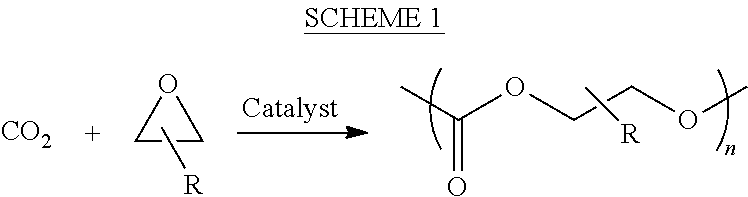
a polyol and composition technology, applied in the field of polycarbonate polyol compositions and methods, can solve the problems of inconvenient polymer production, inconvenient polymer production, and inability to meet the requirements of many polyol applications, and achieve the effect of efficient production of polycarbona

a polyol and composition technology, applied in the field of polycarbonate polyol compositions and methods, can solve the problems of inconvenient polymer production, inconvenient polymer production, and inability to meet the requirements of many polyol applications, and achieve the effect of efficient production of polycarbona

US20110230580A1Active Publication Date: 2011-09-22SAUDI ARAMCO TECH CO

Image

Smart Image Click on the blue labels to locate them in the text.
Viewing Examples
Smart Image
  • Polycarbonate polyol compositions and methods
  • Polycarbonate polyol compositions and methods
  • Polycarbonate polyol compositions and methods

Examples

Experimental program
Comparison scheme
Effect test

example 1

[0364]This example demonstrates the use of the polymerization system of the present invention with a chain transfer agent Y-A-(Y), and a catalyst Lp-M-(LI)m utilizing a co-catalyst PPN+ Cl—, where[0365]n is 1,[0366]each —Y is —OH,[0367]-A- is

[0368]-Lp is a salcy ligand

[0369]-M- is Co(III),[0370]-LI is a chain transfer agent -Q′-A′(Z)n, where Q′ is COO−, -A- is —CH2—, and Z′ is —OH, and[0371]n is 1.

[0372]24 mg of catalyst E1 (0.04 mmol), 0.45 g (3.1 mmol) 1,4-cyclohexanedimethanol and 20 mg (0.04 mmol) PPN+Cl− were held under vacuum in a Fisher-Potter bottle. The bottle was filled with nitrogen and 20 ml propylene oxide was added. The bottle was pressurized with 100 psi CO2. After 41 h at 30° C. the bottle was opened and the polymer was isolated by pouring into methanol. GPC analysis showed formation of a polymer of Mn=4460, Mw=4610, PDI=1.035. The polymer has a carbonate content of >97%.

[0373]The polycarbonate polyol composition thus obtained consists predominantly of three types of...

example 2

[0374]This example demonstrates the use of the polymerization system of the present invention with a chain transfer agent Y-A-(Y)n and a catalyst Lp-M-(LI)m utilizing a co-catalyst PPN+ Cl—, where[0375]n is 3,[0376]each —Y is —OH,

[0377]-Lp is a salcy ligand

[0378]-M- is Co(III), and[0379]-LI is trifluoroacetate.

[0380]51 mg of catalyst E2 (0.07 mmol), 0.5 g (1.4 mmol) of propoxylated pentaerythritol and 41 mg (0.08 mmol) PPN+Cl−were held under vacuum in a Fisher-Potter bottle. The bottle was filled with nitrogen and 20 ml propylene oxide was added. The bottle was pressurized with 100 psi CO2. After 22 h at 30° C. the bottle was opened and the polymer was isolated by pouring into methanol. GPC analysis showed formation of a polymer formation of a polymer of Mn=13660, Mw=15420, PDI=1.129. The polymer has a carbonate content of >97%.

[0381]The polycarbonate polyol composition thus obtained consists predominantly of three types of polymer chains: chains P1a arising from initiation by the p...

example 3

[0382]Example 3 was conducted using conditions similar to Example 2, except Poly(caprolactone) diol having an Mn of 530 g / mol was used as the chain transfer agent.

the structure of the environmentally friendly knitted fabric provided by the present invention; figure 2 Flow chart of the yarn wrapping machine for environmentally friendly knitted fabrics and storage devices; image 3 Is the parameter map of the yarn covering machine
Login to View More

PUM

PropertyMeasurementUnit
PDIaaaaaaaaaa
PDIaaaaaaaaaa
molecular weight distributionaaaaaaaaaa
Login to View More

Abstract

In one aspect, the present disclosure encompasses polymerization systems for the copolymerization of CO2 and epoxides comprising 1) a catalyst including a metal coordination compound having a permanent ligand set and at least one ligand that is a polymerization initiator, and 2) a chain transfer agent having two or more sites that can initiate polymerization. In a second aspect, the present disclosure encompasses methods for the synthesis of polycarbonate polyols using the inventive polymerization systems. In a third aspect, the present disclosure encompasses polycarbonate polyol compositions characterized in that the polymer chains have a high percentage of —OH end groups and a high percentage of carbonate linkages. The compositions are further characterized in that they contain polymer chains having an embedded polyfunctional moiety linked to a plurality of individual polycarbonate chains.

Description

PRIORITY CLAIM[0001]This application claims priority to U.S. Provisional Patent Application Ser. No. 61 / 095,178, filed Sep. 8, 2008, the entire contents of which are incorporated herein by reference.BACKGROUND [0002]Aliphatic polycarbonates (APCs) have utility as polyol building blocks for the construction of co-polymers such as flexible urethane foams, urethane coatings, rigid urethane foams, urethane / urea elastomers and plastics, adhesives, polymeric coatings and surfactants among others. Examples of such APCs include polypropylene carbonate) (PPC); poly(ethylene carbonate) (PEC); poly(butylene carbonate) (PBC); and poly(cyclohexene carbonate) (PCHC) as well as copolymers of two or more of these.[0003]To have utility in these applications, it is preferable that all polycarbonate polymer chain ends terminate with hydroxyl groups. Such hydroxyl groups serve as reactive moieties for cross-linking reactions or act as sites on which other blocks of a co-polymer can be constructed. It i...

Claims

the structure of the environmentally friendly knitted fabric provided by the present invention; figure 2 Flow chart of the yarn wrapping machine for environmentally friendly knitted fabrics and storage devices; image 3 Is the parameter map of the yarn covering machine
Login to View More

Application Information

Patent Timeline
22 Sep 2011
Publication
US20110230580A1
IPC
C07C69/96; C07D493/04; C08G65/26; C08G18/00; C09D175/04; B01J31/02
CPC
C08G64/0208; C08G18/44; C08G64/34; C08G64/0216
Inventors
ALLEN, SCOTT D.; COATES, GEOFFREY W.