Method and apparatus for adjusting channel delay parameter of multi-channel signal
- Summary
- Abstract
- Description
- Claims
- Application Information
AI Technical Summary
Benefits of technology
Problems solved by technology
Method used
Image



Examples
embodiment 1
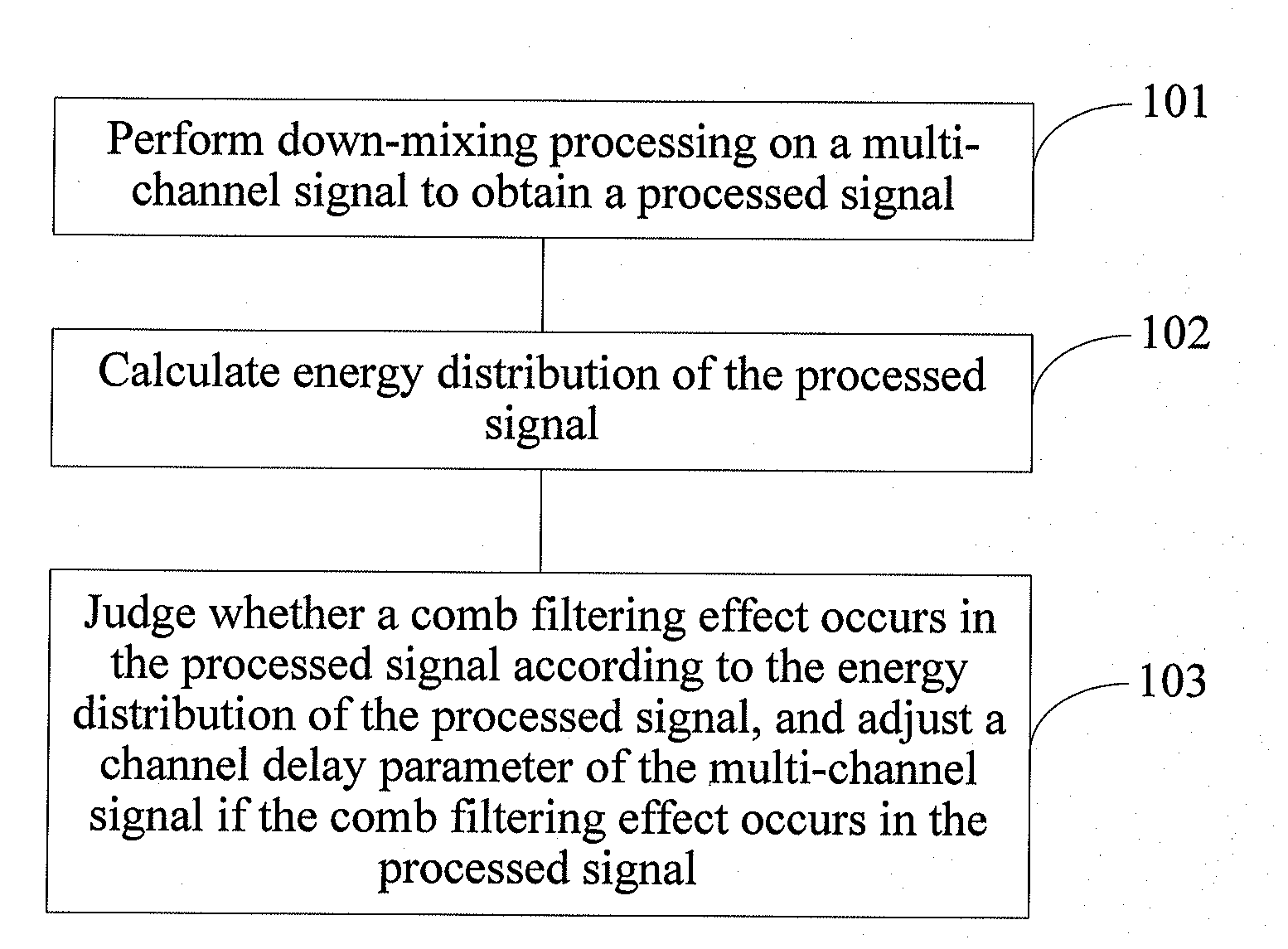
[0034]A processing flow of a method for adjusting a channel delay parameter of a multi-channel signal according to the embodiment is shown in FIG. 2, and includes the following steps.
[0035]In this embodiment, input signals are a stereo left channel time domain signal Lk{l1, l2, . . . lN} and a stereo right channel time domain signal Rk{r1, r2, . . . rN}, where k denotes a kth frame, and N denotes that a frame of signals has N sampling points.
[0036]Step 201: Calculate a channel delay parameter channel_delay between a left channel and a right channel that are corresponding to a current frame, according to a correlation between a stereo left channel signal and a stereo right channel signal.
[0037]Step 202: Perform down-mixing on a current frame signal of the left channel signal L and the right channel signal R according to the channel delay parameter channel_delay, to obtain a processed signal (an M signal and an S signal), thereby calculating a first S / M ratio ratio—1, a second S / M rat...
embodiment 2
[0090]The difference between this embodiment and Embodiment 1 lies in that, the input signal adopted when the down-mixed M signal and the down-mixed S signal are calculated is a signal obtained after the original left channel signal and the original right channel signal are simply extracted.
[0091]In this embodiment, simple extraction processing is performed on the originally input stereo left channel time domain signal Lk{l1, l2, . . . lN} and the originally input stereo right channel time domain signal Rk{r1,r2, . . rN}, that is, down-sampling processing is performed, to obtain down-sampled signals L′k, {l′1,l′2, . . . l′M} and R′k, {r′1,r′2, . . . r′M}, where M is the number of sampling points of a frame of signals after the extraction, and k denotes a kth frame. The down-sampling processing method is as follows:
[0092]l′j=lN / M×j
[0093]r′j=rN / M×j
[0094]Then, the down-sampled signals L′k{l′1,l′2, . . . l′M} and R′k{r′1,r′2,. . . r′M} are utilized to judge whether the comb filtering ...
embodiment 3
[0096]In this embodiment, if it is detected that a channel delay parameter needs to be adjusted, that is, delay_change_flag=1 is detected in the frame, a tailing range is set, and channel delay parameters are adjusted for all frames in the tailing range after the frame, no matter whether these frames really satisfy a condition under which the comb filtering effect occurs, that is, delay adjusting indication flags of these frames are forced to be 1. Then, the channel delay parameters of these frames are adjusted by using the four indirect adjusting methods or the direct adjusting method according to Embodiment 1.
[0097]The frames of the tailing range may be set according to a practical case, for example, it is set that channel delay parameters of 100 frames after the frame are adjusted.
[0098]After the comb filtering effect occurs in the current frame, the possibility that the comb filtering effect continues to occur in a subsequent frame is also great. This embodiment is equivalent to...
PUM
 Login to View More
 Abstract
Description
Claims
Application Information
 Login to View More
 - R&D
- Intellectual Property
- Life Sciences
- Materials
- Tech Scout
- Unparalleled Data Quality
- Higher Quality Content
- 60% Fewer Hallucinations
Browse by: Latest US Patents, China's latest patents, Technical Efficacy Thesaurus, Application Domain, Technology Topic, Popular Technical Reports.
© 2025 PatSnap. All rights reserved.Legal|Privacy policy|Modern Slavery Act Transparency Statement|Sitemap|About US| Contact US: help@patsnap.com