Unlock instant, AI-driven research and patent intelligence for your innovation.

Concurrent add-heavy set data gathering

Inactive Publication Date: 2012-05-17
IBM CORP
View PDF2 Cites 1 Cited by
  • Summary
  • Abstract
  • Description
  • Claims
  • Application Information

AI Technical Summary

Benefits of technology

[0028]In one embodiment, the logical removal is performed on the thread effectuating the logical removal and does not have to be performed on a thread that performs the addition. Further, in one embodiment, the physical removal sweep is per-t

Problems solved by technology

However, applications also often have to record information for use in unusual situations.
This tradeoff is not beneficial for an Add-Heavy set.
These instructions have to go to main memory and are very slow compared with normal instructions which at most access the processor's Level-1 cache.

Method used

the structure of the environmentally friendly knitted fabric provided by the present invention; figure 2 Flow chart of the yarn wrapping machine for environmentally friendly knitted fabrics and storage devices; image 3 Is the parameter map of the yarn covering machine
View more

Image

Smart Image Click on the blue labels to locate them in the text.
Viewing Examples
Smart Image
  • Concurrent add-heavy set data gathering
  • Concurrent add-heavy set data gathering
  • Concurrent add-heavy set data gathering

Examples

Experimental program
Comparison scheme
Effect test

Embodiment Construction

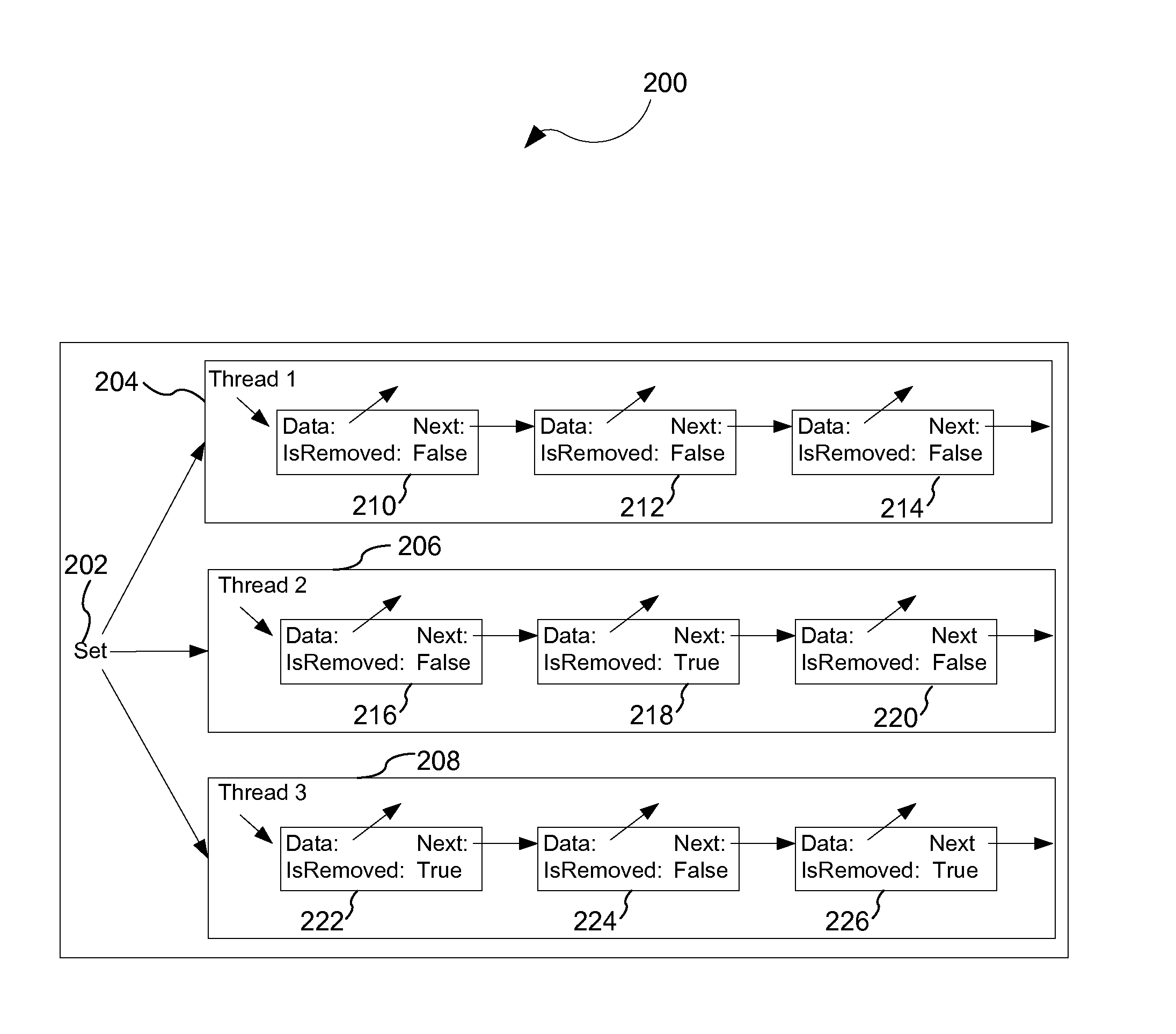
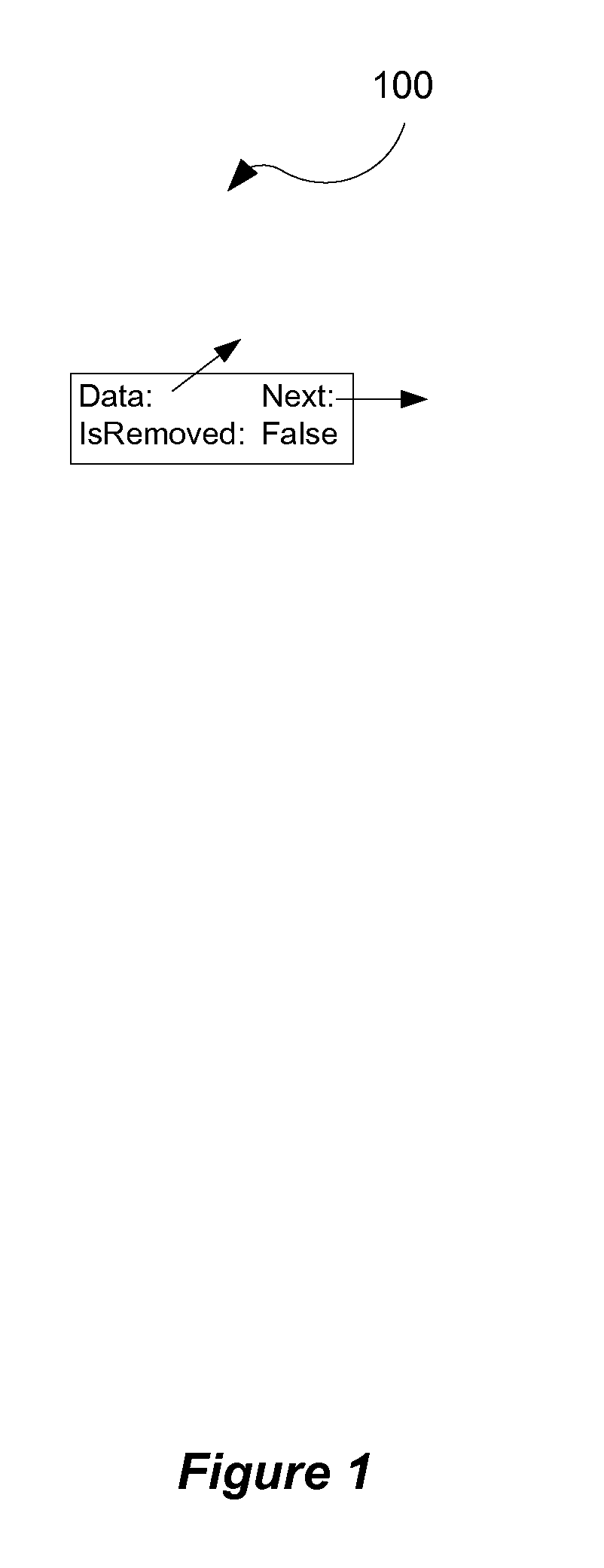
[0014]A data gathering method, system, and computer program product is provided that enables data gathering with optimal performance. In one embodiment, objects are allowed to be logically removed from a list without being physically removed by having the objects store a bit for logical removal from the set. Objects are not re-used. Once an object is passed to the set, it can be viewed, but it is owned by the set. Internally, the set is implemented as the union of several subsets which are stored separately per-thread. In one embodiment, each subset can only have objects added and physically removed by its thread. Therefore, each subset can be implemented without using main memory concurrency primitives for thread safety, i.e., without any Compare and Swap (“CAS”)-style main-memory operations and without any locking. The term CAS is herein intended to include any main-memory synchronization primitive such as Compare and Swap, Load-Linked / Store-Conditional, or any other Read-Modify-W...

the structure of the environmentally friendly knitted fabric provided by the present invention; figure 2 Flow chart of the yarn wrapping machine for environmentally friendly knitted fabrics and storage devices; image 3 Is the parameter map of the yarn covering machine
Login to View More

PUM

No PUM Login to View More

Abstract

Object are created such that each of the objects stores a bit that designates eventual removal of one of the objects. Further, the objects are added to a data structure that includes a set that comprises a union of a plurality of subsets such that each subset in the plurality of subsets is stored separately according to a corresponding thread and such that an added object that is added to the set by a given thread is stored in the corresponding subset. In addition, one of the objects is logically removed, without physical removal, from the set by activating the bit. Each subset is periodically swept. All objects marked with the activated bit are physically removed.

Description

BACKGROUND[0001]1. Field[0002]This disclosure generally relates to a computing environment. More particularly, the disclosure relates to data gathering.[0003]2. General Background[0004]The computer set data structure has three operations: Add( ) Remove( ) and some form of accessor to read the contents of the set. Typical sets access the contents of the set approximately ninety percent of the time, perform Add( ) approximately nine percent of the time, and perform Remove( ) approximately one percent of the time. Thus, most implementations are optimized for these scenarios. In particular, most implementations are optimized around read-access being fast.[0005]However, applications also often have to record information for use in unusual situations. An example is information that will only be utilized in the case of debugging, but cannot be reacquired later and thus has to be saved. Another example is information that will only be utilized in an infrequent clean-up activity. Any of thes...

Claims

the structure of the environmentally friendly knitted fabric provided by the present invention; figure 2 Flow chart of the yarn wrapping machine for environmentally friendly knitted fabrics and storage devices; image 3 Is the parameter map of the yarn covering machine
Login to View More

Application Information

Patent Timeline
no application Login to View More
IPC IPC(8): G06F17/30
CPCG06F17/30359G06F16/2336
Inventor MATSA, MOSHE M.E.PERKINS, ERIC D.
Owner IBM CORP