Check patentability & draft patents in minutes with Patsnap Eureka AI!

Testing Protocol for a Double Walled Tank

a technology of double walled tanks and testing protocols, which is applied in the direction of fluid loss/gain rate measurement, fluid tightness measurement, instruments, etc., can solve the problems of affecting the lives of people, affecting the stability of the environment, and exaggerating the problems, etc., to achieve the effect of stabilizing the vacuum pressure applied

Active Publication Date: 2012-06-14
RUSSELL DAVID D
View PDF2 Cites 0 Cited by
  • Summary
  • Abstract
  • Description
  • Claims
  • Application Information

AI Technical Summary

Benefits of technology

[0012]Because of these and other problems with the art, described herein, among other things is a testing protocol suitable for a double-walled tank structure. In one embodiment this testing protocol comprises a method for testing the integrity of a double-walled underground storage tank, the method comprising: inspecting a monitor pipe for liquid in an annular space; removing any liquids detected in the annular space; applying vacuum pressure to the annular space; stabilizing the vacuum pressure applied to the annular space; holding the vacuum pressure applied to the annular space for a first time period; if the vacuum pressure applied for the first time period has a vacuum decrease greater than 0.5″ Hg, determining the tank fails; if the vacuum pressure applied for the first time period has a vacuum decrease of 0.5″ Hg or less then holding the vacuum pressure applied t

Problems solved by technology

Because the liquids stored in such tanks are often hazardous (gasoline for use as a motor fuel being one of the most common), and thus can cause severe environmental damage and greatly impact the lives of people living, working, and recreating in nearby areas, careful attention to the potential for leaks from such tanks must be exercised.
In some cases, even small leakage from such an underground tank can have profound effects as the chemical can serve to poison a local water supply, or lead to a situation where nearby soil or other materials become directly hazardous to life.
The fact that many of these storage tanks are in areas of higher population density simply exaggerates the problems.
Due to these potential problems from leaks, safer storage tanks have been designed with a double wall, such that a breach in the integrity of either of the inner or outer wall alone will not allow a leak of the liquid contained in the tank outside of the tank.
While new tanks can be built to more stringent safety standards, because a large number of tanks have already been placed prior to the rules being imposed and the operation for removing and replacing them can be economically unviable, it is often the case that tanks need to be retrofitted in place to comply with more stringent safety regulations or simply taken out of service, which results in a major waste of resources.
While this method provides for a new primary containment system, allowing the existing tank to act as a secondary containment, the new primary containment is not necessarily structurally equivalent to an independent tank.
This difference in the structural integrity of the primary containment system renders the known, traditional protocols for testing the integrity of traditional double-walled and single-walled tanks unacceptable and dangerous.
The risk of puncturing or rendering the primary containment system of these self-supporting bladders inoperable through these traditional testing techniques is simply too high.
These traditional testing protocols simply do not take into account the difference in structural integrity between the primary containment system and the secondary containment system in these self-supporting bladder structures and, as such, is not useable in these types of double-walled structures.

Method used

the structure of the environmentally friendly knitted fabric provided by the present invention; figure 2 Flow chart of the yarn wrapping machine for environmentally friendly knitted fabrics and storage devices; image 3 Is the parameter map of the yarn covering machine
View more

Image

Smart Image Click on the blue labels to locate them in the text.
Viewing Examples
Smart Image
  • Testing Protocol for a Double Walled Tank
  • Testing Protocol for a Double Walled Tank
  • Testing Protocol for a Double Walled Tank

Examples

Experimental program
Comparison scheme
Effect test

Embodiment Construction

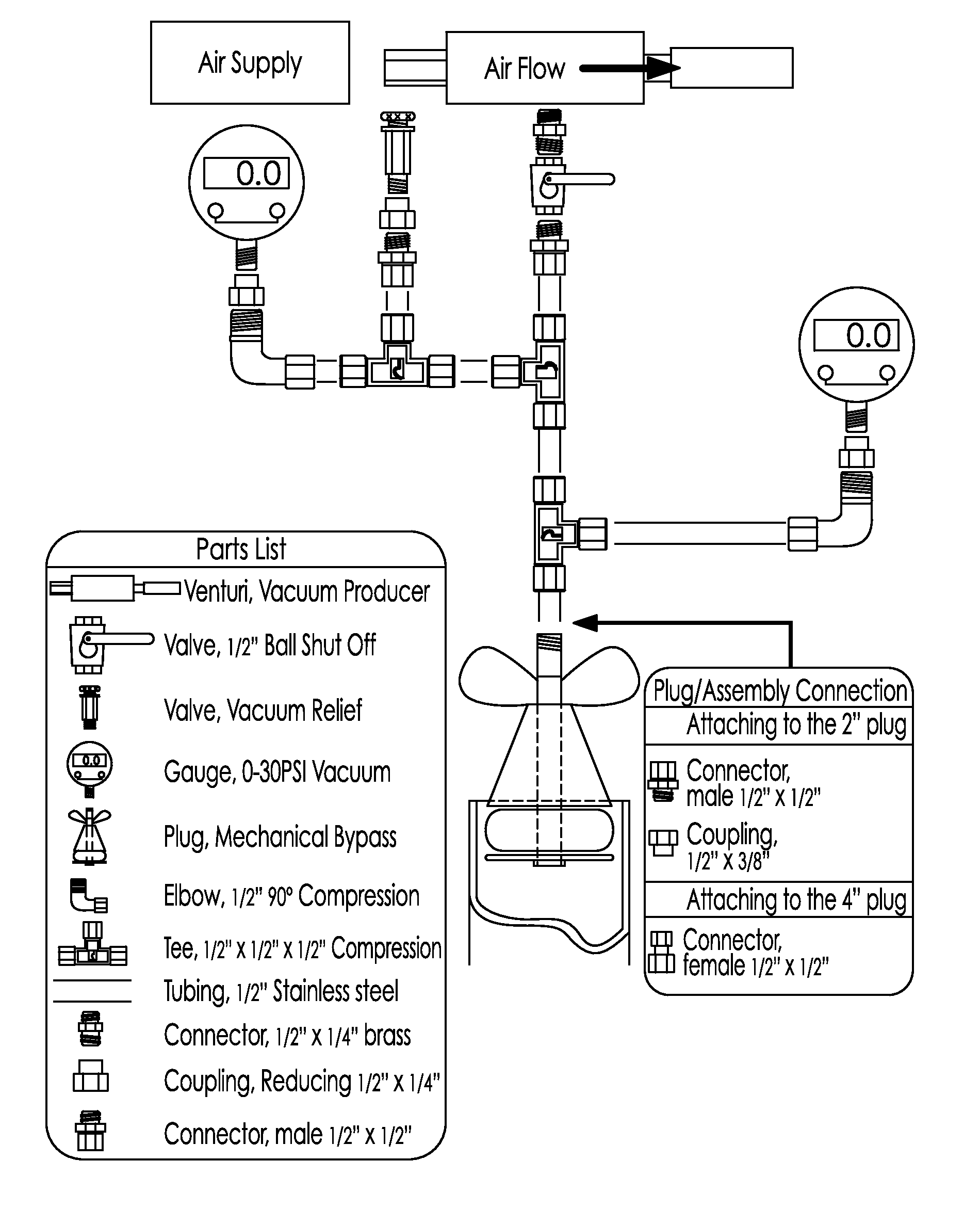
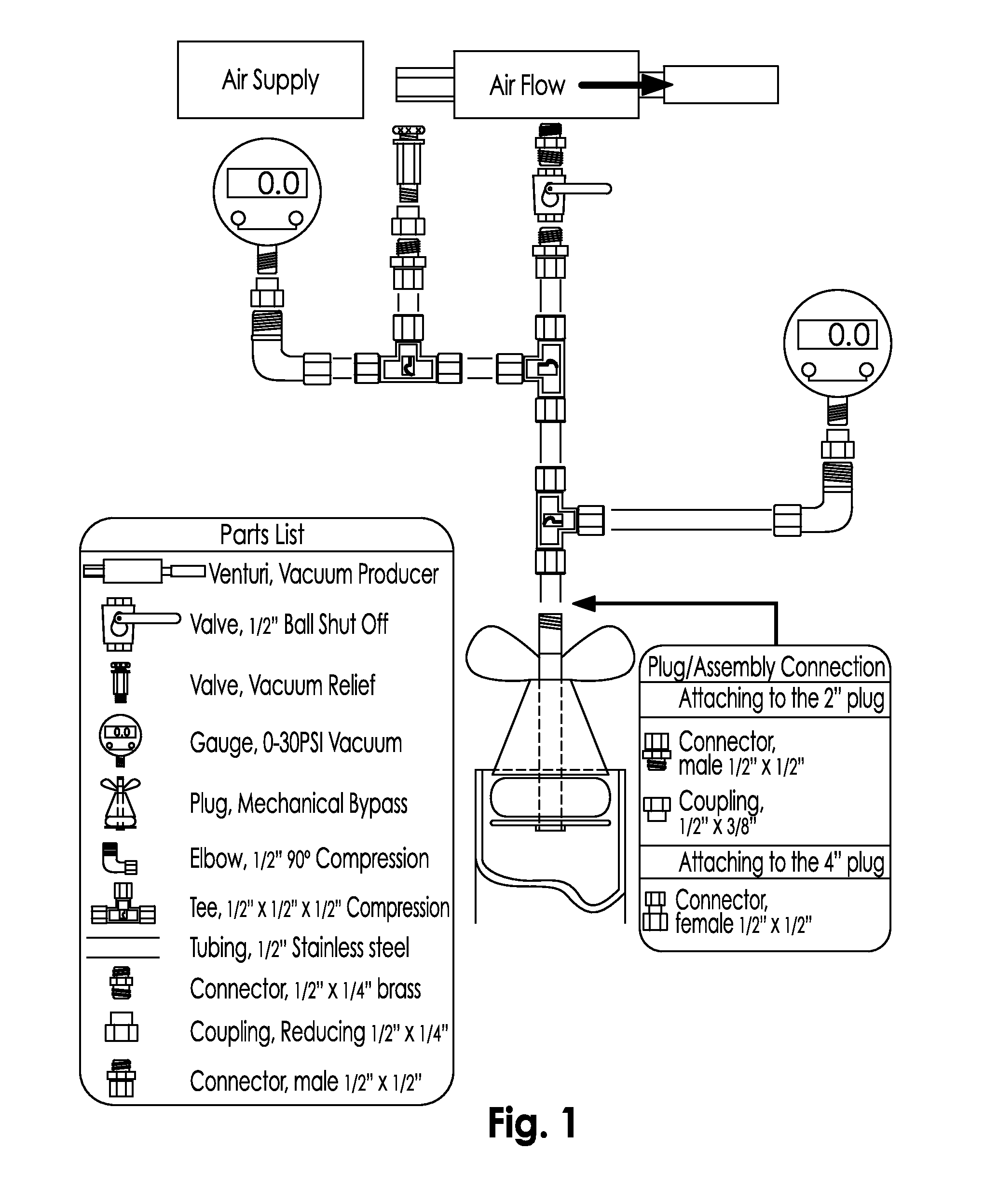
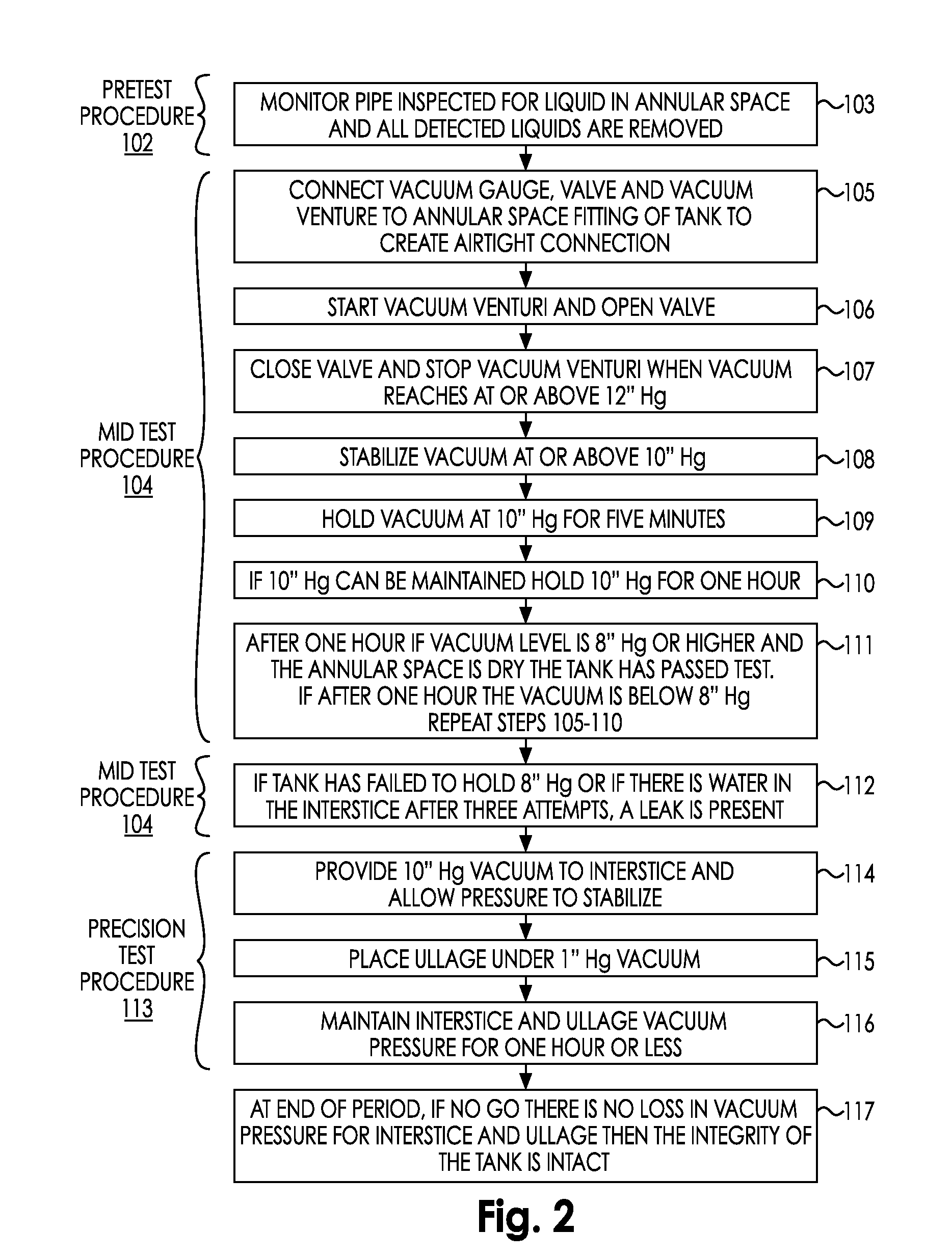
[0022]Embodiments of a testing protocol suitable for a double-walled tank liner are described with respect to FIGS. 1-2. As a preliminary manner, it is noted that the testing protocol (101) of this application will be described as being used for a double-walled tank created by a self-supporting bladder. However, it should be understood that this description is not limiting. It is contemplated that the testing protocol (101) described herein may be utilized to test the integrity of any double-walled or other multi-walled underground tank system known to those of ordinary skill in the art. Further, it is also contemplated that the testing protocol described herein may be utilized with single-walled underground storage tanks.

[0023]Generally, the equipment required for the testing protocol described herein consists of the following components, as demonstrated in FIG. 1. First, a vacuum gauge known to those of ordinary skill in the art. In one embodiment, a vacuum gauge with a range of 0...

the structure of the environmentally friendly knitted fabric provided by the present invention; figure 2 Flow chart of the yarn wrapping machine for environmentally friendly knitted fabrics and storage devices; image 3 Is the parameter map of the yarn covering machine
Login to View More

PUM

No PUM Login to View More

Abstract

A protocol for testing the integrity of a double-walled underground storage tank.

Description

CROSS REFERENCE TO RELATED APPLICATION(S)[0001]This application claims benefit of and priority to U.S. Provisional Patent Application Ser. No. 61 / 418,287 filed Nov. 30, 2010, the entire disclosure of which is incorporated herein by reference.BACKGROUND[0002]1. Field of the Invention[0003]This invention relates to the field of testing protocols to verify the integrity of double walled tanks.[0004]2. Description of Related Art[0005]Commercial and industrial liquids of all types are stored in storage tanks. One of the most notable such types of storage is for motor vehicle fuel. For reasons of space, many of these tanks are placed underground to be able to supply filling stations and other places where large amounts of liquids are to be stored and distributed. Underground fuel tanks are generally cylindrical in shape and usually have a capacity in the range of 500 to 20,000 gallons or more. Such tanks are generally made of either metal (usually steel) or a fiber reinforced resinous mat...

Claims

the structure of the environmentally friendly knitted fabric provided by the present invention; figure 2 Flow chart of the yarn wrapping machine for environmentally friendly knitted fabrics and storage devices; image 3 Is the parameter map of the yarn covering machine
Login to View More

Application Information

Patent Timeline
no application Login to View More
IPC IPC(8): G01M3/34B65D90/503
CPCB65D90/503
Inventor RUSSELL, DAVID D.
Owner RUSSELL DAVID D
Features
  • R&D
  • Intellectual Property
  • Life Sciences
  • Materials
  • Tech Scout
Why Patsnap Eureka
  • Unparalleled Data Quality
  • Higher Quality Content
  • 60% Fewer Hallucinations
Social media
Patsnap Eureka Blog
Learn More