[0004]The present invention meets many needs in the art by providing functional, cost-effective, mobile lighting that can be powered by clean, renewable,
solar energy that eliminates the dependency on
fossil fuel in relation to providing such lighting and that also eliminates associated carbon emissions, as well as any
noise pollution. In particular embodiments, the present invention relates to a mobile
lighting system and device that provides excellent and useful lighting on-demand and at any site where the relatively compact device may be positioned. The
system and device utilizes a
renewable energy source, particularly solar energy, to charge and recharge an on-board battery or suite of batteries that provide power to a
light emitting device (e.g., comprising light emitting diodes or “LED” floodlights) that is positioned atop a mast that can be adjusted to varying heights and orientations to most effectively light a defined area for a variety of uses, such as
recreation events, camping, sports events, construction and other work activities, mining, security,
emergency situations, airport uses, military operations,
storm or
disaster recovery, and the like.
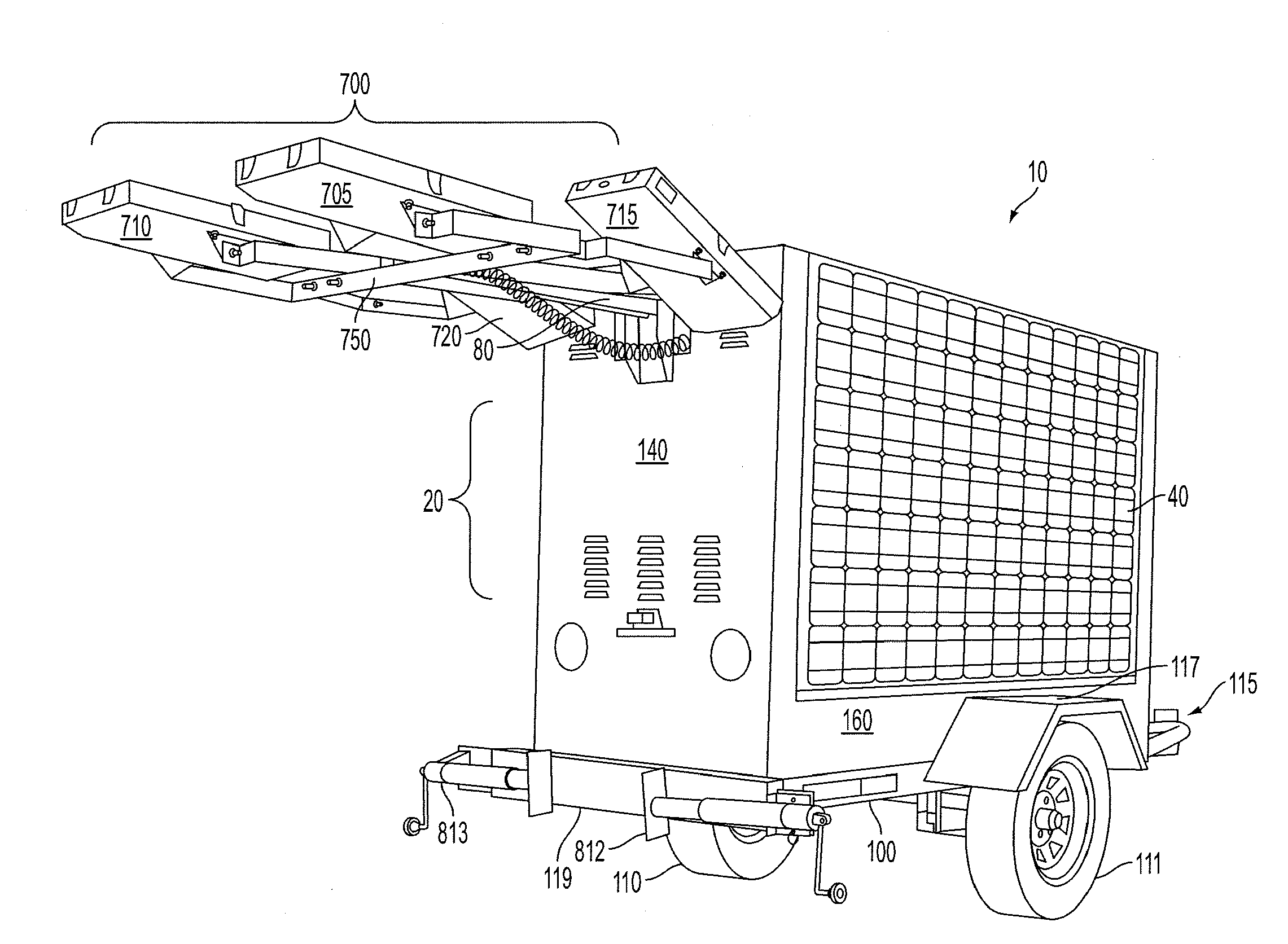
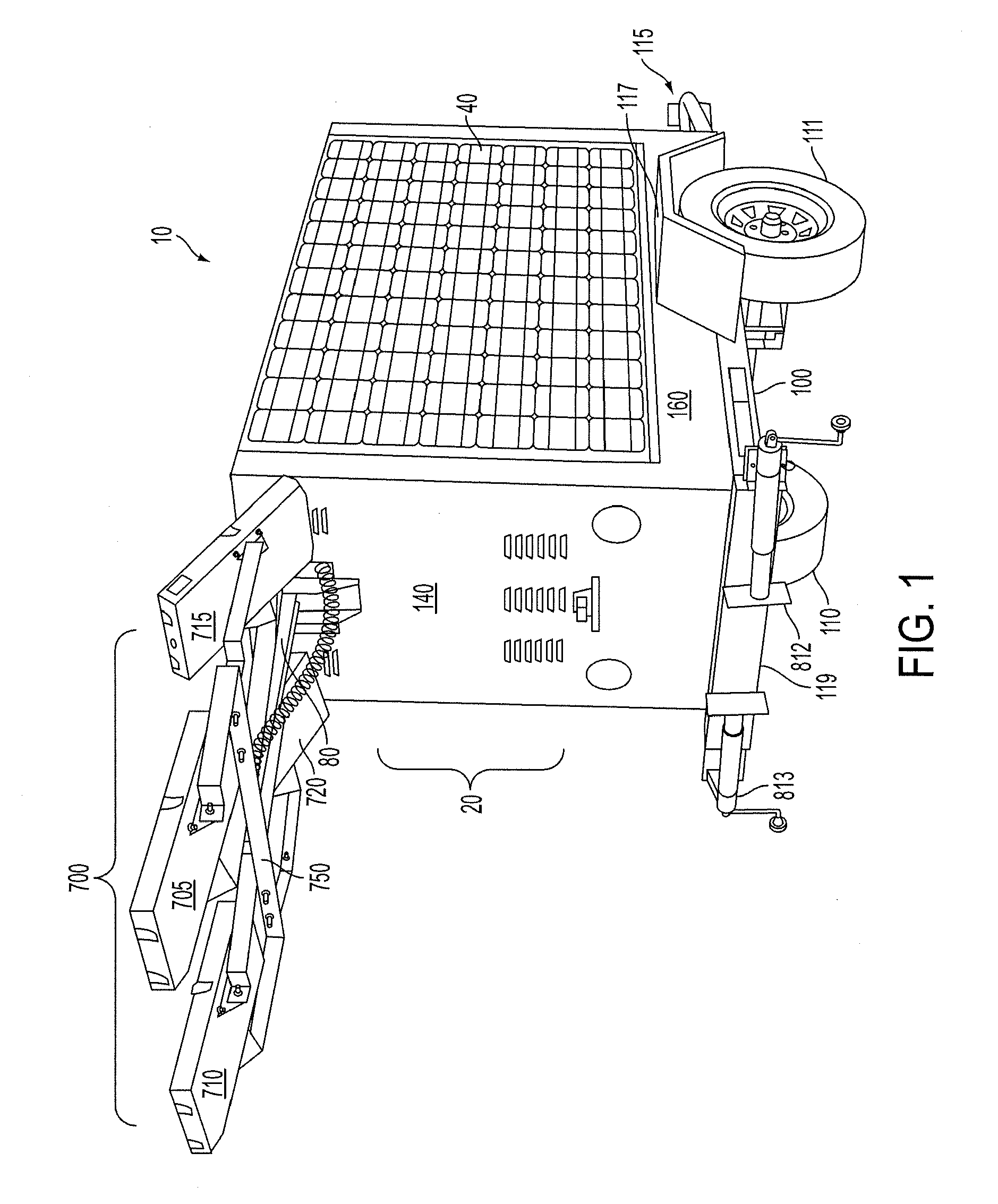
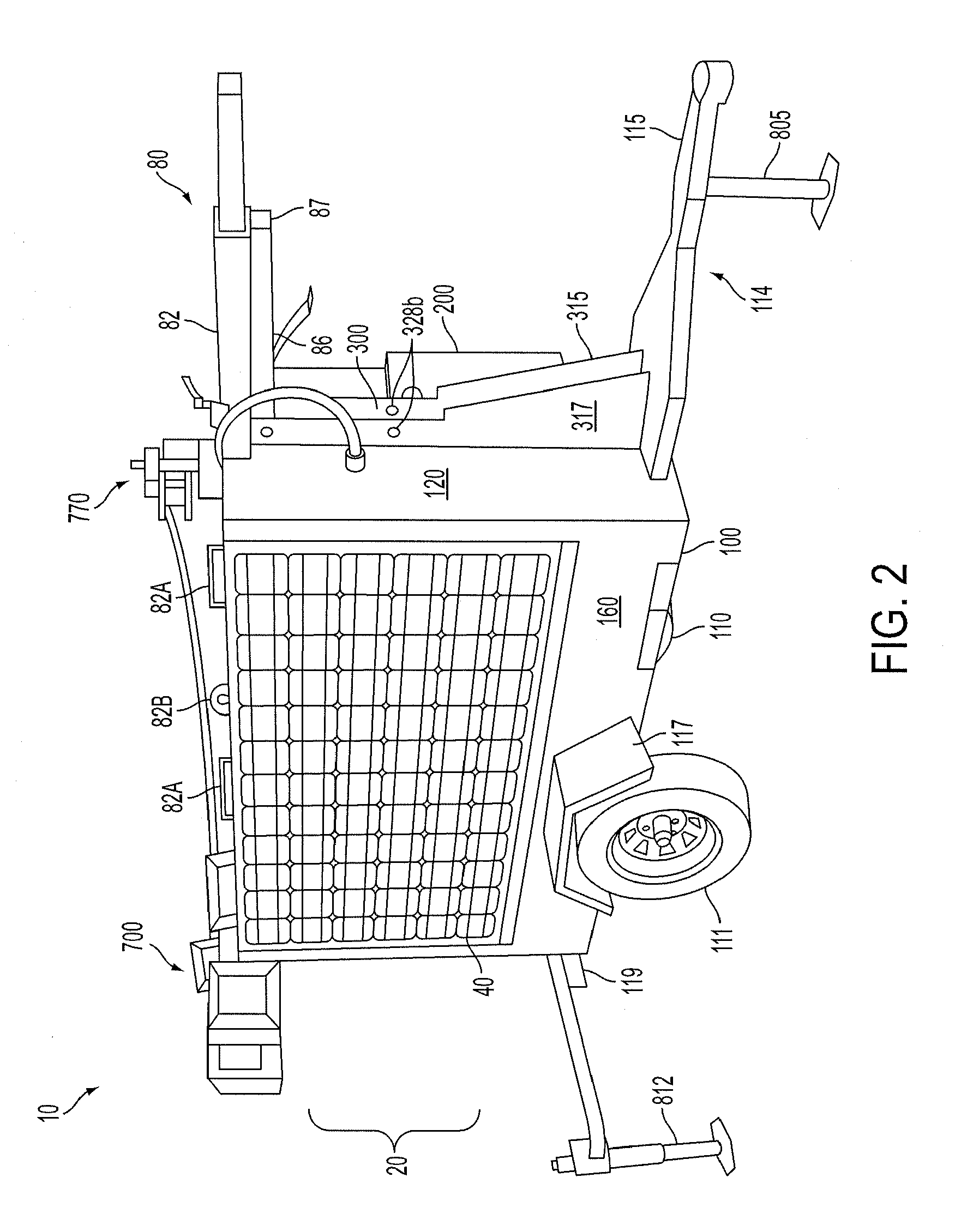
[0005]In various embodiments, the invention can relate to a mobile solar lighting device that can include an extendable mast that is connected at one end portion to a base unit, and that is connected at an opposing end portion to a lighting module, such as a high output LED
floodlight. The base unit may be constructed upon a device for facilitating mobility of the device, such as a trailer. The solar lighting device also can include one or more solar power modules (e.g., solar panels) that can be moved between
modes that optimize mobility of the solar lighting device and
modes that optimize
receipt of solar energy and thus optimize charging. The inventive device further can include a battery or batteries (i.e., a battery “
bank” or battery “suite”) that can be housed in a housing unit that specifically can be attached to or formed on a trailer frame or floor /
deck. The mast beneficially can be raised, lowered, and rotated to a variety of positions. In operation, the solar panels (or other
renewable energy acquisition device) can be used to form electrical current that is used to charge the batteries. The charged batteries are useful to provide electrical power to a load such as the lighting module and thus provide a
light source that, in various embodiments, is mobile, self-contained, renewable energy powered, emission-free, and noiseless.
[0006]In specific embodiments, a mobile, solar power lighting device according to the present invention may comprise the following: a base housing unit having two opposing side walls; one or more solar power modules pivotally attached to one or both of the opposing side walls of the base housing unit, the solar power modules being effective to convert solar energy into electrical current; one or more batteries positioned within the base housing unit, the one or more batteries being at least partially rechargeable using the electrical current formed by the solar power modules; a lighting module that is at least partially powered using the one or more batteries; and a mast having a first end section for connection to the base housing unit and having a second, opposing end section for connection to the lighting module, the mast being one or more of extendable, pivotable, and rotatable. In some embodiments, the base housing unit more particularly may include the following: a trailer frame; a front wall and a back wall interconnecting the two opposing side walls, wherein the front wall, back wall, and side walls are attached to the trailer frame; and a roof attached to the front wall, the back wall, and the opposing side walls. In specific embodiments, the roof of the base housing unit can include a recessed portion that extends along an approximate midline from front to back, and such recess can be useful for receiving the mast when pivoted in a down position. This beneficially assists in protecting the mast during transport and can reduce the profile of the device when in a transport configuration.



 Login to View More
  Login to View More