[0012]The telescopic guides can be formed respectively from at least two linear guides. Linear guides are comparatively simple to produce and are therefore available at a favourable cost. Also, linear guides, according to degree of overlap of guide elements, enable a transfer of comparatively high transverse forces. A linear guide can be constructed as a linear sliding guide of two guide elements or as a linear rolling guide with rolling bodies between two guide elements. As at least two linear guides are provided for the construction of the telescopic guides, the telescopic guide can also be constructed for example from three guide elements, which form two linear guides. The linear guide can be formed in the manner of a dovetail guide, rail guide or
round bar guide. A telescoping capability of the linear guides or respectively of the guide elements can be achieved by a parallel offset arrangement of the guide elements relative to one another or a coaxial arrangement of the guide elements.
[0014]In order to obtain a comparatively wide drum unit having a great
axial length, the drum can comprise a further second deflection device, which is spaced apart from the first deflection device. The axial movement of the actuation device can then be transferred via both deflection devices to the drum unit or respectively to the respective drum segments. Thus, it can be avoided that a jamming of the drum segments occurs due to one-sided loading of the drum unit, because an actuation force can be distributed by means of the two deflection devices relatively uniformly onto a length of the drum unit. Basically, it thus also becomes possible to construct comparatively wide tire bodies or to manufacture a plurality of tire bodies simultaneously with the drum. Depending on the case of application and the length of the drum unit, further deflection devices can also be provided.
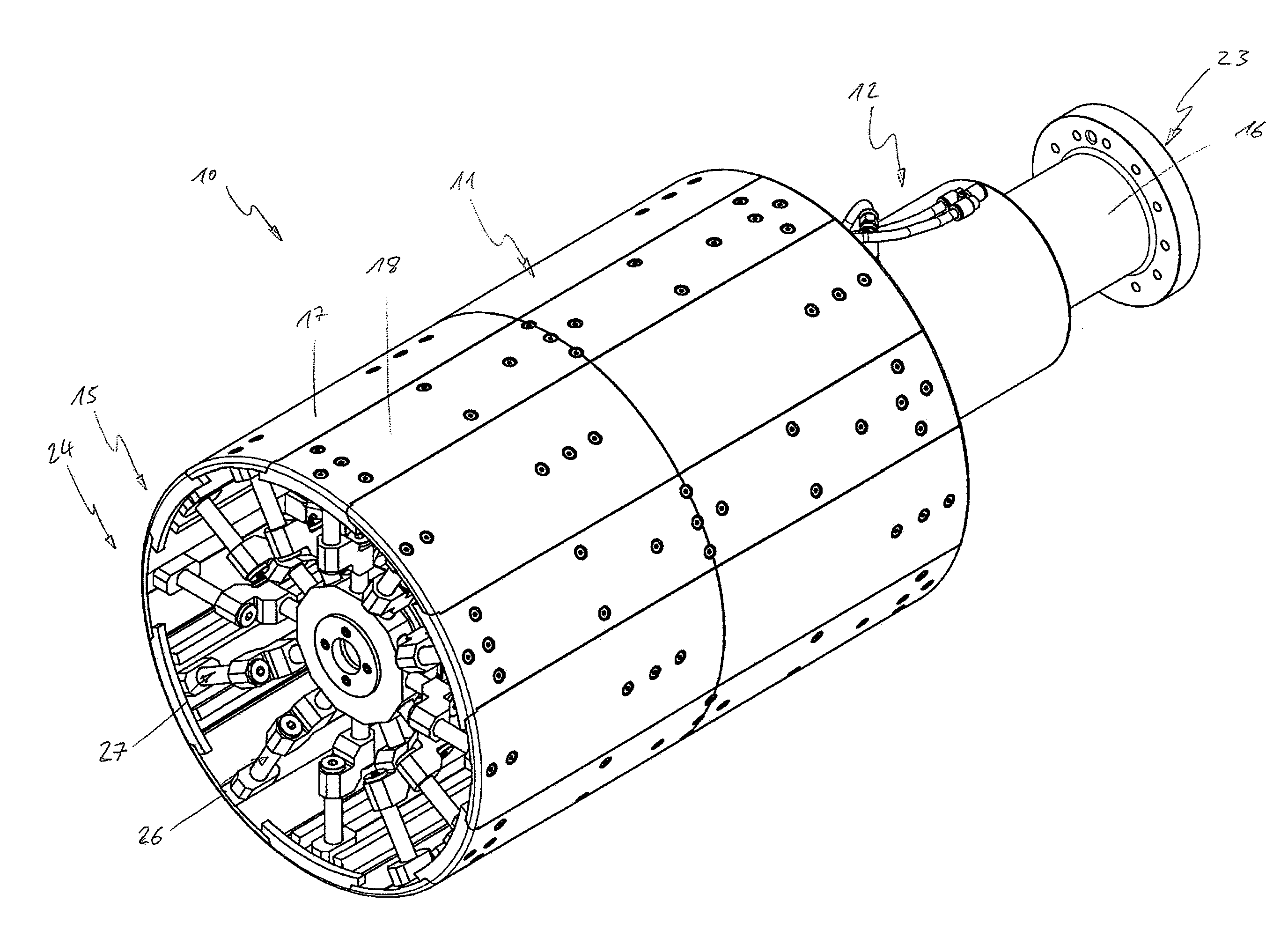
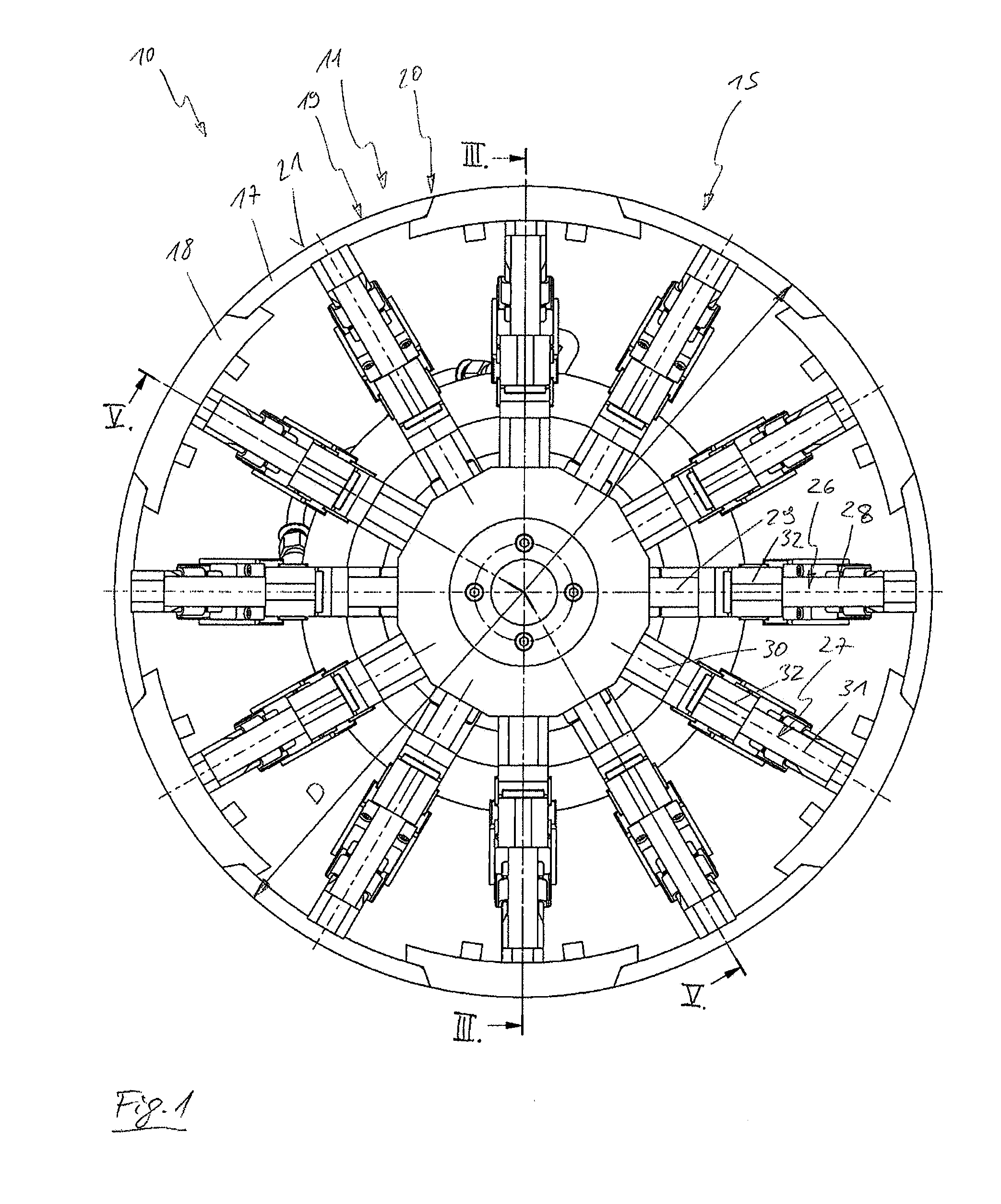
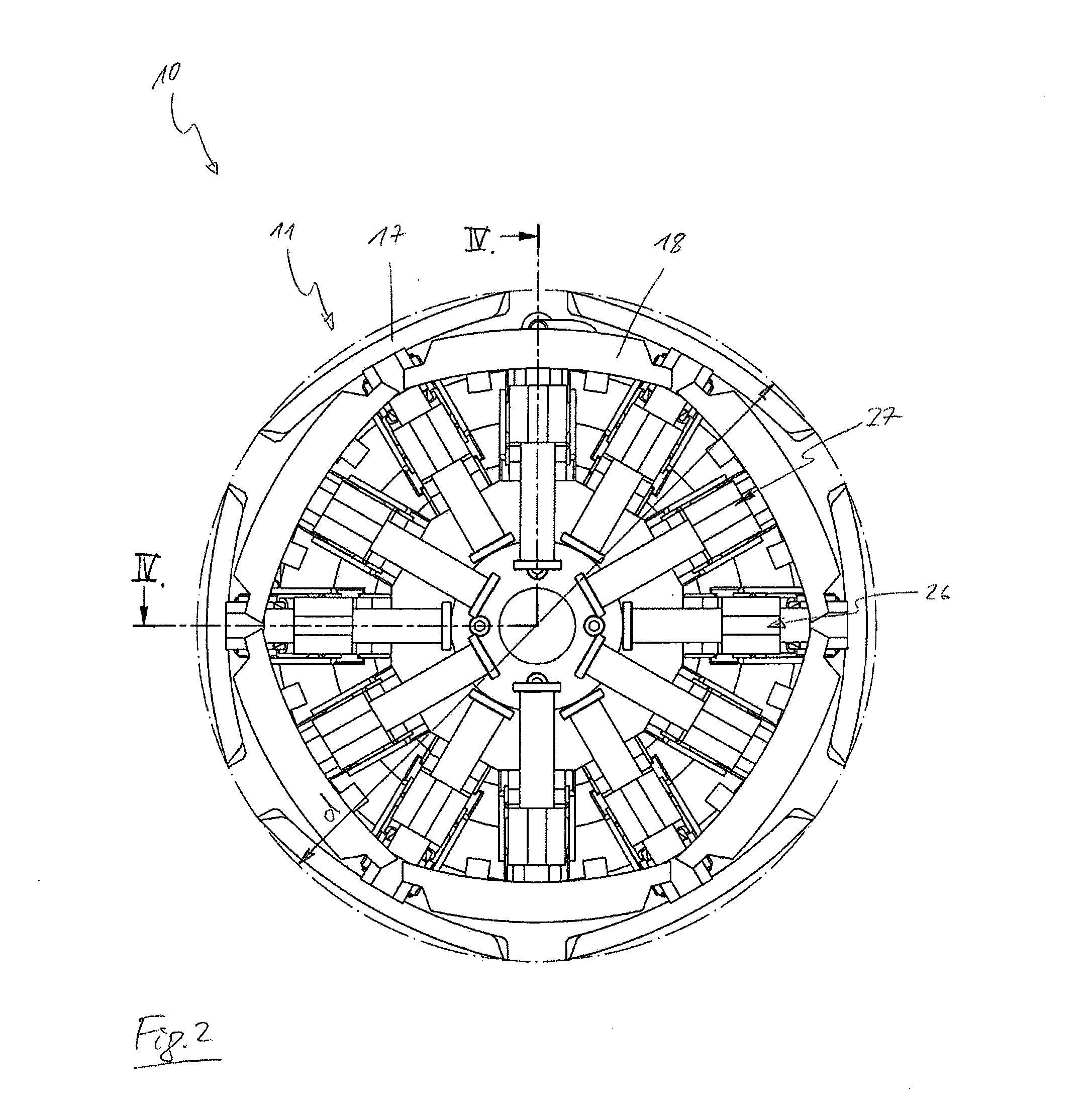
[0015]The drum unit can comprise a set of outer drum segments and a set of inner drum segments, which in turn can be arranged respectively alternately over a periphery of the drum unit. A use of two types of drum segments makes it possible, with a contraction of the external diameter, to separate the respective drum segments from one another in a suitable manner.
[0016]Thus, an external diameter D of the drum unit can be formed in an expanded position of the drum unit by all drum segments, and an external diameter d of the drum unit can be formed in a contracted position of the drum unit by solely the outer drum segments. Thus, it becomes possible that in the expanded position of the drum unit, a substantially closed circular cylinder can be formed from all drum segments. Gaps between the drum segments on the periphery of the drum unit, such as are known from clamping mandrels, can thus be avoided. A tire body can then be constructed in a particularly precise manner. When, in the contracted position, the outer drum segments form the external diameter d, the inner drum segments can be arranged inside the drum unit or respectively inside the circular cylinder which is thus formed. Thereby, it likewise becomes possible to reduce external diameter d in size as far as possible.
[0017]In this respect, it is advantageous if the telescopic guides for the inner drum segments have a greater guide length than the telescopic guides for the outer drum segments. The inner drum segments can then be moved further in radial direction than the outer drum segments. Also, via respectively different inclinations of the guide arrangements of the inner and outer drum segments, different movement lengths can be brought about with a movement of
equal size of the actuation device.
[0020]In addition, the actuation device can have at least one fluid
piston which is arranged concentrically on the
drive shaft and is axially movable. Thereby, it becomes possible to move the conical rings in axial direction by means of the fluid
piston. The fluid
piston can be driven hydraulically or pneumatically. In addition, it is also conceivable to provide, instead of a fluid piston, an electromechanical
linear drive or a drive which is not concentrically arranged on the
drive shaft for the conical rings. A concentrically arranged fluid piston is, however, very compact and can generate great actuation forces.


 Login to View More