

Method for identifying touch object
a touch object and stylus technology, applied in the field of identifying a stylus on a touch panel, can solve the problems of difficult to decide a fixed noise threshold value, and the finger sensed signals are not easy to be incorrectly identified as those of other touch objects
- Summary
- Abstract
- Description
- Claims
- Application Information
AI Technical Summary
Benefits of technology
Problems solved by technology
Method used
Image

Examples
first embodiment
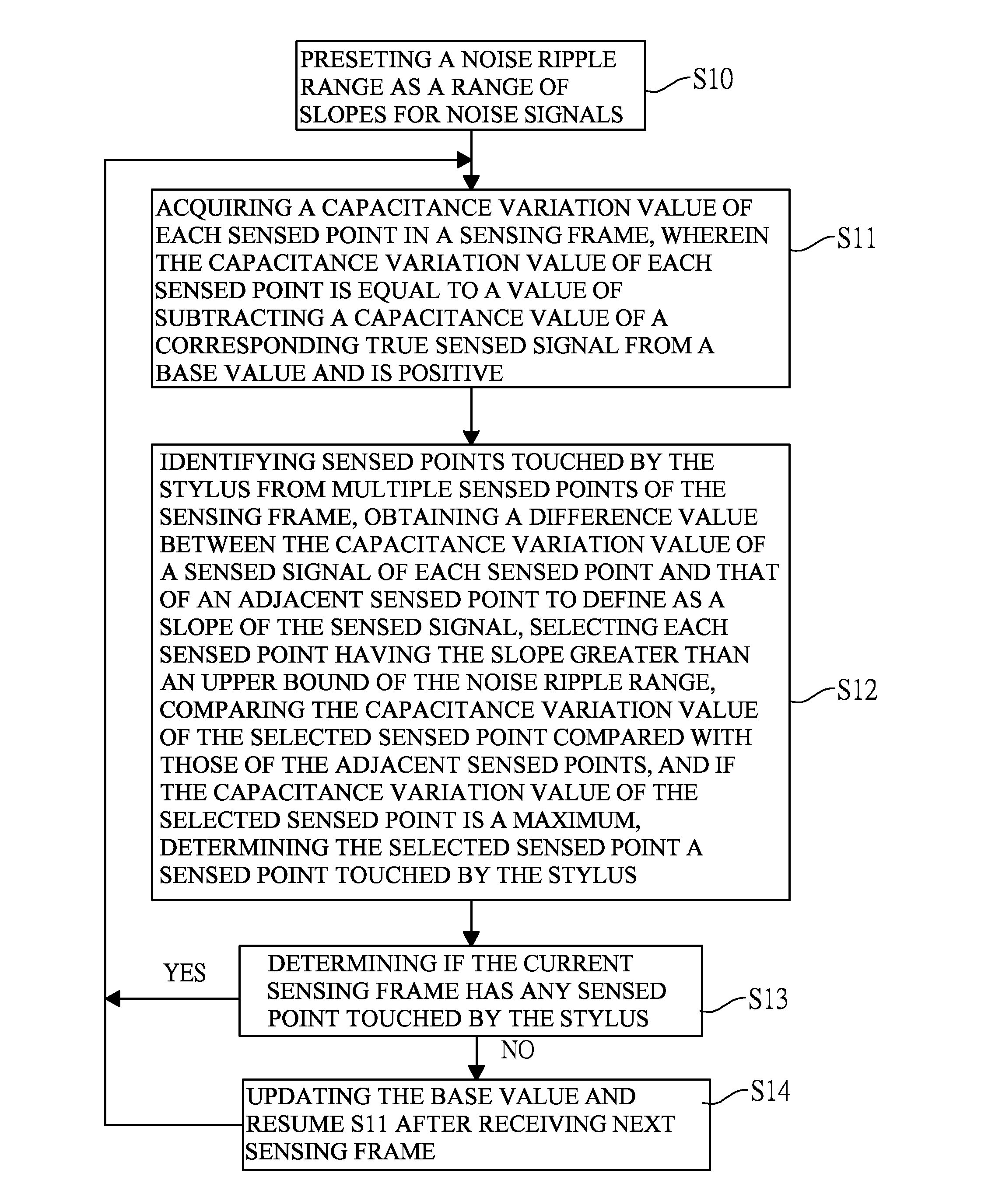
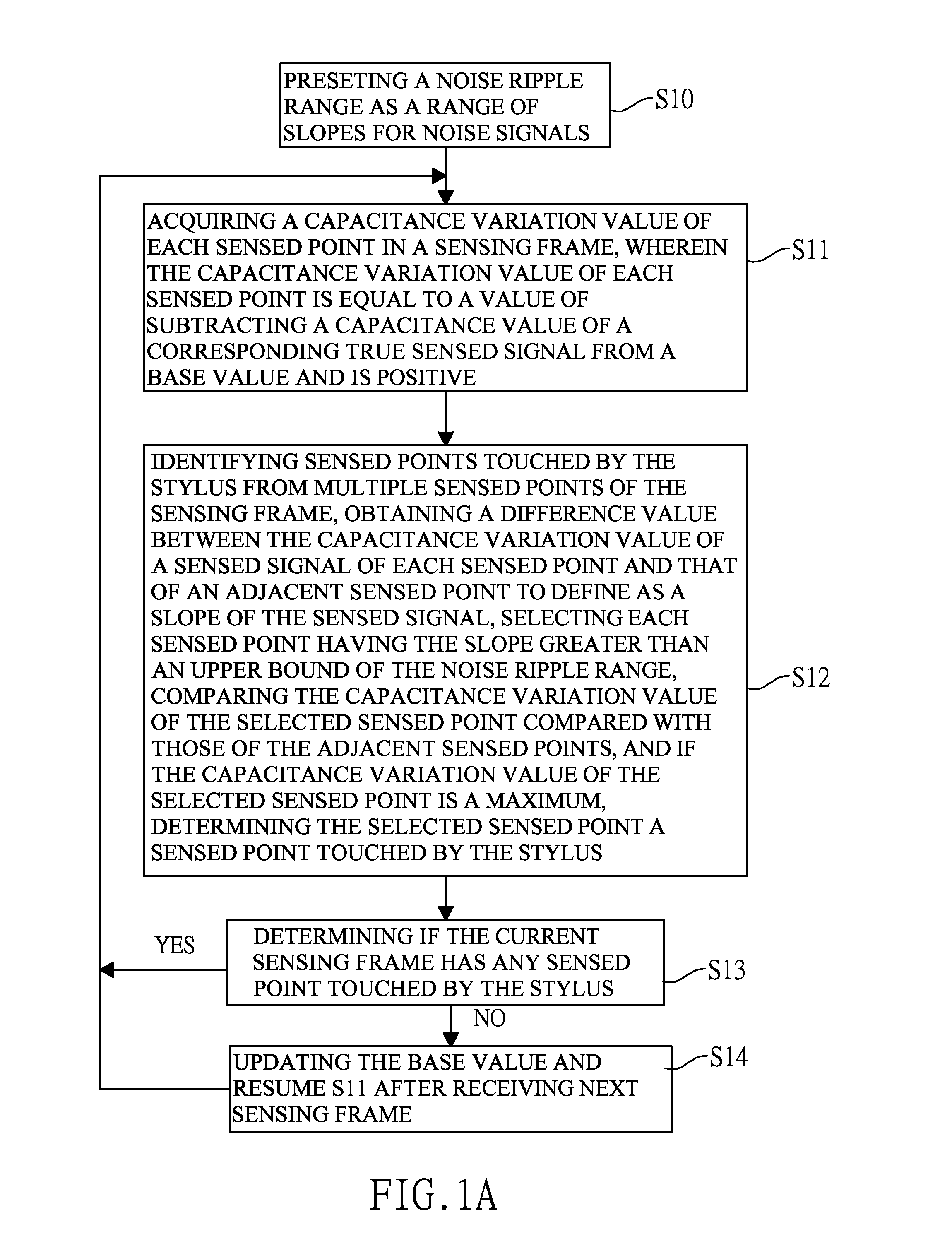
[0029]With reference to FIGS. 1A and 1C, a method for identifying touch object in accordance with the present invention is applied to full-scanning sensing frames and has the following steps.
[0030]Preset a noise ripple range dVRnoise as a range of slopes for noise signals (S10).
[0031]Acquire a capacitance variation value of each sensed point in a sensing frame (S11). The capacitance variation value of each sensed point is equal to a value of subtracting a capacitance value of a corresponding true sensed signal from a base value and is positive.
[0032]Identify sensed points touched by the stylus from multiple sensed points of the sensing frame, obtain a difference value between the capacitance variation value of a sensed signal of each sensed point and that of an adjacent sensed point to define as a slope of the sensed signal, select each sensed point having the slope greater than an upper bound of the noise ripple range dVRnoise, and compare the capacitance variation value of the sel...
second embodiment
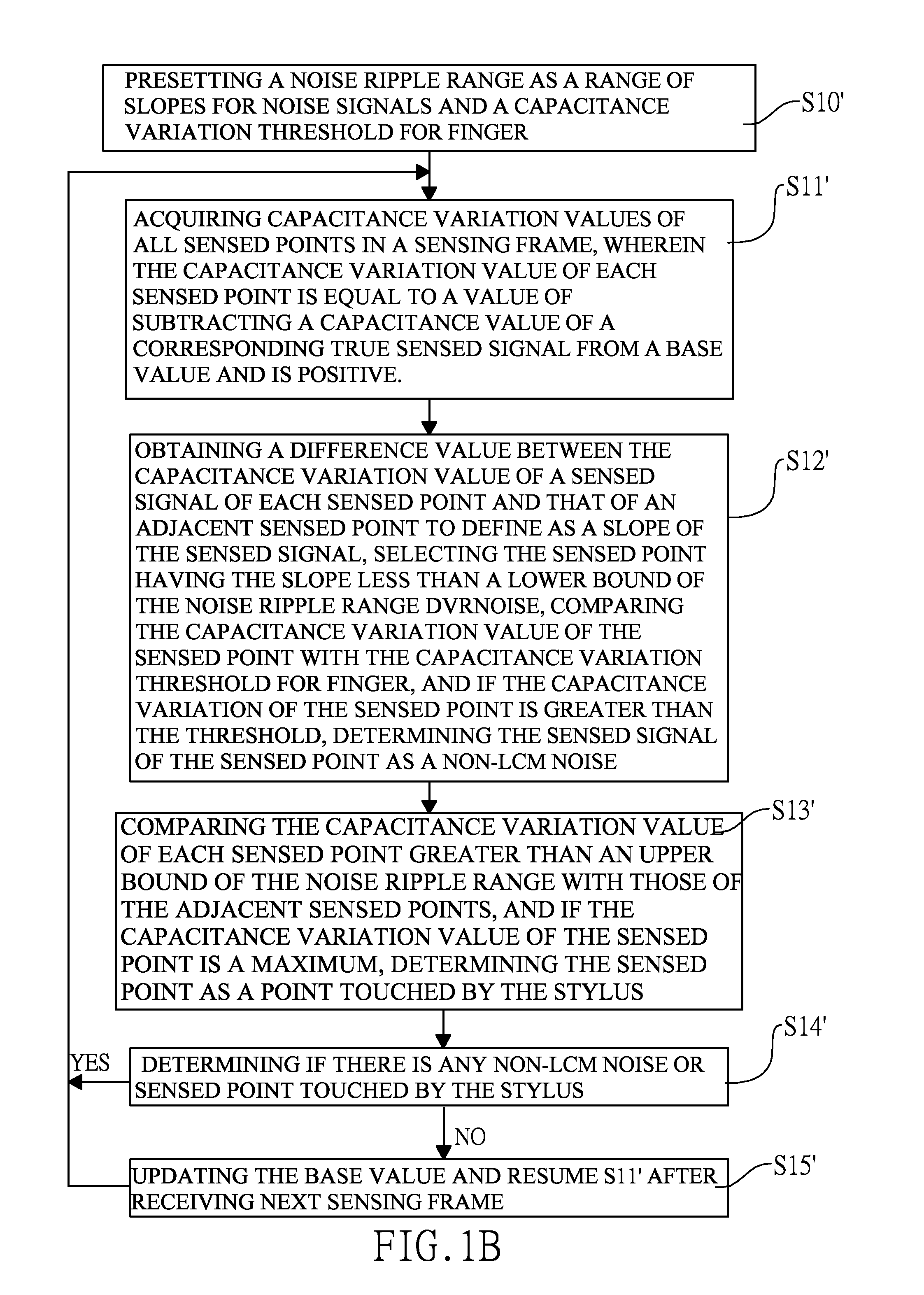
[0034]With reference to FIGS. 1B and 1D, a method for identifying touch object in accordance with the present invention is applied to a touch panel capable of being touched by fingers and a stylus, and has the following steps.
[0035]Preset a noise ripple range dVRnoise as a range of slopes for noise signals and a capacitance variation threshold for finger dVfth (S10′).
[0036]Acquire capacitance variation values of all sensed points in a sensing frame (S11′). The capacitance variation value of each sensed point is equal to a value of subtracting a capacitance value of a corresponding true sensed signal from a base value and is positive.
[0037]Obtain a difference value between the capacitance variation value of a sensed signal of each sensed point and that of an adjacent sensed point to define as a slope of the sensed signal, select the sensed point having the slope less than a lower bound of the noise ripple range dVRnoise, compare the capacitance variation value of the sensed point wit...
PUM
 Login to View More
 Abstract
Description
Claims
Application Information
 Login to View More