

Multi-Cell Incremental Redundancy
a wireless communication access network and incremental redundancy technology, applied in the direction of site diversity, wireless commuication services, transmitter monitoring, etc., can solve the problem of largely limited user performan
- Summary
- Abstract
- Description
- Claims
- Application Information
AI Technical Summary
Benefits of technology
Problems solved by technology
Method used
Image

Examples
Embodiment Construction
[0016]For purposes of this discussion, the term “module” shall he understood to include at least one of software, firmware, and hardware (such as one or more circuits, microchips, or devices, or any combination thereof), and any combination thereof. In addition, it will be understood that each module can include one, or more than one, component within an actual device, and each component that forms a part of the described module can function either cooperatively or independently of any other component forming a part of the module. Conversely, multiple modules described herein can represent a single component within an actual device. Further, components within a module can be in a single device or distributed among multiple devices in a wired or wireless manner.
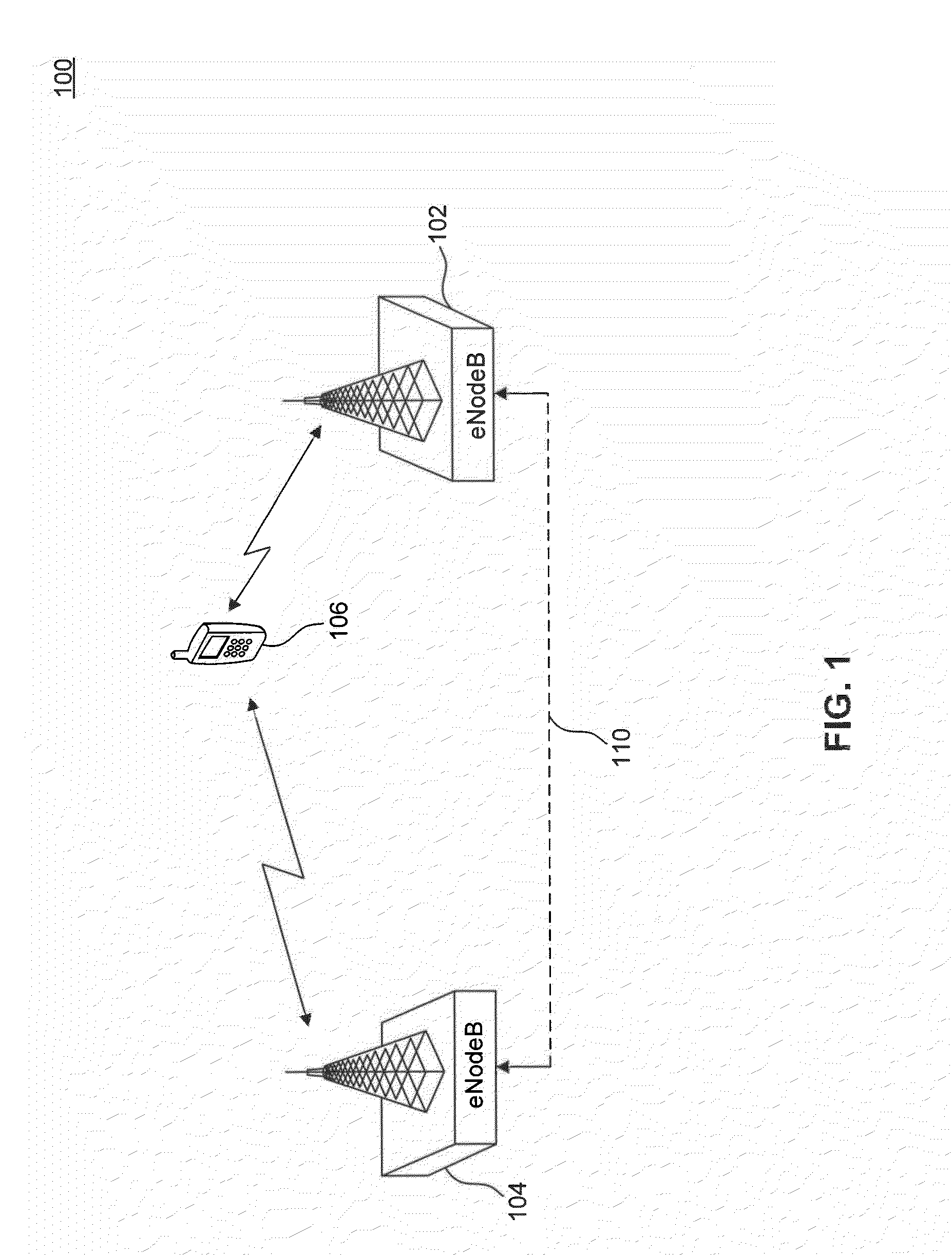
[0017]In the following disclosure, terms defined by the Long-Term Evolution (LTE) standard are sometimes used. For example, the term “eNodeB” is used to refer to what is commonly described as base station (BS) or base transcei...
PUM
 Login to View More
 Abstract
Description
Claims
Application Information
 Login to View More