As the amount of data handled in this way increases, the size and complexity of
individual data sets also increases.
As the size and complexity of data sets increases, the difficulty in providing users with an intuitive way of being able to navigate these data sets also increases.
In addition, the challenge of returning only relevant results pertinent to users' queries also increases.
In particular, there is a real and increasingly significant challenge in providing a user-friendly interface that is flexible and intuitive enough to allow users to navigate complex data sets using increasingly sophisticated queries.
In addition, a challenge also exists in ensuring that suitable interfaces are economical in terms of the computing resources they use (i.e. storage,
processing requirements, etc), and are therefore scalable so that they can deal with data sets of a wide variety of sizes and levels of complexity.
Nevertheless, there are problems with these faceted classification schemes and associated navigation systems.
They fail to facilitate the navigation of complex data sets that comprise more than a single collection of
data records, when the collections have a
relational structure.
In particular, such systems cannot accommodate navigation where users' constraints apply to more than one related collection of
data records and / or where the set of matching
data records depends on the relationships between data records from different collections of records.
Accordingly, the
disadvantage of the traditional faceted
classification scheme and
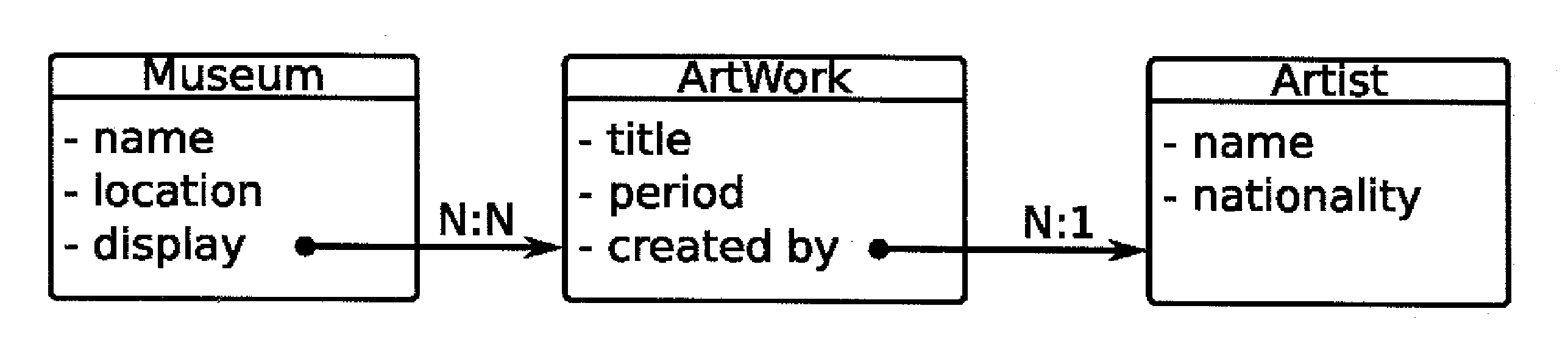
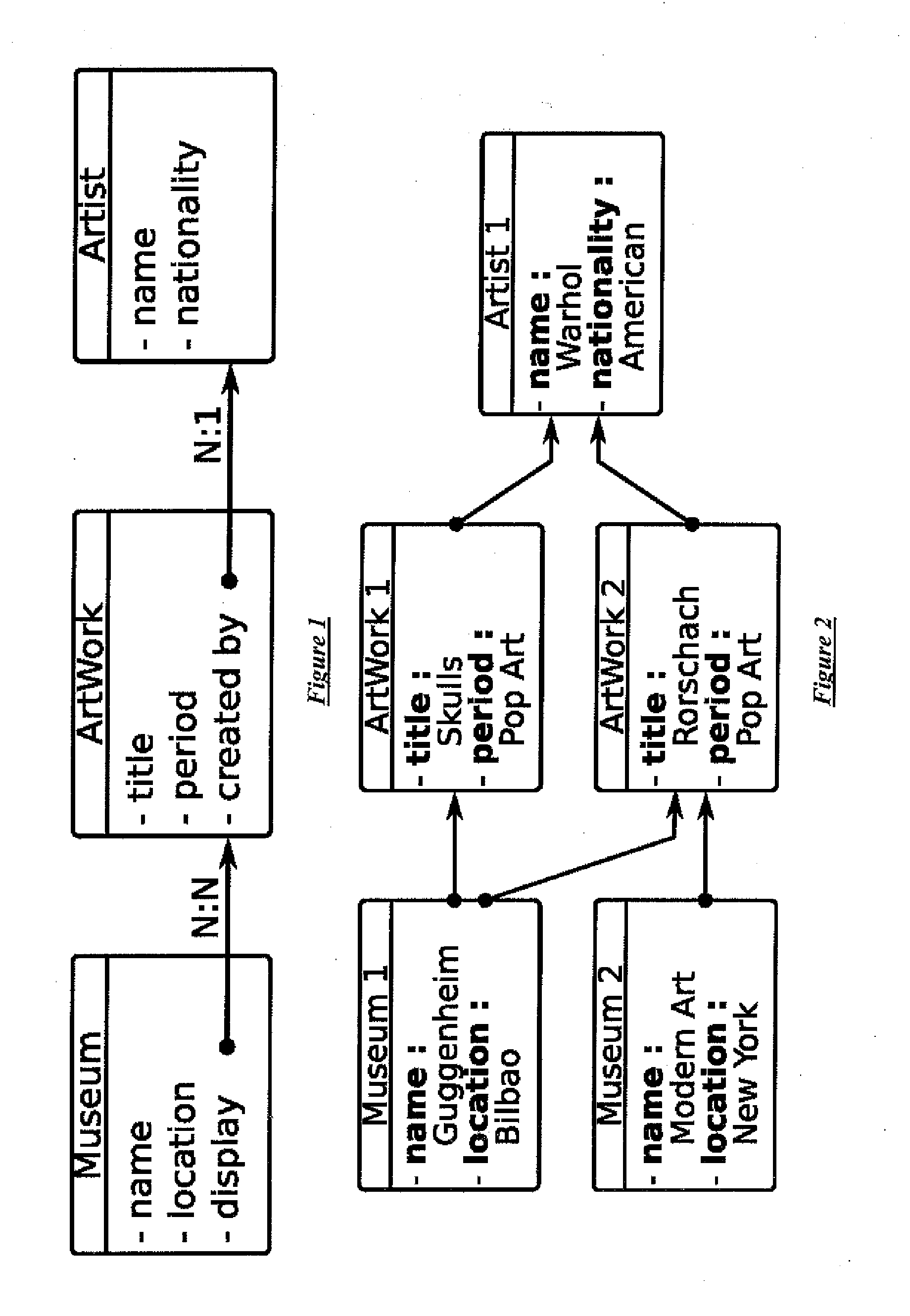
navigation system is that it would not—for example—be possible to perform faceted searching of artworks by artist nationality or by museum location (or both), because this information is not directly comprised in the “artwork” data
record collection.
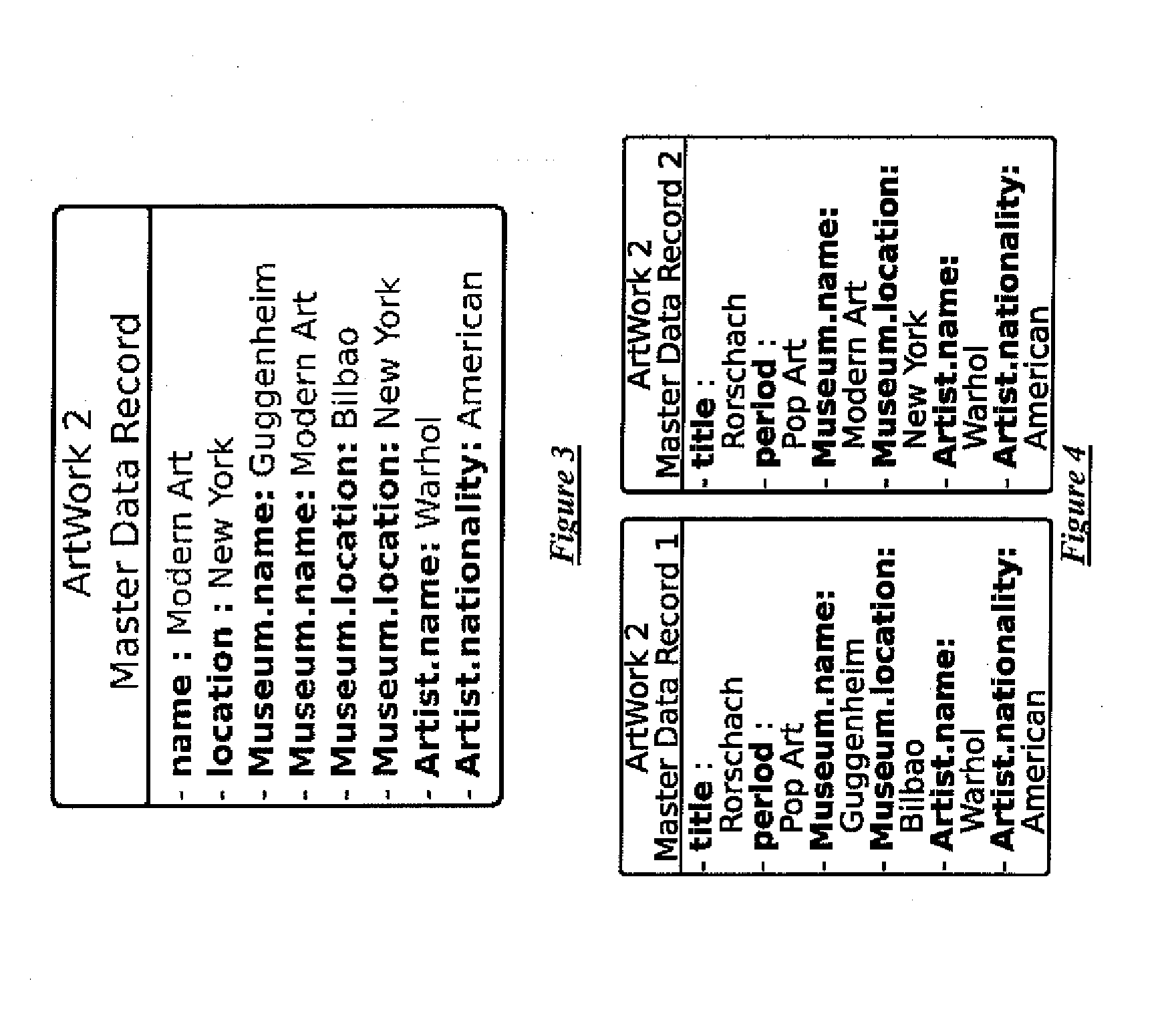
This solution, however, is not practical for large datasets, because each
record in the secondary record collections must be reproduced for every associated record in the primary record collection, leading to a large amount of duplication of information.
In addition, this first
denormalization solution cannot deal in a satisfactory manner with complex interrelationships where a data record has relationships with multiple records in another collection.
While the temptation in such a
scenario would be to “flatten” the dataset by including additional
facet values in each record bearing such multiple relationships, this can lead to the return of false positives during a search.
While this solution overcomes the false positive problem associated with the first denormalization solution, it comes with its own problems.
Firstly, a search for the artwork in question could produce duplicate results in 1:N, N:1 and N:N type relationships.
While this issue could be dealt with by passing search results through a filter to remove duplicates, this filter adds to the overall complexity of the
system.
However, this should not be underestimated, as properly removing a duplicate in the search results can be quite costly.
It should thus be clear that in scenarios where larger data record collections exist with more complex interrelationships between the records in each collection, the
data set produced via the second denormalization solution would increase in size compared to the
source data set by an even higher multiple—it would be unfeasibly and unjustifiably large.
Accordingly, the second denormalization solution is not a scalable solution to the limitations of traditional faceted classification schemes and navigation systems.
Further still, the second denormalization solution would suffer from the additional drawback of losing information concerning the distinction between values of a multi-valued
facet, if it were to be used in conjunction with an
inverted index.
This is because, due to the limitation of traditional attribute-based inverted indices, these values would be dernomalised into one single value through
concatenation.
This is equally an additional drawback of the “first denormalization solution”.
However the problem with this approach is that joining tables is a resource intensive operation both in terms of computing space and
processing power, and this limits the
scalability and performance of the
system.
Furthermore, this operation becomes even more complex with the number of relation types present in the dataset.
The problem—as acknowledged by the authors of this document—is that this approach remains onerous in terms of computational requirements.
As mentioned already, joining tables is an expensive operation both in terms of space (i.e., memory) and time (i.e., CPU), limiting the
scalability and performance of the
system.
The problem increases in complexity with the number of data record types and relation types present in the dataset.



 Login to View More
  Login to View More