Check patentability & draft patents in minutes with Patsnap Eureka AI!

Non-concatenated fec codes for ultra-high speed optical transport networks

Active Publication Date: 2016-10-13
MARVELL ASIA PTE LTD
View PDF0 Cites 9 Cited by
  • Summary
  • Abstract
  • Description
  • Claims
  • Application Information

AI Technical Summary

Benefits of technology

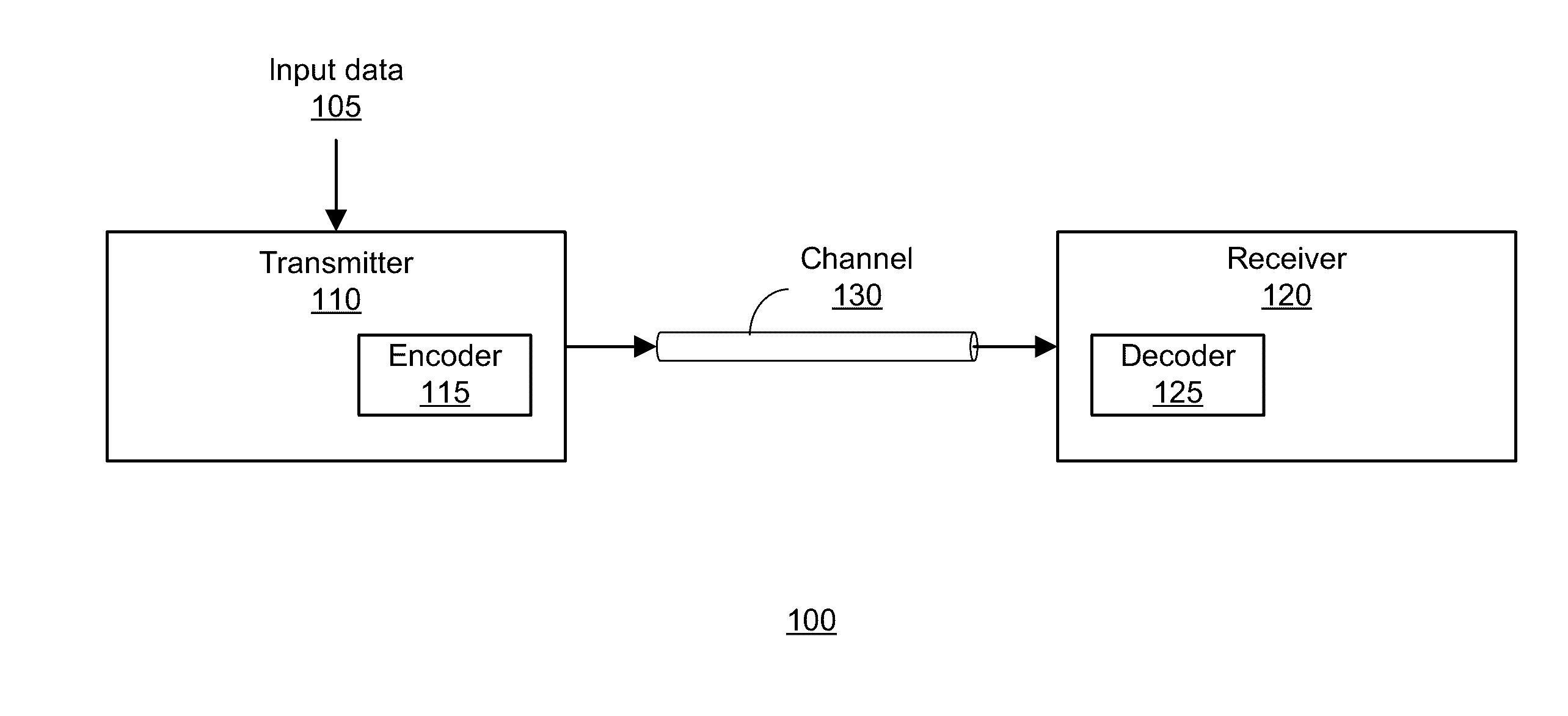
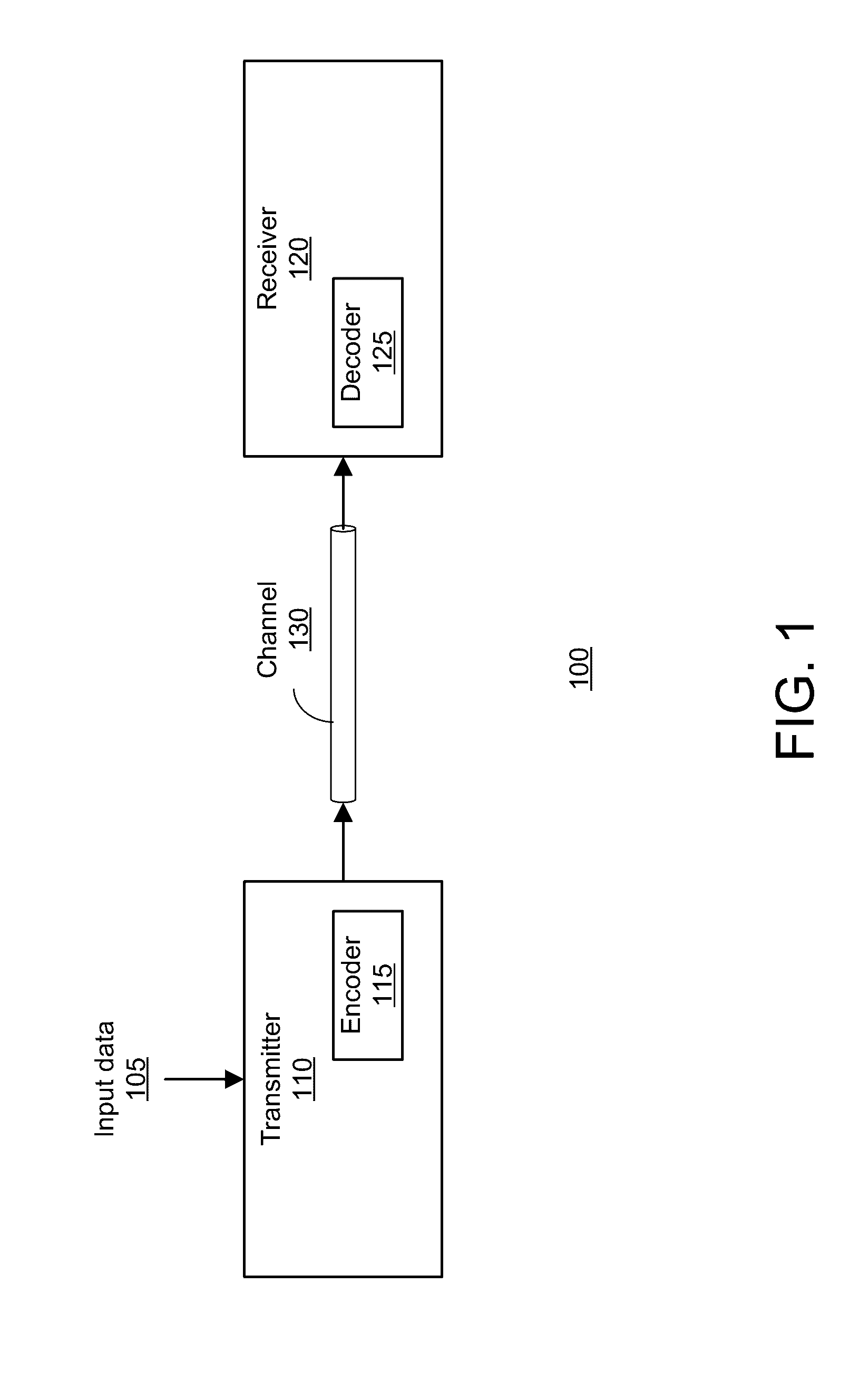
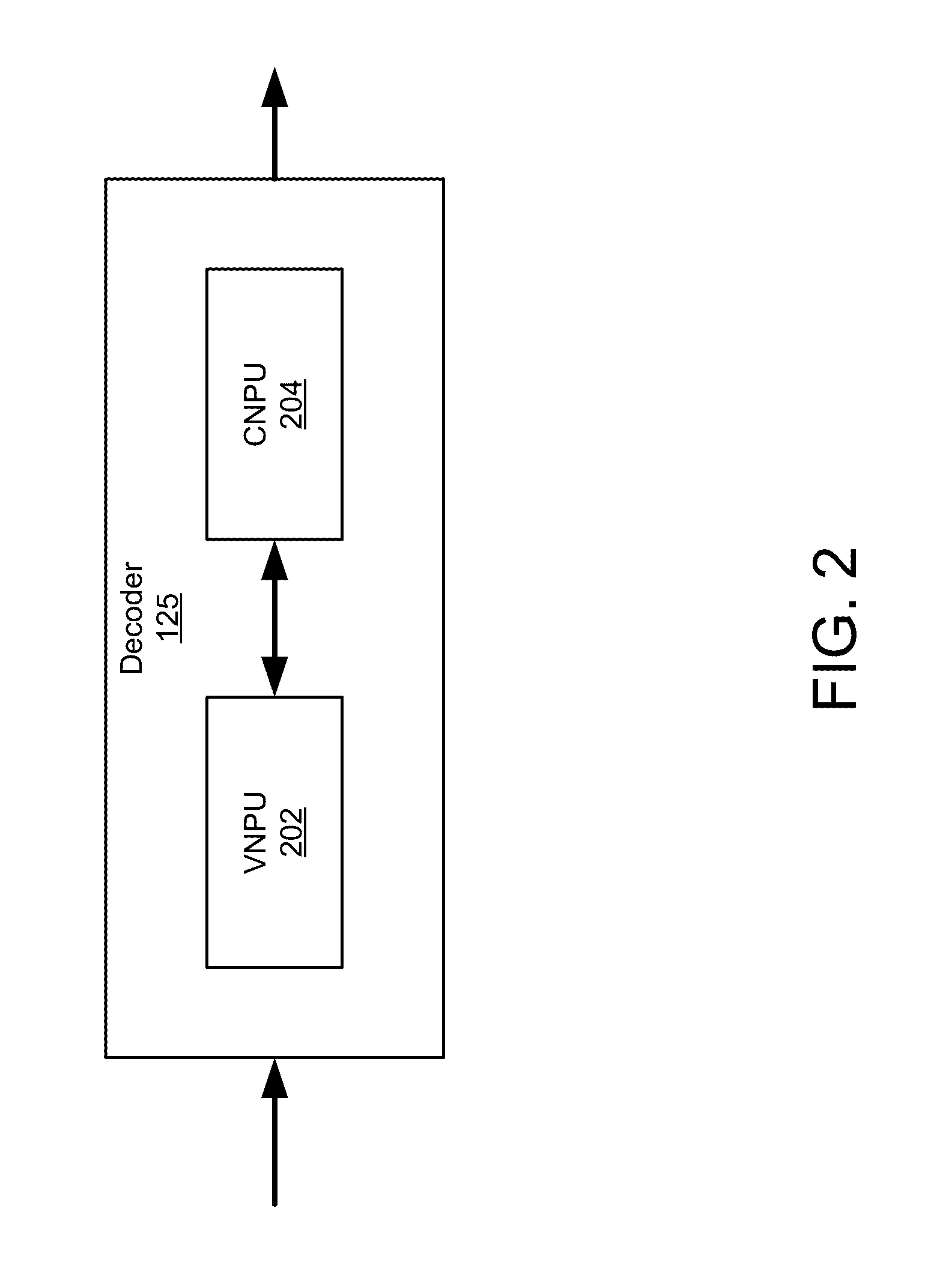
The patent describes a decoder that can correct errors in a data transmission using a matrix with multiple sub-matrices. The decoder has multiple processing units and an output circuit. The processing units each receive a different error correction code and perform a computation to generate output messages. The output circuit then combines these messages to create a decoded code. The decoder can output a code with a smaller effective code dimension by discarding certain symbols. The length of the error correction code can vary, but in one embodiment, it is a power of 2 multiple. The technical effect of this invention is to provide a more efficient and accurate decoder for error correction in data transmission.

Problems solved by technology

The main stumbling block for the application of this coding approach has been the fact that traditional LDPC codes suffer from BER error floors that are undesirably high.
However, this approach increases the overhead and reduces the performance and the spectral efficiency.

Method used

the structure of the environmentally friendly knitted fabric provided by the present invention; figure 2 Flow chart of the yarn wrapping machine for environmentally friendly knitted fabrics and storage devices; image 3 Is the parameter map of the yarn covering machine
View more

Image

Smart Image Click on the blue labels to locate them in the text.
Viewing Examples
Smart Image
  • Non-concatenated fec codes for ultra-high speed optical transport networks
  • Non-concatenated fec codes for ultra-high speed optical transport networks
  • Non-concatenated fec codes for ultra-high speed optical transport networks

Examples

Experimental program
Comparison scheme
Effect test

example performance measurements

[0107]In one embodiment, performance of the LDPC codewords can be evaluated using a combination of analytical tools and simulation (e.g., using a field-programmable gate array or other device). For example, in one embodiment, simulations in the proximity of the low BER region of interest (e.g., ≧10−13) could be used to obtain dominant trapping sets. Based on these trapping sets, BER can be estimated by using importance sampling technique.

[0108]Let ra and re be the number of bits used to represent the prior LLRs and the messages from both check and variables nodes, respectively. In one embodiment, the prior LLRs are quantized (e.g., using ra=5 bits). Furthermore, in one embodiment, the decoder is implemented using re=5 bits. To obtain the perform measures, an all-zeros codeword can be transmitted using binary phase-shift keying (BPSK) modulation (i.e., bits {0, 1} are mapped into symbols {+1, −1} for transmission). An additive white Gaussian noise (AWGN) channel can also be implement...

the structure of the environmentally friendly knitted fabric provided by the present invention; figure 2 Flow chart of the yarn wrapping machine for environmentally friendly knitted fabrics and storage devices; image 3 Is the parameter map of the yarn covering machine
Login to View More

PUM

No PUM Login to View More

Abstract

A decoder performs forward error correction based on quasi-cyclic regular column-partition low density parity check codes. A method for designing the parity check matrix reduces the number of short-cycles of the matrix to increase performance. An adaptive quantization post-processing technique further improves performance by eliminating error floors associated with the decoding. A parallel decoder architecture performs iterative decoding using a parallel pipelined architecture.

Description

RELATED APPLICATIONS[0001]This application is a continuation-in-part of U.S. patent application Ser. No. 15 / 000,978 entitled “Non-Concatenated FEC Codes for Ultra-High Speed Optical Transport Networks” to Damian Alfonso Morero, et al., filed on Jan. 19, 2016, which is a continuation-in-part of U.S. patent application Ser. No. 14 / 561,183 entitled “Non-Concatenated FEC Codes for Ultra-High Speed Optical Transport Networks” to Damian Alfonso Morero, et al. filed on Dec. 4, 2014, which is a divisional of U.S. patent application Ser. No. 13 / 406,452 entitled “Non-Concatenated FEC Codes for Ultra-High Speed Optical Transport Networks” to Damian Alfonso Morero, et al. filed on Feb. 27, 2012 which claims priority under 35 U.S.C. § 119(e) to U.S. Provisional Patent Application Ser. No. 61 / 447,620 entitled “Non-Concatenated FEC Codes for Ultra-High Speed Optical Transport Networks,” filed Feb. 28, 2011 by Damian Morero, et al. U.S. patent application Ser. No. 15 / 000,978 also claims the benefit...

Claims

the structure of the environmentally friendly knitted fabric provided by the present invention; figure 2 Flow chart of the yarn wrapping machine for environmentally friendly knitted fabrics and storage devices; image 3 Is the parameter map of the yarn covering machine
Login to View More

Application Information

Patent Timeline
no application Login to View More
IPC IPC(8): H03M13/11H03M13/00
CPCH03M13/1128H03M13/1131H03M13/616H03M13/112H03M13/1137H03M13/114H03M13/1145H03M13/116H03M13/1168H03M13/1177H03M13/6577
Inventor MORERO, DAMIAN ALFONSOCASTRILLON, MARIO ALEJANDROSCHNIDRIG, MATIAS GERMANHUEDA, MARIO RAFAELPALUDI, FRANCO
Owner MARVELL ASIA PTE LTD
Features
  • R&D
  • Intellectual Property
  • Life Sciences
  • Materials
  • Tech Scout
Why Patsnap Eureka
  • Unparalleled Data Quality
  • Higher Quality Content
  • 60% Fewer Hallucinations
Social media
Patsnap Eureka Blog
Learn More