
Electrochemical cell
- Summary
- Abstract
- Description
- Claims
- Application Information
AI Technical Summary
Benefits of technology
Problems solved by technology
Method used
Image

Examples
first embodiment
[0061]First, a battery 1 according to a first embodiment is explained.
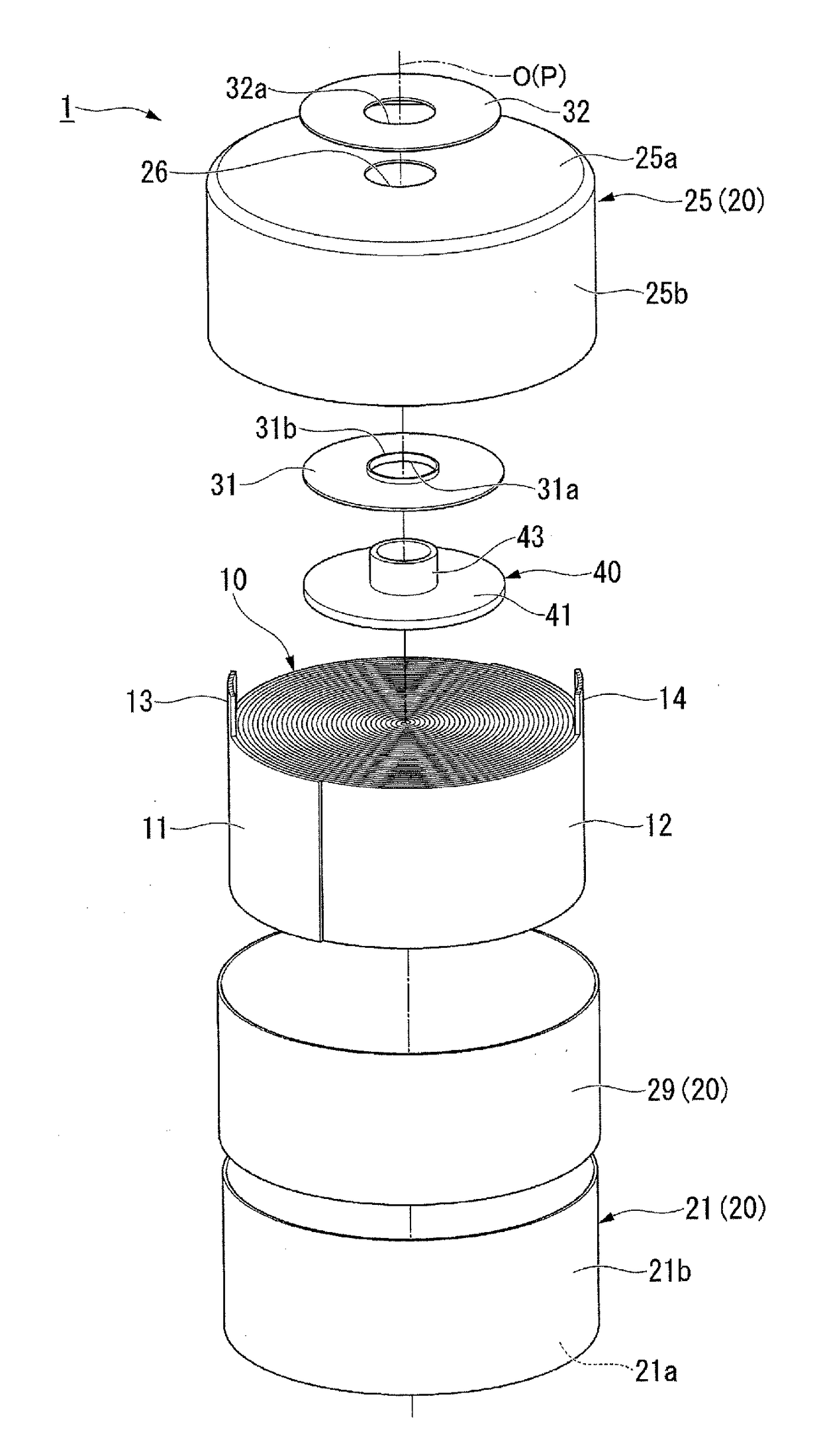
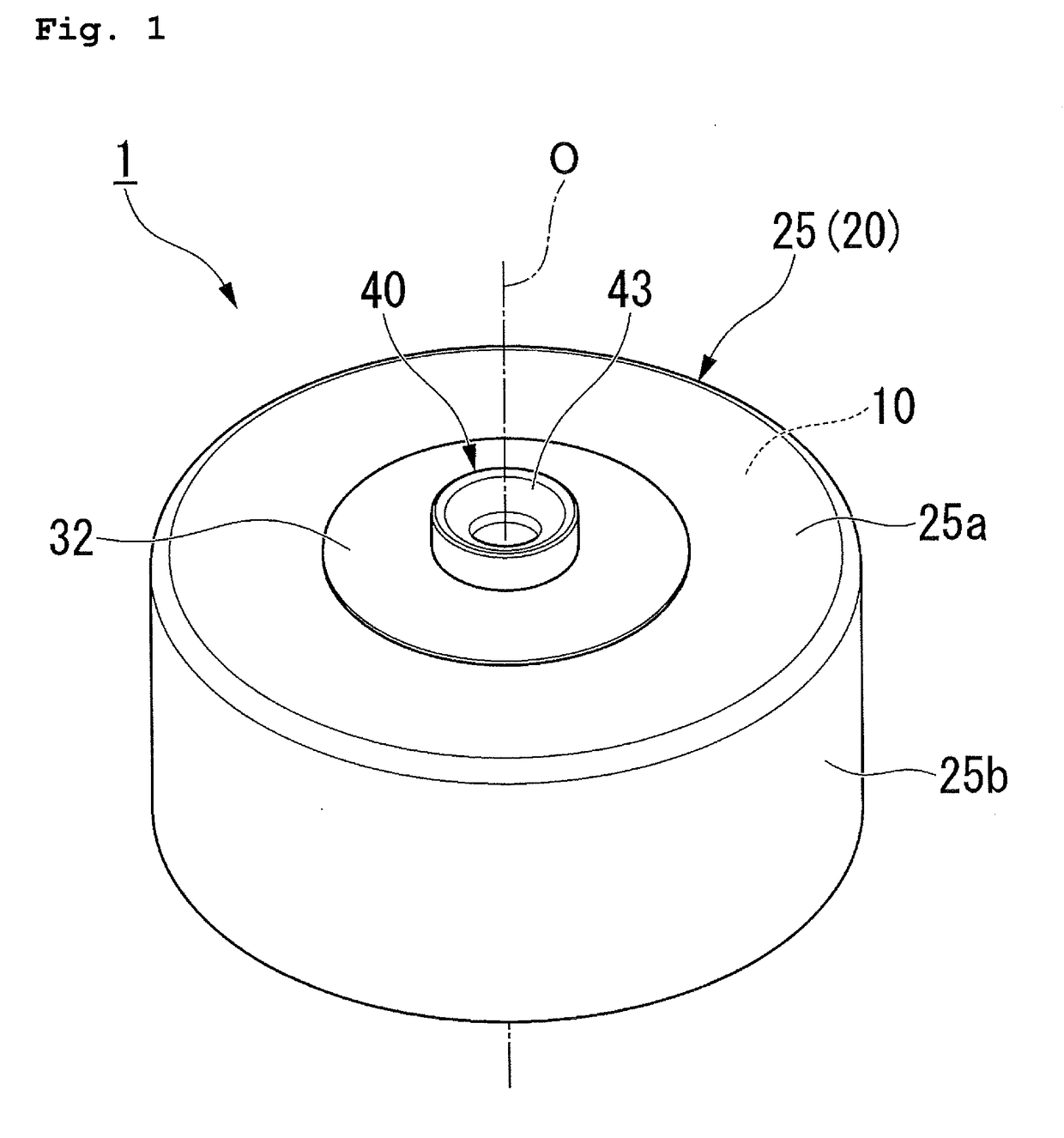
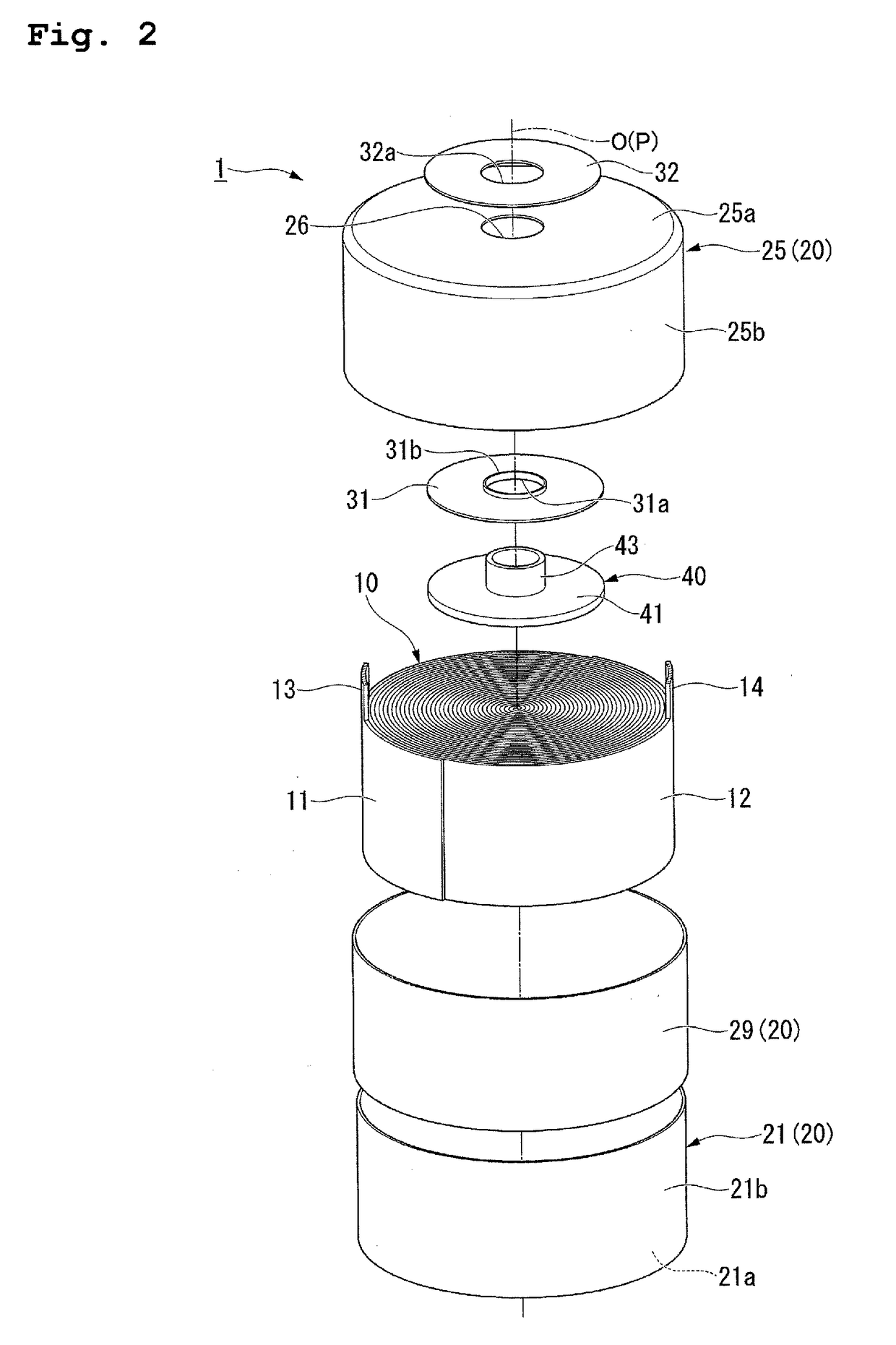
[0062]FIG. 1 is a perspective view of the battery 1 according to the first embodiment. FIG. 2 is an exploded perspective view of the battery 1 according to the first embodiment.
[0063]As shown in FIGS. 1 and 2, the battery 1 is a so-called button-type battery. The battery 1 mainly includes an electrode body 10 including a positive electrode body 11 and a negative electrode body 12 and an exterior body 20 in which the electrode body 10 is housed.
[0064]As shown in FIG. 2, the electrode body 10 is formed in a columnar shape by winding the positive electrode body 11 and the negative electrode body 12, both of which are belt-like, one on top of the other. Specifically, the electrode body 10 has structure in which the belt-like positive electrode body 11 and the belt-like negative electrode body 12 are wound around a winding axis P in a state in which the belt-like positive electrode body 11 and the belt-like negative el...
second embodiment
[0121]A battery 101 according to a second embodiment is explained.
[0122]FIG. 14 is a perspective view of the battery 101 according to the second embodiment.
[0123]In the first embodiment shown in FIGS. 1 and 2, the battery 1 is formed in a so-called button shape. The second embodiment shown in FIG. 14 is different from the first embodiment in that the battery 101 is formed in a so-called cylinder shape. Note that components same as the components in the first embodiment shown in FIGS. 1 and 2 are denoted by the same reference numerals and signs and detailed explanation of the components is omitted (the same applies to embodiments explained below).
[0124]As shown in FIG. 14, a first container 121 is formed such that a dimension in the axial direction is larger than the dimension of the second container 25. The second circumferential wall section 25b of the second container 25 surrounds an opening end portion of a first circumferential wall section 121b of the first container 121. An el...
third embodiment
[0137]A battery 201 according to a third embodiment is explained.
[0138]FIG. 22 is a perspective view of the battery 201 according to the third embodiment.
[0139]In the first embodiment shown in FIGS. 1 and 2, the battery 1 is formed in a so-called button shape. The third embodiment shown in FIG. 22 is different from the first embodiment in that the battery 201 is formed in a so-called coin shape.
[0140]FIG. 23 is an exploded perspective view of an electrode body according to the third embodiment.
[0141]As shown in FIG. 23, an electrode body 210 is configured by alternately stacking a plurality of positive electrode bodies 211 and negative electrode bodies 212 in the axial direction via not-shown separators.
[0142]The positive electrode bodies 211 are formed in a circular shape when viewed from the axial direction. The positive electrode bodies 211 include positive electrode collectors 211a made of circular metal foil and positive electrodes 211b disposed on the surfaces of the positive ...
PUM
 Login to View More
 Abstract
Description
Claims
Application Information
 Login to View More