

Abnormality estimation apparatus
- Summary
- Abstract
- Description
- Claims
- Application Information
AI Technical Summary
Benefits of technology
Problems solved by technology
Method used
Image



Examples
first embodiment
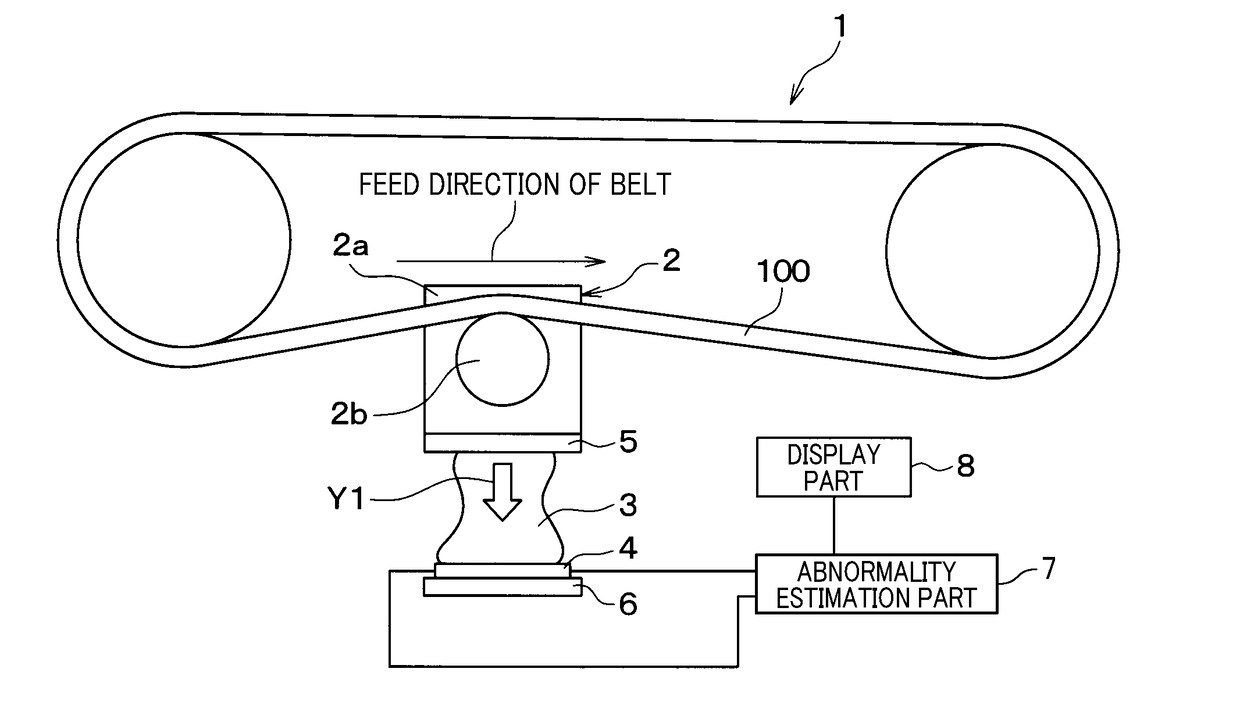
[0029]An abnormality estimation apparatus 1 according to a first embodiment of the invention is described with reference to FIGS. 1 to 6. The abnormality estimation apparatus 1 is an apparatus for estimating an abnormality in a belt 100 of a belt conveyor show in FIG. 1. FIG. 2 is a diagram showing the structure of the abnormality estimation apparatus 1 when the tension of the belt 100 starts to be measured. FIG. 3 is a diagram showing the structure of the abnormality estimation apparatus 1 when the tension of the belt 100 has increased thereafter. The abnormality estimation apparatus 1 includes a displacement part 2, an elastic body 3, a heat flow sensor 4, plate-like members 5 and 6, an abnormality estimation part 7 and a display part 8. The arrow Y1 in FIG. 2 shows the direction of displacement of the elastic body 3 at a time when the tension of the belt 100 has increased.
[0030]As shown in FIGS. 2 and 3, the plate-like member 6, the heat flow sensor 4, the elastic body 3, the pla...
second embodiment
[0059]Next a second embodiment of the invention is described with a focus on differences with the first embodiment referring to FIGS. 7 and 8.
[0060]In FIGS. 7 and 8, the abnormality estimation part 7 and the display part 8 are omitted from illustration. In FIG. 7, the arrow Y2 shows the direction of displacement of the displacement part 2 at a time when the tension of the belt 100 has changed, and the arrow Y3 in FIG. 7 shows the direction of displacement of the elastic body 3 at a time when the tension of the belt 100 has increased.
[0061]The abnormality estimation apparatus 1 of this embodiment includes, in addition to the displacement part 2, the elastic body 3, the heat flow sensor 4, the abnormality estimation part 7 and the display part 8, a case part 9 for supporting the elastic body 3, a support mechanism 10 which causes the case part 9 to support the displacement part 2, a radiator 11, and a plate-like member 12.
[0062]In this embodiment, the displacement part 2 rotates with ...
third embodiment
[0080]Next a third embodiment of the invention is described with a focus on differences with the first embodiment referring to FIGS. 9 and 10.
[0081]In FIGS. 9 and 10, the abnormality estimation part 7 and the display part 8 are omitted from illustration. In FIG. 9, the arrow Y4 shows the direction of displacement of the displacement part 2 at a time when the tension of the belt 100 has changed, and the arrows Y5 to Y8 show the directions of displacement of the elastic body 3 at a time when the tension of the belt 100 has increased.
[0082]In this embodiment, the displacement part 2 includes the proximal portion 2c and the roller portion 2d. As shown in FIGS. 9 and 10, the proximal portion 2c of the displacement part 2 includes a rod-shaped portion 2ca formed with the roller portion 2d at one distal end thereof and formed with a polyhedral portion 2cb at the other distal end thereof. In this embodiment, the polyhedral portion 2cb of the displacement part 2 has a cubic shape. The rod-sh...
PUM
 Login to View More
 Abstract
Description
Claims
Application Information
 Login to View More