
Polyolefin Pipe
a polyolefin pipe and polymer technology, applied in the field of polymer pipes, can solve the problems of pipe leakage, degradation products, crosslinking by-products, pipe leakage, etc., and achieve the effect of reducing the level of leaching of chemical residues and reducing the leaching
- Summary
- Abstract
- Description
- Claims
- Application Information
AI Technical Summary
Benefits of technology
Problems solved by technology
Method used
Image

Examples
example 1
Formulation
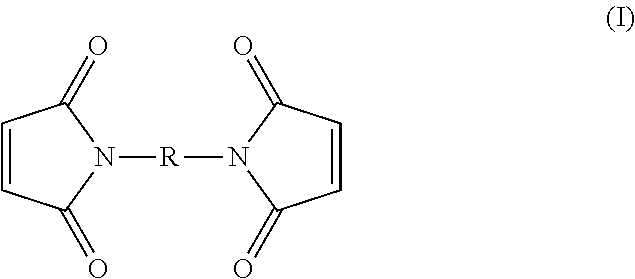
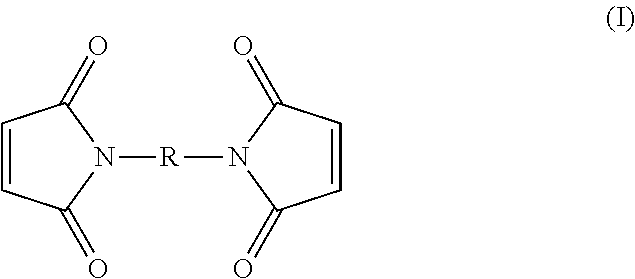
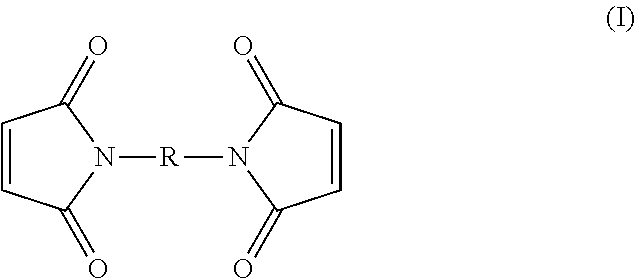
[0079]A pipe was made from polyethylene Borealis 1878E, with the formulation comprising hexamethylene-1,6-dimaleimide (CAS 4856-87-5) in an amount of 1.75% weight.
[0080]The formulation was carefully dry mixed in a blender / mixer prior being inserted into the extruder. The pipe was processed using a Weber DS7 twin screw extruder. The heating up of the pipe, for activating the crosslinking process, was made using an IR oven, located directly after the extruder. The extrusion was run at 75 kg / h, producing a 20*2.8 mm pipe.
Results
[0081]A cross-linked pipe was made. The chemical crosslinking level was 60.5%.
[0082]TOC at room temperature, when measured in accordance with the KTW Guideline and EN 1484: 1.3 (≦2.5 requirement).
[0083]Taste and odour at 60° C., when measured in accordance with the KTW Guideline: 2-4 (requirement ≦4).
[0084]This formulation therefore meets TOC at room temperature and taste and odour requirements. In contrast, for a PEX-a or a PEX-b pipe a pos...
example 2
[0085]The procedure of Example 1 was repeated, but with the formulation comprising hexamethylene-1,6-dimaleimide (CAS 4856-87-5) in an amount of 2.0% weight. The chemical crosslinking level was the same as the chemical crosslinking level obtained in Example 1 (60.5%).
PUM
| Property | Measurement | Unit |
|---|---|---|
| degree of crosslinking | aaaaa | aaaaa |
| degree of crosslinking | aaaaa | aaaaa |
| degree of crosslinking | aaaaa | aaaaa |
Abstract
Description
Claims
Application Information
 Login to View More