

Electronic apparatus, restarting method, and non-transitory recording medium
a technology of electronic equipment and recording medium, which is applied in the direction of instruments, error detection/correction, computing, etc., can solve the problem that the normal end will be damaged in the futur
- Summary
- Abstract
- Description
- Claims
- Application Information
AI Technical Summary
Benefits of technology
Problems solved by technology
Method used
Image



Examples
first embodiment
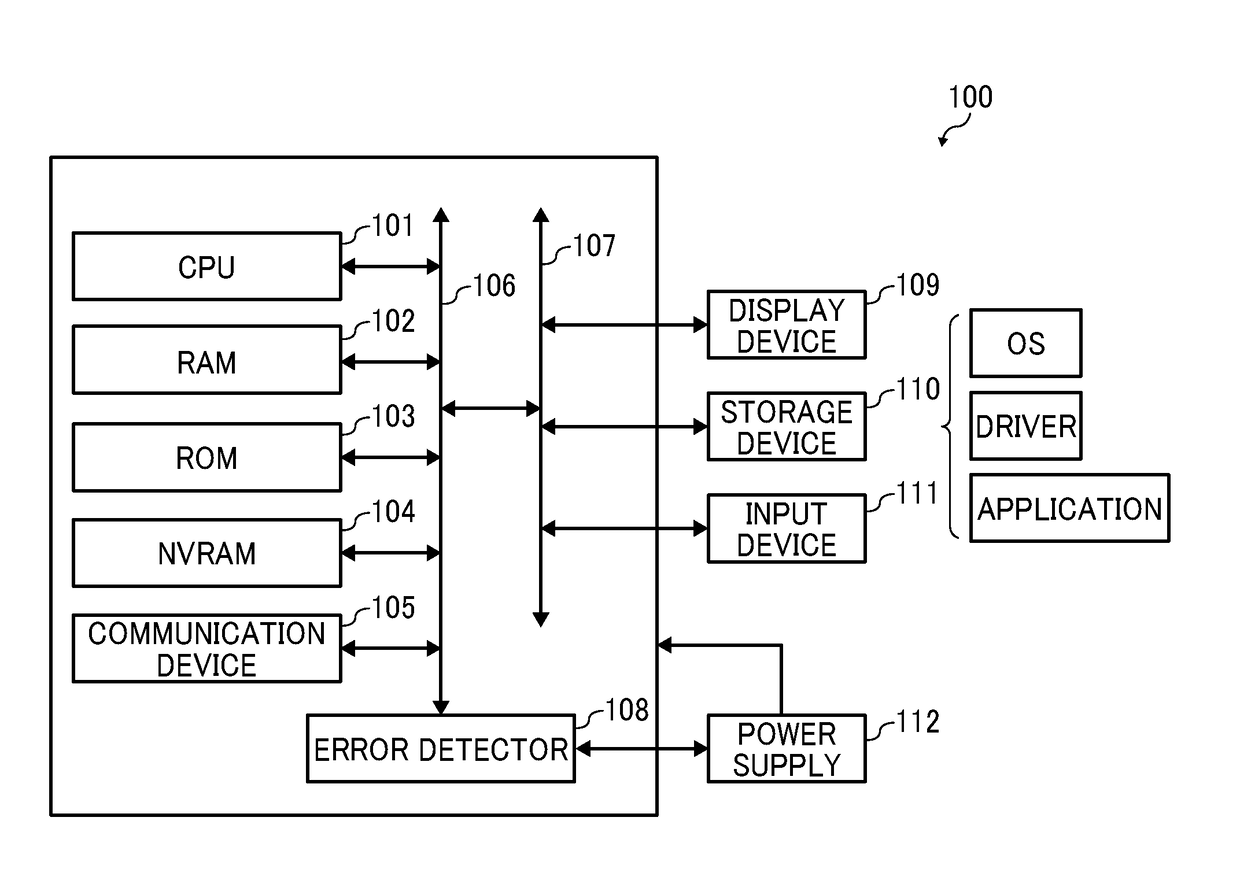
[0031]Hereinafter, while embodiments of the present disclosure will be described, the present disclosure is not limited to the embodiments to be described below. FIG. 1 illustrates the hardware blocks of an electronic apparatus 100 according to this embodiment. The electronic apparatus 100 illustrated in FIG. 1 will be described as an information processing apparatus, an image forming apparatus, an embedded apparatus, an in-vehicle apparatus, or an apparatus that can electronically and electrically operated using LSI. The electronic apparatus 100 according to this embodiment includes a CPU 101, a random access memory (RAM) 102, a read-only memory (ROM) 103, and a non-volatile random access memory (NVRAM) 104.
[0032]In this embodiment, the CPU 101 is a multi-core processor and executes a plurality of programs in parallel under operating systems that are independent for each CPU core. The RAM 102 reads a program called an operating system (OS) and provides an execution space required f...
second embodiment
[0067]Here, a second embodiment will be described. In the first embodiment, a form for solving a case where a fatal error of the CPU core occurs, and the CPU core in which the error has occurred cannot perform a subsequent process has been described. The second embodiment to be described below has a form in which, in a state in which a CPU core is sound, in a case where an error or a failure occurs in an application operating on the core, by resetting the CPU 101 to avoid a CPU error or an abnormal operation of the system in the future, recovery from the error state is performed.
[0068]FIG. 8 is a diagram illustrating functional blocks 800 of software mounted to a CPU 101 according to the second embodiment. The functional blocks illustrated in FIG. 8 are realized as functional units on the CPU 101 as the CPU 101 executes software. In the embodiment illustrated in FIG. 8, while a core 201 is described to operate RTOS as an OS-1, and a core 202 is described to operate LINUX (registered...
third embodiment
[0109]Hereinafter, a third embodiment will be described. In the second embodiment, as described with reference to FIG. 12, a full-size OS including an abnormality detecting mechanism such as UNIX (registered trademark) determines whether or not a failure such as a fault process has occurred in an application program and performs restarting in a case where a failure is determined to have occurred. In other words, in a case where an application program abnormally ends, the OS receives a notification from an application program for each type of abnormality and determines the occurrence of a failure based on the notification.
[0110]However, even when an application program does not abnormally ends, there are cases where an unrecoverable problem is caused, and system restarting is required. For example, there is a case where, in a main body of an apparatus such as a multi-function peripheral (MFP) including the main body and an operator, communication with the operator is disconnected. In...
PUM
 Login to View More
 Abstract
Description
Claims
Application Information
 Login to View More