Compositions and methods for HIV quasi-species excision from HIV-1-infected patients
a quasi-species and patient technology, applied in the field of compositions and methods for excision of hiv1infected patients, can solve the problems of vqs) affecting the development of a cure, cytotoxic t lymphocytes (ctls) immune response is not robust enough to eliminate infected cells, and the type of therapeutic approach has several limitations
- Summary
- Abstract
- Description
- Claims
- Application Information
AI Technical Summary
Benefits of technology
Problems solved by technology
Method used
Image

Examples
example 1
HIV Quasi-Species Excision Utilizing CRISPR / Cas9 Technology
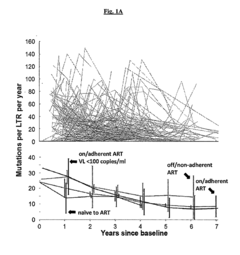
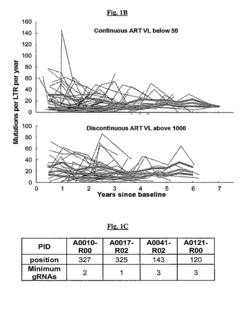
[0161]The sequence analyses from HIV-1-infected patients enrolled in the Drexel Medicine CNS AIDS Research and Eradication Study (CARES) Cohort (Li, et al., 2011, J. Neurovirol. 17:92-109) showed that the predominant sequence of the LTR from integrated provirus from PBMCs exhibited a decrease in the number of variations per year regardless of type of therapy (FIG. 1A). However, the virus still underwent continued genetic change of the predominant genotype in these cells for at least 6 years while on effective suppressive ART, with a constant median of 10-20 unique mutations per year throughout the entire LTR (FIG. 1B).
[0162]Given these results, the use of next-generation sequencing is essential to determine all of the viral quasi-species (vQS) present in a well-controlled patient's reservoir. This approach allows designing gRNA regimen that eliminate, with excision therapy, all vQS present. This eliminates the need to unders...
example 2
Designing gRNAs from the Drexel Medicine CARES Cohort Patients and Measuring their Effectiveness on Additional CARES Cohort Patient Samples and Samples from the National NeuroAlDS Tissue Consortium (NNTC) Texas Collection Site
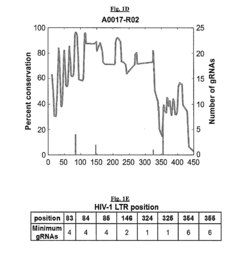
[0170]Illumina next generation sequencing (NGS) was performed on genomic DNA isolated from PBMCs of 264 samples from 168 unique patients in the Drexel Medicine CARES cohort and 5 samples from 3 patients in the NNTC cohort to gain an appreciation for the conservation of the HIV-1 LTR and number of gRNAs potentially needed to target all known quasi-species. From the 264 PBMC samples, 100 were randomly selected to comprise the training dataset and the other 164 were held out to function as a testing dataset.
[0171]Solely using data from the 100 training samples gRNAs were determined by finding all segments of the LTR sequences ending in GG resulting in over 4.65 million possibilities. Each of these were then rescanned against the 100 training samples to determine t...
example 3
Measuring the Effectiveness of Previously Described gRNAs Against the Drexel Medicine CARES Cohort Patient Samples
[0174]Assessing how well a package of gRNAs cleaves a set of patients is one of the first steps associated with determining its effectiveness as a potential therapy. In order to do this two gRNAs from a previous study (termed A and B; Hu, et al., 2014, Proc. Nat. Acad. Sci. USA 111(31):11461-11466, see also PCT / US2014 / 053441) were compared to the patient samples from the Drexel Medicine CARES cohort. The computational evaluation was performed using the gRNAs A and B as inputs and compared to the 269 NGS samples as described previously.
[0175]NGS reads were aligned to the HXB2 genome using the BWA aligner and those falling within the LTR region were kept. Those reads that overlap the regions expected to be cut by gRNAs A and B were checked for cleavage efficiency using the method described in Hsu, et al., 2013, Nature Biotech. 31:827-832. The fraction of reads having at le...
PUM
| Property | Measurement | Unit |
|---|---|---|
| Composition | aaaaa | aaaaa |
| Strain point | aaaaa | aaaaa |
Abstract
Description
Claims
Application Information
 Login to View More