Unlock instant, AI-driven research and patent intelligence for your innovation.

End-to-end transparent clocks and methods of estimating skew in end-to-end transparent clocks

a technology of transparent clocks and transparent clocks, applied in time-division multiplex, multiplex communication, electrical devices, etc., can solve the problems of inability to apply over networks (even ethernet), affecting the quality of synchronization of slave devices, and inaccurate residence time measurements

Active Publication Date: 2020-01-16
BRITISH TELECOMM PLC +2
View PDF0 Cites 5 Cited by
  • Summary
  • Abstract
  • Description
  • Claims
  • Application Information

AI Technical Summary

Benefits of technology

The invention provides a method and device for estimating the skew of a local clock in a network between a master device and a slave device using a transparent clock device. The method involves exchanging timing messages between the master device and the slave device, recording the times of sending and receiving of the messages, and extracting the times of the messages in other transparent clock devices between the master device and the transparent clock device. The device includes a local clock and a processor that extracts the times of sending and receiving of timing messages, records the times of receipt and re-transmission, and estimates the skew of the local clock compared to the master clock using a plurality of recorded times. The technical effect of the invention is to improve the accuracy and reliability of timing in networked systems.

Problems solved by technology

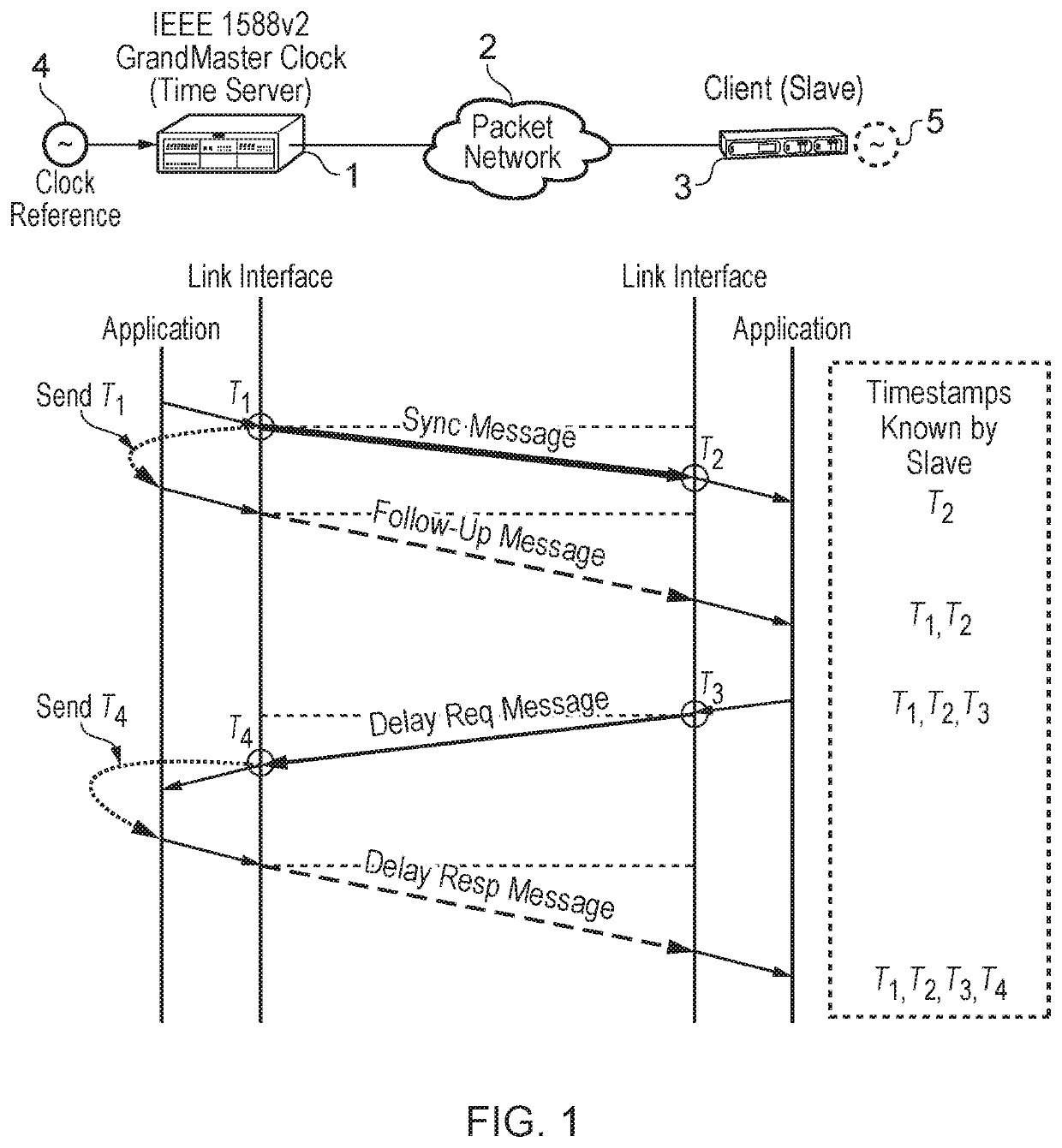
This variation in delay and any asymmetry affects the quality of synchronization of the slave device.
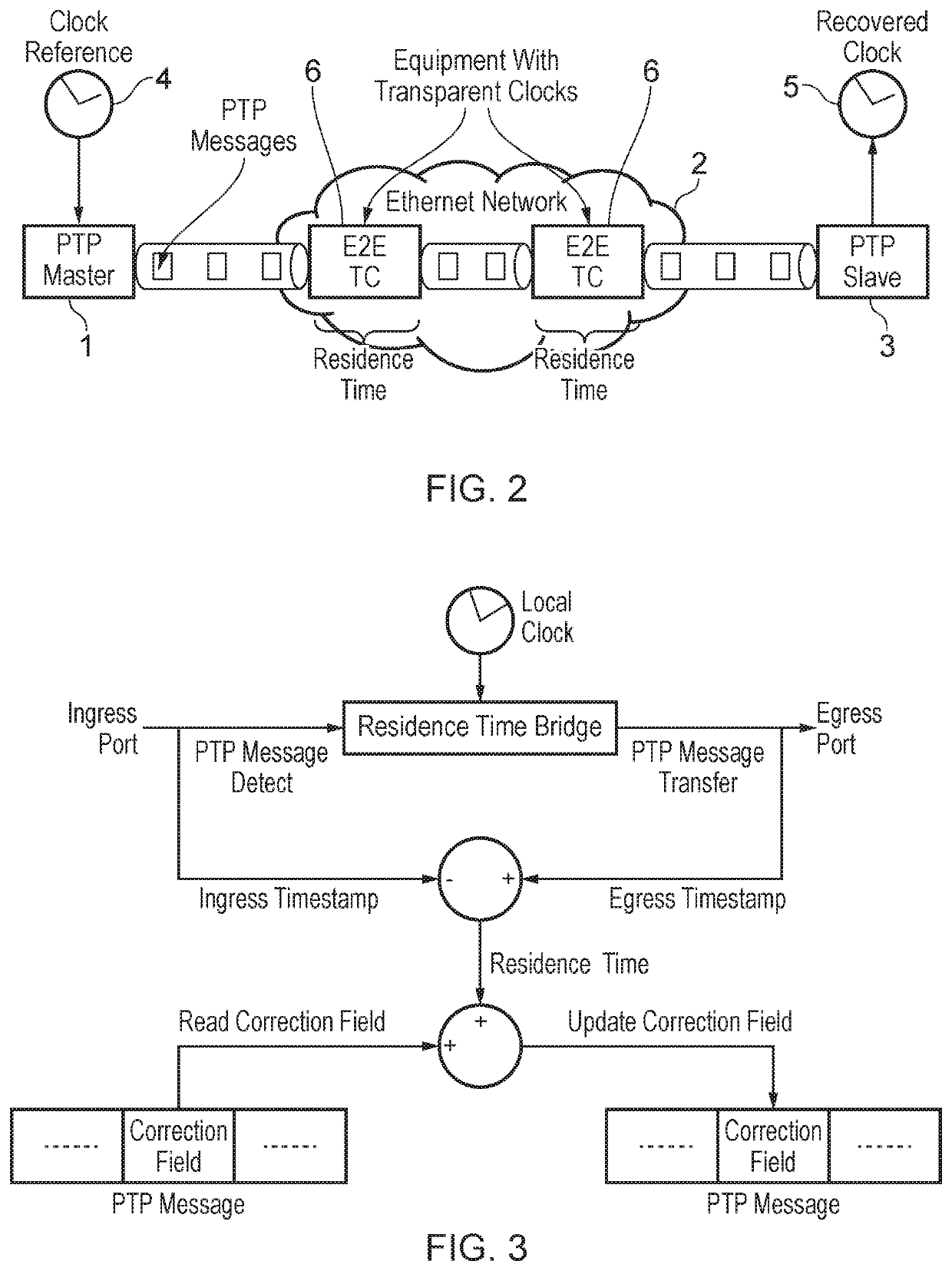
However, the clock skews (or frequency differences) between the clocks at the TCs on the path and the GrandMaster can render the residence time measurements inaccurate.
The main limitation of this method is that it cannot be applied over networks (even Ethernet) which have already been deployed without such timing transfer capabilities.
The syntonization signal can be used to physically tune the TC oscillator or modify the measured residence times. The example methods described in the IEEE 1588 Version 2 Standard for generating the syntonization signals are very simplistic (using Sync messages only and simple linear estimation techniques) such that they do not provide accurate syntonization.
E2E transparent clocks do not provide correction for the propagation delay of the link itself between devices; only P2P TCs support this.
However, a positive effect is that oscillators do not typically operate at the extreme ends of their accuracy limits.

Method used

the structure of the environmentally friendly knitted fabric provided by the present invention; figure 2 Flow chart of the yarn wrapping machine for environmentally friendly knitted fabrics and storage devices; image 3 Is the parameter map of the yarn covering machine
View more

Image

Smart Image Click on the blue labels to locate them in the text.
Viewing Examples
Smart Image
  • End-to-end transparent clocks and methods of estimating skew in end-to-end transparent clocks
  • End-to-end transparent clocks and methods of estimating skew in end-to-end transparent clocks
  • End-to-end transparent clocks and methods of estimating skew in end-to-end transparent clocks

Examples

Experimental program
Comparison scheme
Effect test

Embodiment Construction

[0047]At their broadest, aspects of the present invention provide for methods and systems for estimating the skew of a local clock in an end-to-end transparent clock device using information from timing messages passing between a master and slave device through that transparent clock device.

[0048]A first aspect of the present invention provides a method of estimating the skew of a local clock in an end-to-end transparent clock device connected in a network between a master device having a master clock and a slave device, the method including the steps of: exchanging timing messages between the master device and the slave device over the network, the timing messages passing through said transparent clock device; recording times of sending and receiving of said timing messages by the master device; extracting, in the transparent clock device, from timing messages sent from the master device to the slave device, the times of sending and receiving of said timing messages; recording the ...

the structure of the environmentally friendly knitted fabric provided by the present invention; figure 2 Flow chart of the yarn wrapping machine for environmentally friendly knitted fabrics and storage devices; image 3 Is the parameter map of the yarn covering machine
Login to View More

PUM

No PUM Login to View More

Abstract

This invention relates to end-to-end transparent clocks and methods of estimating skew in end-to-end transparent clocks. Embodiments of the invention relate to techniques for estimating clock skew between a free-running clock in a transparent clock and a master clock, in particular by using the timing information embedded in timing messages passing through the transparent clock. Further embodiments of the invention set out uses of these estimates to modify the residence times computed by the transparent clock and a synchronization network including such transparent clocks.

Description

FIELD OF THE INVENTION[0001]The present invention relates to end-to-end transparent clocks and methods of estimating skew in end-to-end transparent clocks. It is particularly, but not exclusively, concerned with techniques for estimating clock skew between a free-running clock in a transparent clock and a master clock.BACKGROUND OF THE INVENTION[0002]IEEE1588 PTP is a time and frequency transfer protocol wherein a GrandMaster clock is synchronized to a high-quality source such as GPS and then generates packets with precise timestamps that are sent downstream to slave devices. A slave device uses these timestamps (which can be obtained through various PTP message exchange mechanisms) to derive, locally, an accurate estimate of the GM clock. The recovered GM clock at the slave is in turn supplied to equipment requiring synchronization.[0003]The devices between the GM and slave clocks may be ordinary switches and routers, or specialized equipment with on-path support, such as Transpare...

Claims

the structure of the environmentally friendly knitted fabric provided by the present invention; figure 2 Flow chart of the yarn wrapping machine for environmentally friendly knitted fabrics and storage devices; image 3 Is the parameter map of the yarn covering machine
Login to View More

Application Information

Patent Timeline
no application Login to View More
IPC IPC(8): H04J3/06
CPCH04J3/0644H04J3/0661H04J3/0667H04J3/0673
Inventor AWEYA, JAMES
Owner BRITISH TELECOMM PLC