Unlock instant, AI-driven research and patent intelligence for your innovation.

Steerable instrument comprising a detachable part

a technology of detachable parts and instruments, applied in the field of telescopes, can solve the problems of inconvenient connection and disconnection of instruments, poor plasticity of most plastics, and high cost, and achieve the effect of convenient connection and disconnection, and easy connection of instruments

Pending Publication Date: 2022-06-02
FORTIMEDIX ASSETS II BV
View PDF0 Cites 0 Cited by
  • Summary
  • Abstract
  • Description
  • Claims
  • Application Information

AI Technical Summary

Benefits of technology

The invention is a steering device for medical or other operations. It allows for easy coupling and decoupling of an instrument for these operations. It uses longitudinal elements for steering purposes, which can be controlled by the steering unit for bending and movement at the distal end of the instrument. This allows for easy connection and disconnection of the instrument from the steering device, making it quick, secure, and easily coupled. The connecting parts of the instrument are designed with an opening to facilitate easy connection and disconnection. This simplifies the process and makes it easier for non-technical persons to couple the instrument to the steering device. The instrument can be disposable while the steering device and its parts are reusable. Overall, this steering device simplifies the connection process and improves operational efficiency.

Problems solved by technology

Most of the known instruments are complex to manufacture resulting in expensive instruments.
However, most plastics are rather weak.
In case of very long instruments, e.g. longer than 1 meter, therefore, problems may arise due to the high forces exerted on the cables, both the steering cables and the actuation cable arranged to operate the tool at the distal end of the instrument.
Problems may be undesired cuts, slip stick effects in the plastic tube and often a too high friction on the cables causing steering by the steering cables to be difficult and hard to manage.
Moreover, mechanical properties of many plastics may be too poor to guarantee a high enough torsion stiffness which is required because the instruments should be capable of being rotated in use where they may have been guided through several curves impeding rotation of the whole instrument.
Another disadvantage of a plastic tube may be that in case it is provided with an actuation cable to operate a tool at the distal end of the instrument the force in the actuation cable can increase to an extent that it exceeds the maximum longitudinal force allowed in the extruded plastic tube.
If so, it would be impossible to operate the tool with an acceptable force.
Moreover, if the plastic tube is in a curved arrangement and high force is exerted on the actuation cable, the channels for the steering cables may be deformed, especially in bent / deflected portions, such that the steering cables are clamped and cannot move freely anymore in the channels, thus, impeding proper operation of the steering of the distal deflectable zones.
In medical applications, contamination of an instrument after it has been used to perform a surgical procedure on a patient can be a problem resulting in undesired post-operative complications.
As a consequence of the contamination, the instrument may contain germs, viruses or other biological or chemical substances that could threat the health of the next patient on which the instrument is used.
In many cases, the cleaning process is not capable of removing all contamination, and / or is very expensive.
Therefore, a risk of adverse effects on a patient that is treated with such an instrument still exists.
Moreover, separate features of different embodiments can be combined, even if not explicitly shown in the drawings or explained in the specification, unless such combination is physically impossible.

Method used

the structure of the environmentally friendly knitted fabric provided by the present invention; figure 2 Flow chart of the yarn wrapping machine for environmentally friendly knitted fabrics and storage devices; image 3 Is the parameter map of the yarn covering machine
View more

Image

Smart Image Click on the blue labels to locate them in the text.
Viewing Examples
Smart Image
  • Steerable instrument comprising a detachable part
  • Steerable instrument comprising a detachable part
  • Steerable instrument comprising a detachable part

Examples

Experimental program
Comparison scheme
Effect test

Embodiment Construction

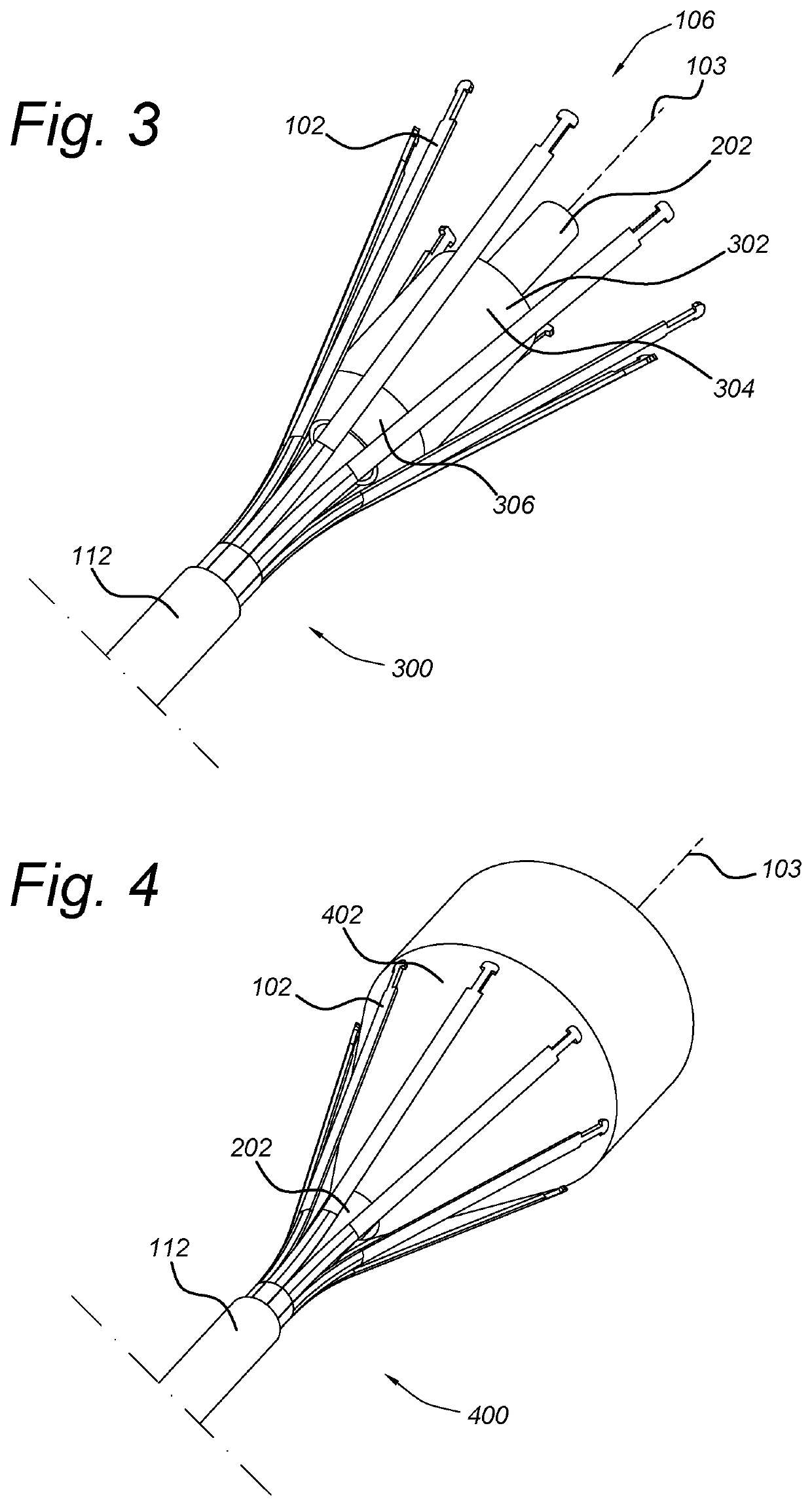
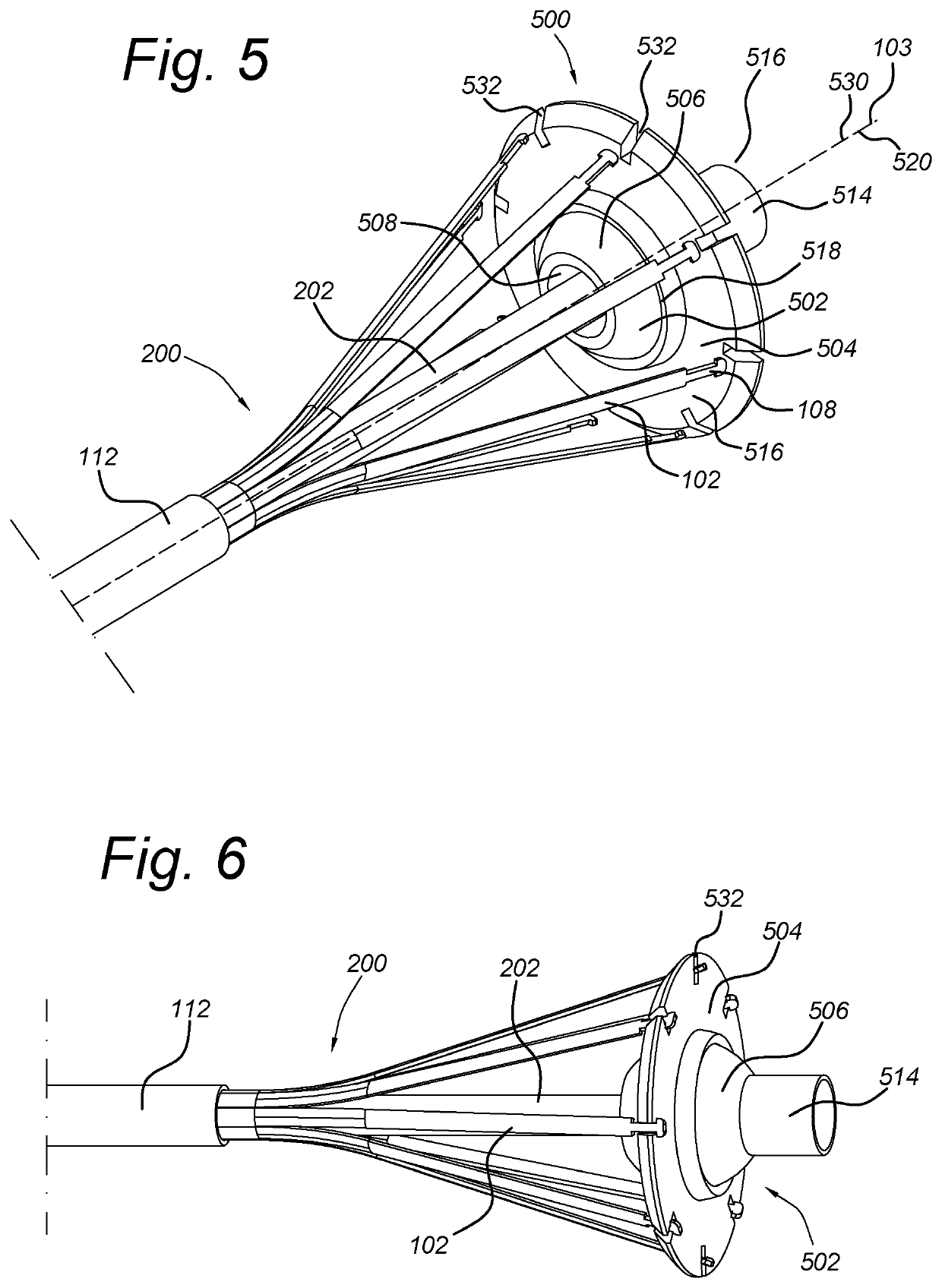
[0040]Same reference number will be used in different figures for indicating the same element.

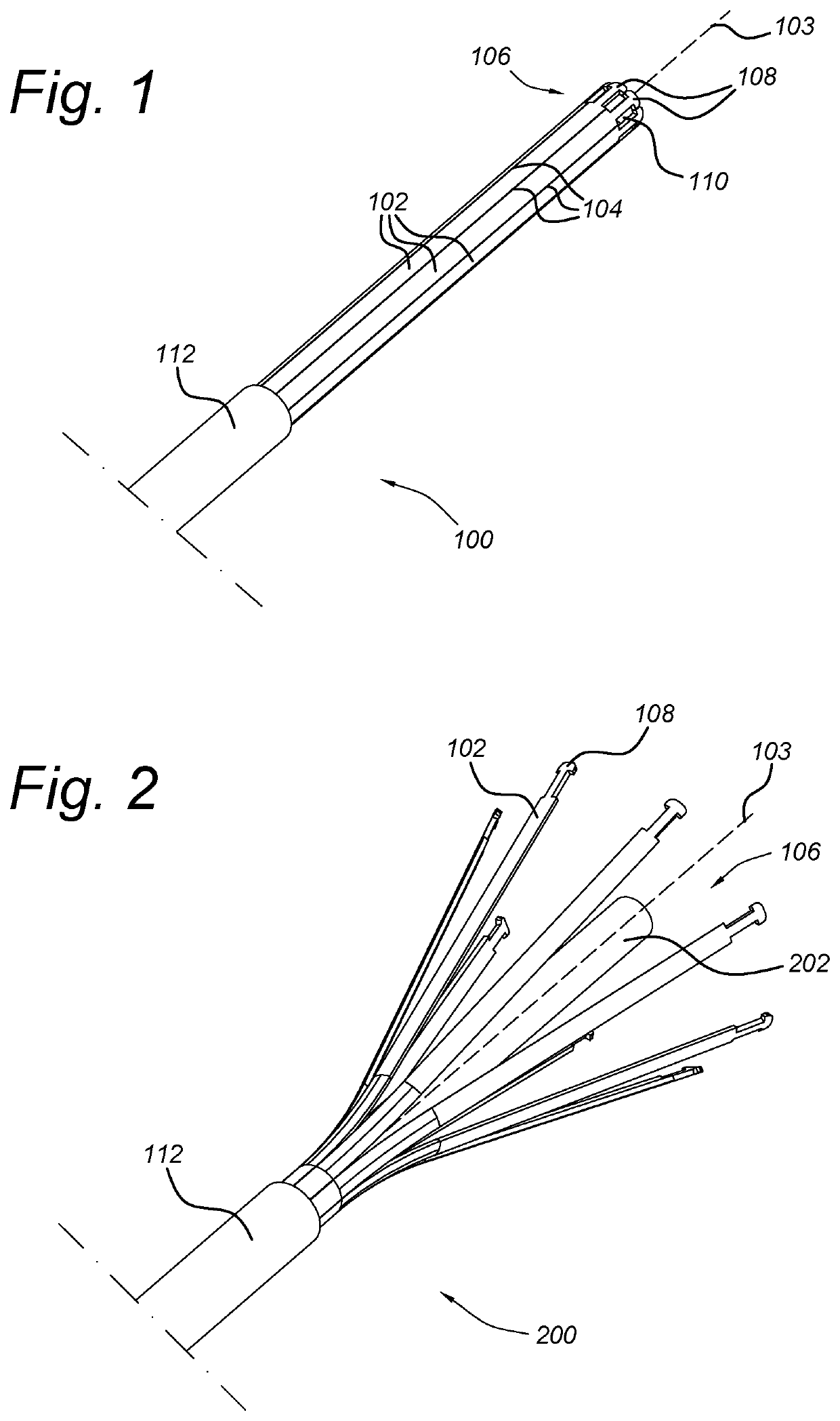
[0041]FIG. 1 shows a non limiting embodiment of an instrument 100 comprising a plurality of longitudinal elements 102 arranged around a central axis 103 of the instrument 100. Instrument 100 is shown schematically to represent any steerable instrument for use in medical or other operations. Suitable instrument arrangements can be found in NL2021823, titled Steerable instrument comprising a tube element, Filed on Oct. 16, 2018 and hereby incorporated by reference. The longitudinal elements 102 shown in FIG. 1 are implemented by longitudinal strip shaped elements in tube elements and separated by longitudinal slots 104 resulting from laser cutting in the cylindrical tube, as explained in detail in, for example, WO 2009 / 112060 A1, WO 2009 / 127236 A1, WO 2017 / 213491 A1, and WO 2018 / 067004, or by rigid cables or wires.

[0042]These longitudinal slots 104 extend through the whole thickness of the ma...

the structure of the environmentally friendly knitted fabric provided by the present invention; figure 2 Flow chart of the yarn wrapping machine for environmentally friendly knitted fabrics and storage devices; image 3 Is the parameter map of the yarn covering machine
Login to View More

PUM

No PUM Login to View More

Abstract

A steering device for connecting to an elongated instrument comprises a supporting unit comprising a first channel having a first central axis, said first channel extending from a distal side to a proximal side of the supporting unit, wherein the supporting unit is arranged around said first channel, and a steering unit rotationally arranged on said supporting unit, the steering unit arranged to secure / release a plurality of longitudinal elements of an instrument to move with the rotational movement of the steering unit.

Description

FIELD OF THE INVENTION[0001]The present invention relates to a steerable instrument for invasive and non-invasive type of applications, such as in surgery. Such instruments can be used in, for instance, the field of gastroscopy, colonoscopy, endoscopy, laparoscopy, and other medical applications. However, the steerable instrument according to the invention can also be used in non-medical applications. Examples of the latter include inspection and / or repair of mechanical and / or electronic hardware at locations that are difficult to reach.BACKGROUND ART[0002]Transformation of surgical interventions that require large incisions for exposing a target area into minimal invasive surgical interventions, i.e. requiring only natural orifices or small incisions for establishing access to the target area, is a well-known and ongoing process. In performing minimal invasive surgical interventions, an operator such as a physician, requires an access device that is arranged for introducing and gui...

Claims

the structure of the environmentally friendly knitted fabric provided by the present invention; figure 2 Flow chart of the yarn wrapping machine for environmentally friendly knitted fabrics and storage devices; image 3 Is the parameter map of the yarn covering machine
Login to View More

Application Information

Patent Timeline
no application Login to View More
IPC IPC(8): A61B1/00A61B1/005
CPCA61B1/00147A61B1/00128A61B1/00133A61B1/0052A61B1/0051A61B1/00066A61B17/00234A61B1/2736A61B1/31A61B1/3132A61B2017/00292A61B1/0057A61B1/0055A61B34/71A61B34/30A61B2017/00323A61B2017/00305A61B2017/00327A61B2017/00477
Inventor THISSEN, MATTHEUS HENDRIK LOUISVERBEEK, MARCEL ANTONIUS ELISABETH
Owner FORTIMEDIX ASSETS II BV