Method of modifying a protocol between distributed objects

a protocol and distributed object technology, applied in the field of protocol modification, can solve the problems of affecting the implementation of the connection point, the drawback of the connection point mechanism, and the standard pairs of proxy/stub representative elements of the interface that may not suit the client object, so as to eliminate the drawbacks of the marshaling mechanism

US6618765B1Inactive Publication Date: 2003-09-09ALCATEL LUCENT SAS
12 Cites 9 Cited by

Patent Information

Authority / Receiving Office
US · United States
Patent Type
Patents(United States)
Current Assignee / Owner
Publication Date
2003-09-09
Estimated Expiration
Not applicable · inactive patent

Smart Images

  • Figure 1
    Figure 1
  • Figure 2
    Figure 2
  • Figure 3
    Figure 3
Patent Text Reader

Abstract

A method of implementing a personalized call-back protocol between an object X of a client process and an object S of a server process in an environment based on an ORB distributed object manager allocates a connection point CP3 of the server object S to a client object X of a call-back service offered by the server object. The connection point includes a marshaling interface IMarshal for implementing an object-object protocol between the client object X and the connection point CP3 by means of a personalized pair of representative elements of the connection point and that personalized pair enables implementation of the particular call-back protocol.
Need to check novelty before this filing date? Find Prior Art

Description

The present invention concerns a method of modifying a protocol between distributed objects in an environment based on an ORB (Object Request Broker) distributed object manager. One prior art ORB is the DCOM (Distributed Component Object Model) ORB.Many applications use an environment of the above kind. Examples are telecommunications or transport supervisory applications, applications constituting an intelligent network, etc.In a distributed object environment, an application can use different servers to provide services to clients.A client process is a program which uses services and a server process is a program which provides services to clients.An object of the client process (a process which therefore corresponds to an instance of execution of a program) can solicit a service of the server by sending it a corresponding message. A corresponding object of the server executes the service and, if necessary, sends a response back to the client process object.The invention addresses...

Examples

Embodiment Construction

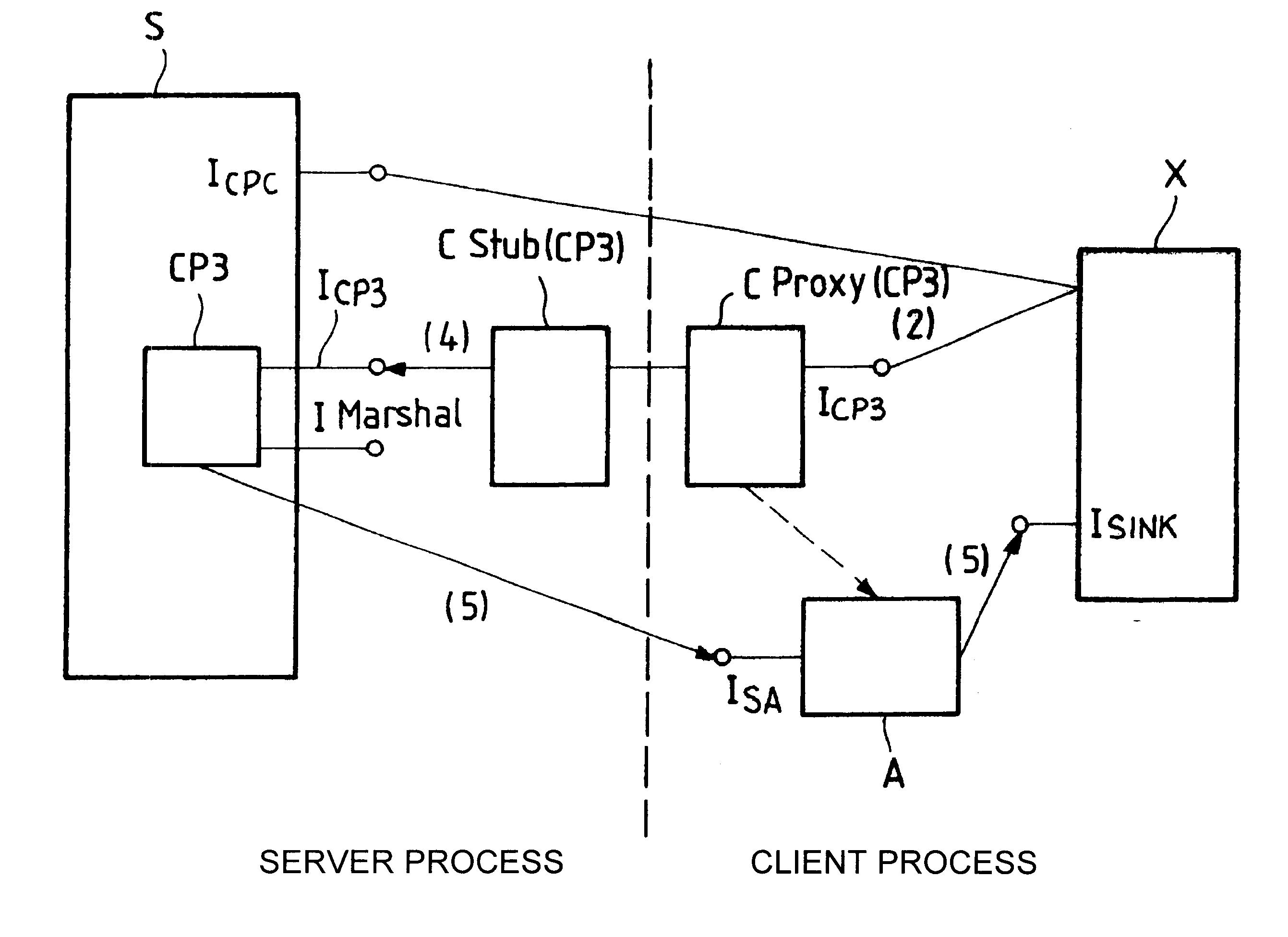
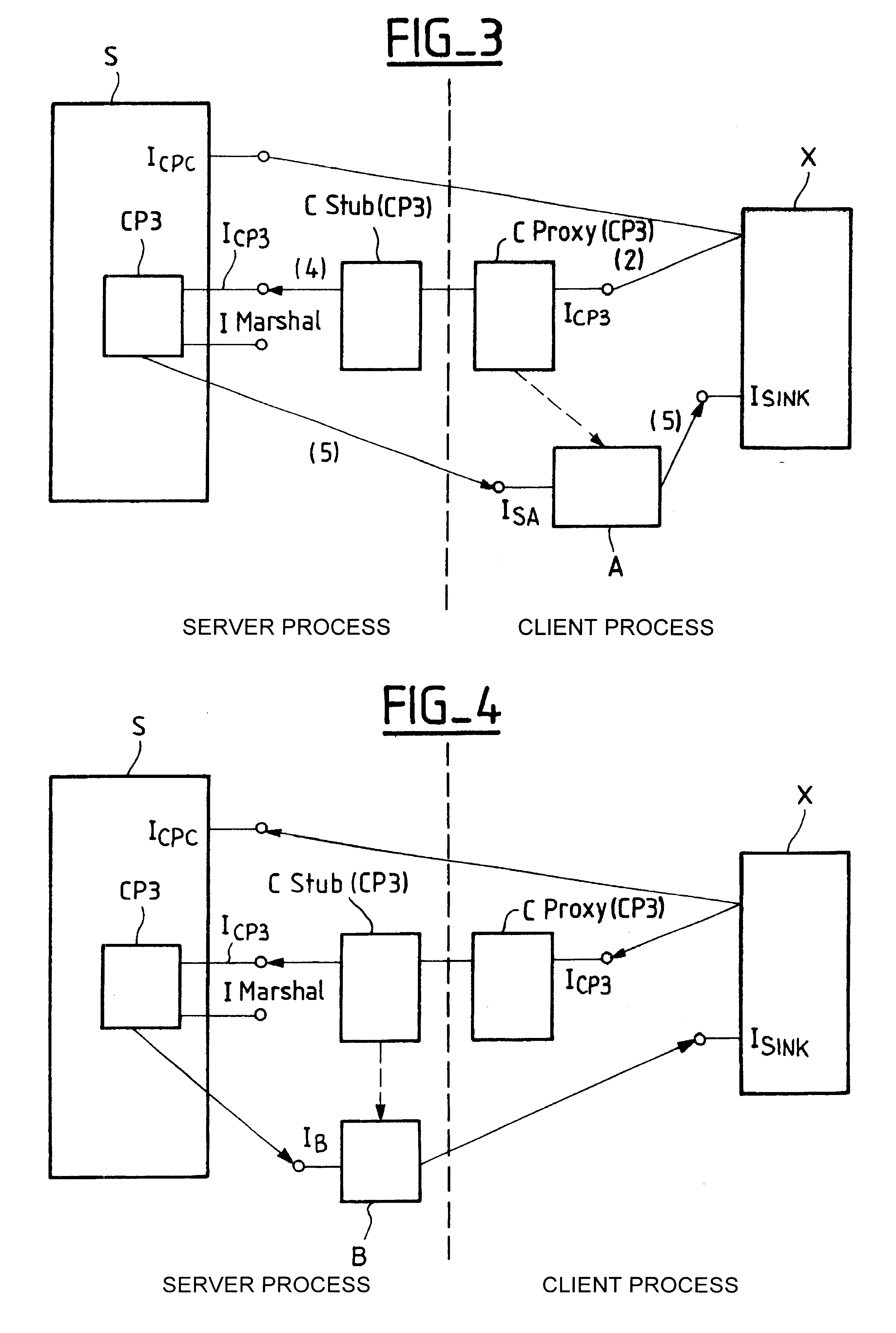
FIG. 3 shows an application of the invention, corresponding to a situation in which a new mechanism is introduced at the first Proxy representative element end.

In the client process there is a client object X with an input interface ISINK.

In the server process there is a server object S with a connection point container interface ICPC.

The client object X sends (1) a connection point allocation request to the corresponding interface ICPC of the server object S.

The latter then creates a corresponding connection point object point CP3 which, in accordance with the invention, includes not only a connection point interface ICP3 but also a marshaling interface IMarshal.

The client object can then send (2) an advise request with a parameter in the form of a pointer to its input interface IA. The ORB which detects the requirement for communication between the object X and the connection point object CP3 asks the connection point object if it supports a marshaling interface and, as this is th...