
Volume rendering in the acoustic grid methods and systems for ultrasound diagnostic imaging
a volume rendering and ultrasound diagnostic technology, applied in the field of three-dimensional imaging, can solve the problems of computationally expensive and time-consuming software that implements volume rendering, and achieve the effect of reducing or eliminating the amount of scan conversion processing
- Summary
- Abstract
- Description
- Claims
- Application Information
AI Technical Summary
Benefits of technology
Problems solved by technology
Method used
Image

Examples
Embodiment Construction
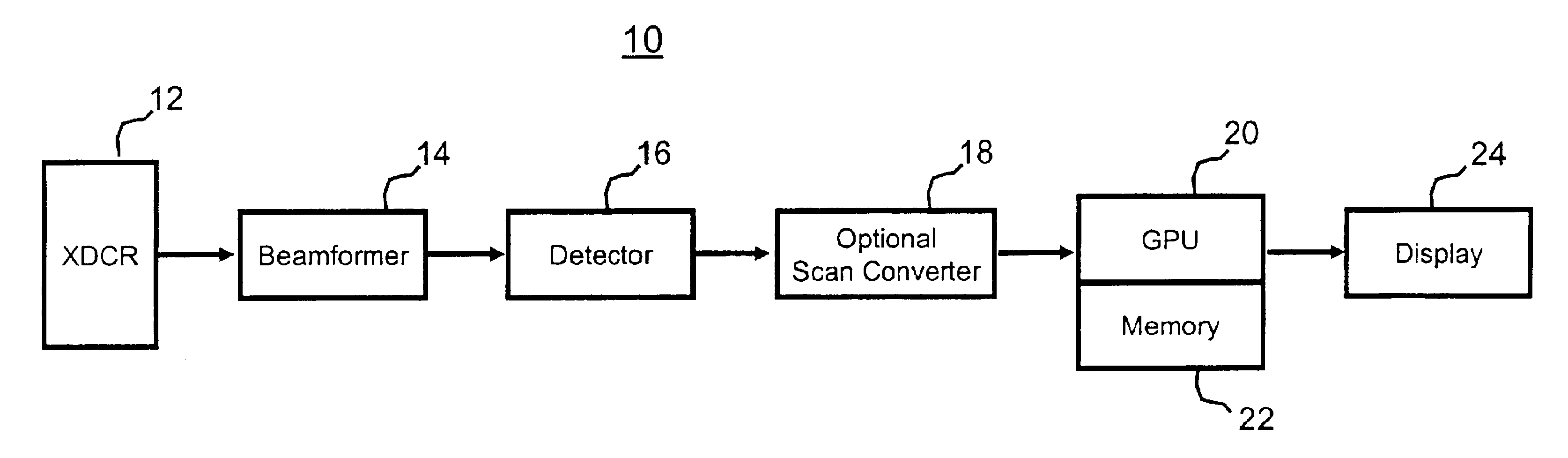
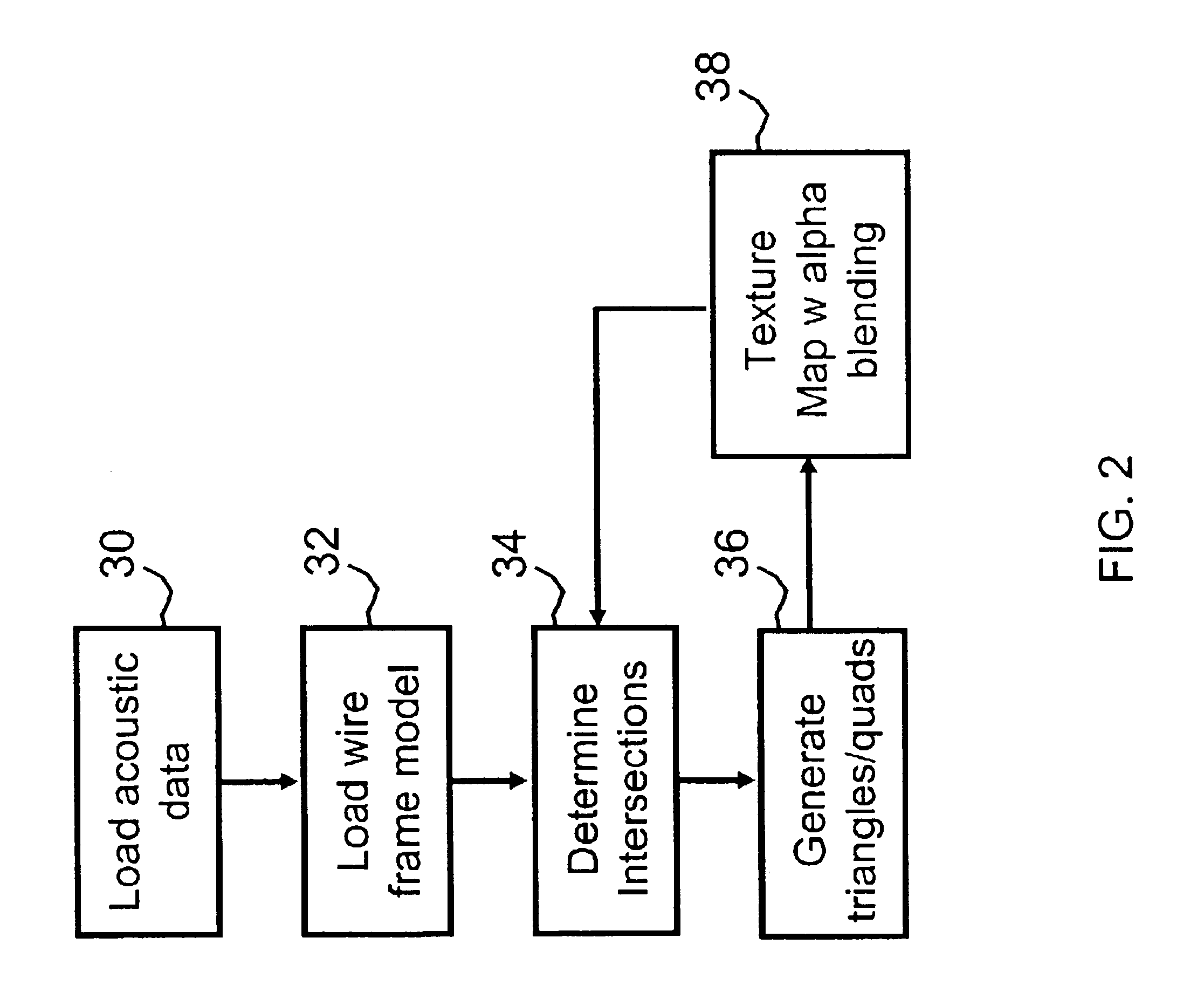
FIG. 2 shows a flowchart of one embodiment a method for volume rendering ultrasound data for three-dimensional imaging. In act 30, ultrasound data formatted at least in part in an acoustic grid is loaded into the GPU 20. The ultrasound data is loaded into the video RAM or memory 22 of the GPU 20 as texture data. The acoustic data preferably is in a form generated by the ultrasound system after detection and log-compression, although post log-compression data may also be used. The ultrasound data comprises data in a substantially entire polar coordinate format (see FIGS. 9 and FIG. 10), such as data free of Cartesian coordinate formatting. Alternatively, the ultrasound data includes partially scan-converted images of ultrasound data spaced in an acoustic grid within the volume (see FIG. 3). The ultrasound data in the acoustic grid is loaded into the memory 22 as a function of the spatial orientation of the image planes or scan lines.
The speed of loading the acoustic data as textures ...
PUM
 Login to View More
 Abstract
Description
Claims
Application Information
 Login to View More