As increased
system capability also increases
system cost, the method of
route planning implemented by a navigation device is a function of overall
system cost.
One feature of increased system capability cost involves the amount of assistance provided at
decision points.
Many conventional navigational devices simply do not incorporate added assistance at
decision points.
Thus, as a user of such a device may often get turned around or confused in unfamiliar territory.
Even more, without self initiated independent study, the user is not provided with any sort of advance notice or warning for when these
decision points are approaching.
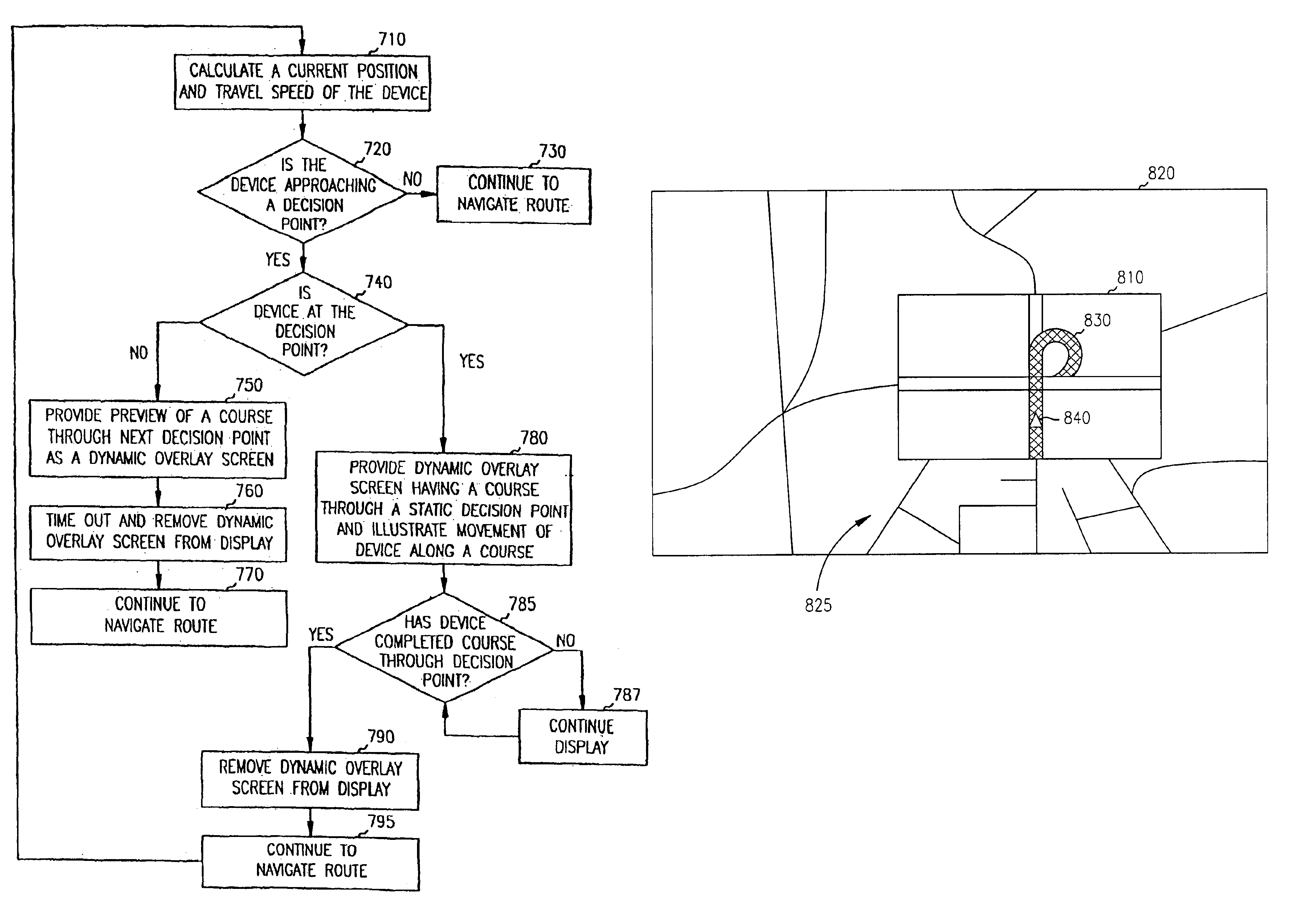
Thus, without careful planning the user can easily miss the decision point or not afford themselves with enough advance notice to be in the right position to navigate a course through the decision point.
However, these systems, particularly low cost free standing navigation systems, limit such assistance to precanned bitmaps of symbols.
While precanned
bitmap navigational aids may be helpful in some instances, they generally do not provide enough instructional aid to a user in unfamiliar surroundings, particularly in a congested network of thoroughfares.
Moreover, these devices do not provide any added assistance to negotiate among the many courses of action which match the instruction of the precanned
bitmap symbol in a crowded network of thoroughfares.
In other words, a left turn arrow symbol does not assist a user to understand which of several immediately approaching left turns to take.
In summary, existing navigation devices do not provide user intuitive assistance at decision points along a route.
Thus, a user of these navigational aids may frequently find themselves missing decision points altogether, or not being in a correct position to navigate a course through an upcoming decision point.
Clearly, in many cases halting travel is not a viable alternative.
For example, when the user is traveling on an interstate it is entirely impossible to simply stop.
The alternative of pulling off on the shoulder is undesirable and can be dangerous.
Pulling off on an exit is equally undesirable since doing so increases
travel time and provides an added inconvenience to the user.
In other instances, such as navigating downtown city streets, the traffic issues alone may prevent the user from stopping their vehicle during the recalculation process.
Even if the user has the ability to safely stop their vehicle, such as when traveling in a neighborhood, the inconvenience factor is present.
Moreover, when the user entirely misses the decision point the headache and
frustration of navigating their route is compounded, leaving the user to further resolve how to back track and again attempt to negotiate the missed decision point.
The lower cost systems currently offer a low degree of accuracy that is often inadequate for users.



 Login to View More
  Login to View More