Interference suppression methods for 802.11

US7046650B2Active Publication Date: 2006-05-16KYOCERA CORP

Image

Smart Image Click on the blue labels to locate them in the text.
Viewing Examples
Smart Image
  • Interference suppression methods for 802.11
  • Interference suppression methods for 802.11
  • Interference suppression methods for 802.11

Examples

Experimental program
Comparison scheme
Effect test

Embodiment Construction

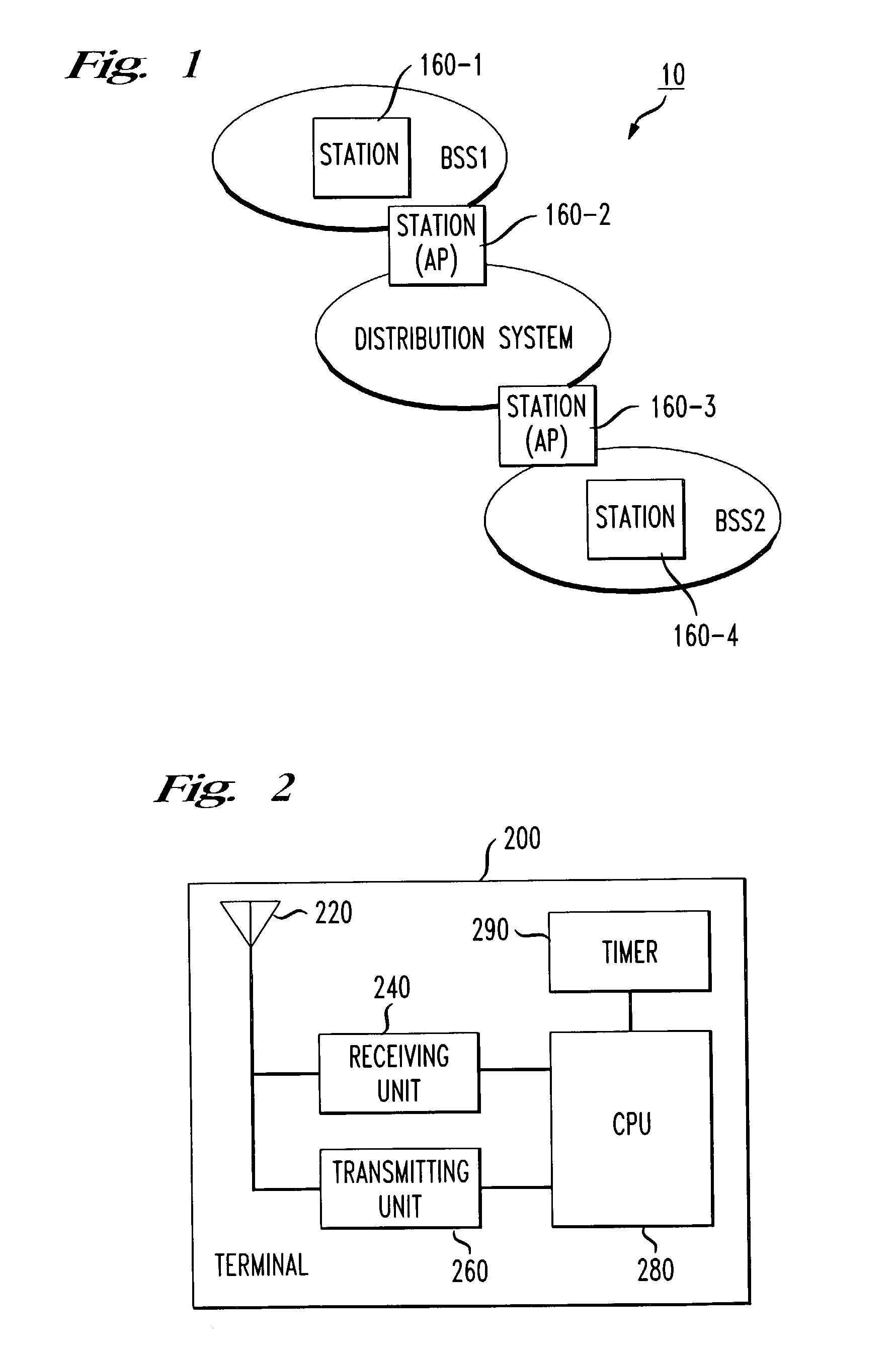
[0028]FIG. 1 discloses an exemplary embodiment of a wireless local area network (WLAN). It should be appreciated that various types of local area networks for forwarding messages to and receiving messages from network stations may be employed in the various exemplary embodiments of this invention.

[0029]As shown in FIG. 1, the wireless local area network 10 includes a distribution system 100, stations 160-1 and 160-2 provided in a first basic service set BSS1 having the same basic service, and stations 160-3 and 160-4 provided in a second basic service set BSS2 having the same basic service. For example, stations 160-1 and 160-2 are network stations provided within a cell under a common coordinating function, with one of the stations providing access to the distribution system 100 being an access point (AP) to a basic service set. Similarly, stations 160-3 and 160-4 are network stations provided within a cell under a common coordinating function, with one of the stations providing ac...

the structure of the environmentally friendly knitted fabric provided by the present invention; figure 2 Flow chart of the yarn wrapping machine for environmentally friendly knitted fabrics and storage devices; image 3 Is the parameter map of the yarn covering machine
Login to View More

PUM

No PUM Login to View More

Abstract

An 802.11 source station transmits a signal with the duration field other than that required for the transmission to prevent transmission by other stations during known sequences. Thus, the source station uses the duration field to spoof the actual time the medium will be occupied, to stations within range of the signal. A station within range of the transmitted signal will check the duration field of the transmitted signal, and update the station's network allocation vector. Thus, the station will not transmit because the station's network allocation vector indicates that the medium is in use, even though the station maybe unable to hear the carrier. Accordingly, spoofed stations may, for example, 1) delay transmission until a more critical transmission has completed, 2) allow unknown or foreign protocol to have preferential use of the medium, 3) prevent interference from hidden stations, and 4) allow sharing of the medium by overlapping basic service sets.

Description

[0001]This application claims the benefit of U.S. Provisional Application No. 60 / 272,854, filed Mar. 2, 2001, entitled Interference Suppression Methods For 802.11, U.S. Provisional Application No. 60 / 274,259, filed Mar. 7, 2001, entitled Interference Suppression Methods For 802.11, U.S. Provisional Application No. 60 / 290,789, filed May 14, 2001, entitled Interference Suppression Methods For 802.11, which are incorporated by reference herein in their entirety.[0002]This application is a continuation-in-part of U.S. application Ser. Nos. 10 / 044,916 and 10 / 045,071, entitled Interference Suppression Methods For 802.11, filed on Jan. 15, 2002, and is related to U.S. applications to Interference Suppression Methods For 802.11 which are filed on even date herewith. These applications are co-pending and commonly assigned.BACKGROUND OF THE INVENTION[0003]Wireless local area networks (WLANs) employ a plurality of mobile network stations, such as data processing devices having wireless communi...

Claims

the structure of the environmentally friendly knitted fabric provided by the present invention; figure 2 Flow chart of the yarn wrapping machine for environmentally friendly knitted fabrics and storage devices; image 3 Is the parameter map of the yarn covering machine
Login to View More

Application Information

Patent Timeline
16 May 2006
Publication
US7046650B2
IPC
H04Q7/24; H04B7/00; H04L1/16; H04L12/28; H04W16/14; H04W28/18; H04W74/00; H04W74/04; H04W74/08; H04W84/12
CPC
H04W74/0808; H04L1/16; H04W84/12; H04W28/18
Inventors
SHERMAN, MATTHEW J.