Check patentability & draft patents in minutes with Patsnap Eureka AI!

Single-instruction multiple-data (SIMD)-based algorithms for processing video data

a single instruction and video data technology, applied in the field of video data processing, can solve the problem of computationally intensive processing of 88 dct coefficients

Active Publication Date: 2007-02-06
III HLDG 12 LLC
View PDF5 Cites 28 Cited by
  • Summary
  • Abstract
  • Description
  • Claims
  • Application Information

AI Technical Summary

Problems solved by technology

Processing 8×8 DCT coefficients is computationally intensive and is desirably performed quickly and efficiently.

Method used

the structure of the environmentally friendly knitted fabric provided by the present invention; figure 2 Flow chart of the yarn wrapping machine for environmentally friendly knitted fabrics and storage devices; image 3 Is the parameter map of the yarn covering machine
View more

Image

Smart Image Click on the blue labels to locate them in the text.
Viewing Examples
Smart Image
  • Single-instruction multiple-data (SIMD)-based algorithms for processing video data
  • Single-instruction multiple-data (SIMD)-based algorithms for processing video data
  • Single-instruction multiple-data (SIMD)-based algorithms for processing video data

Examples

Experimental program
Comparison scheme
Effect test

Embodiment Construction

[0037]Embodiments of this invention will now be described with reference to the figures. It should be appreciated that this invention is not limited to the exemplary embodiments selected for illustration in the figures. It should also be appreciated that variations and modifications to the exemplary embodiments may be made without departing from the spirit or scope of this invention.

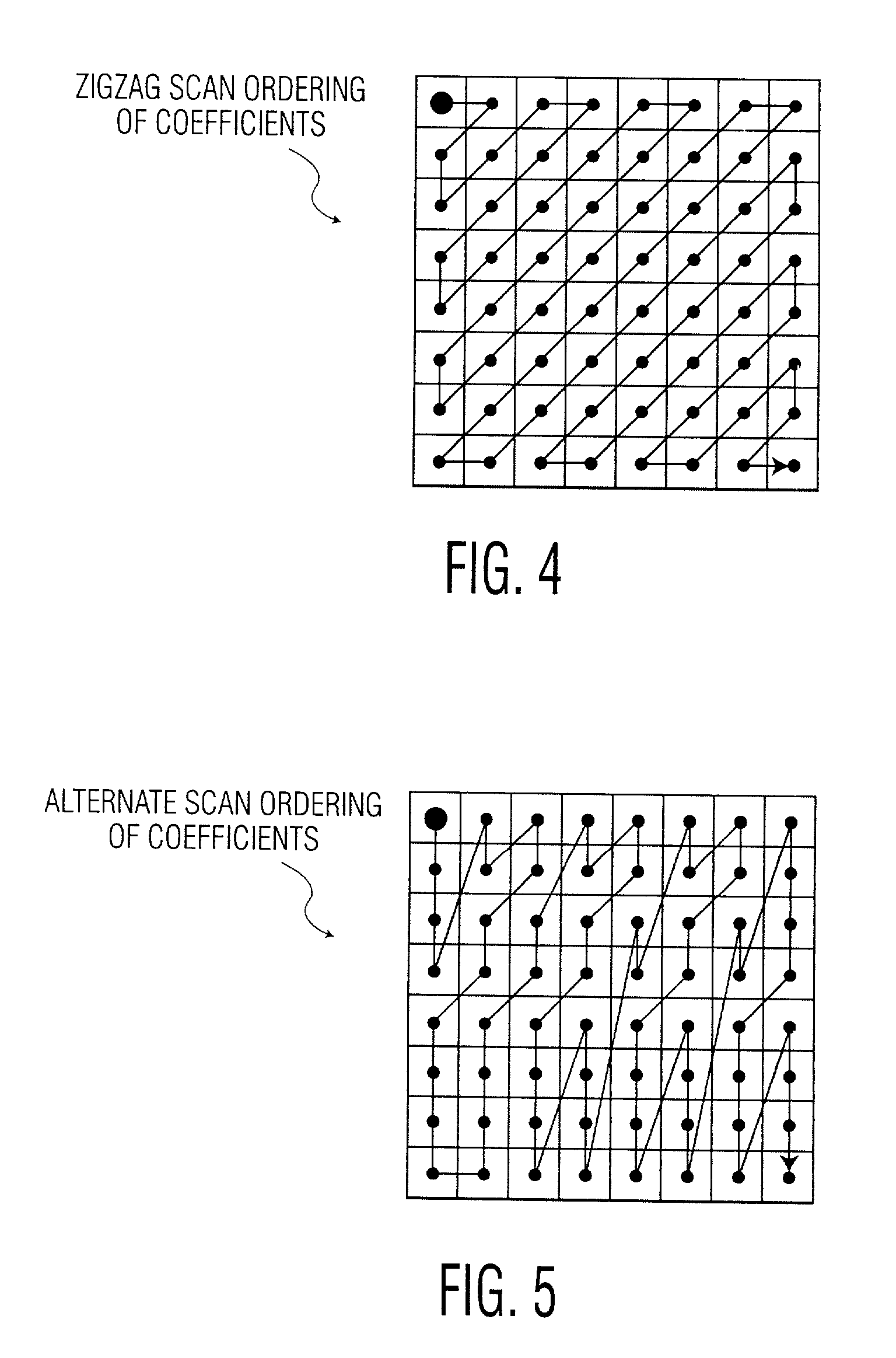
[0038]Generally, this invention relates to a method of concurrently processing multiple DCT coefficients using SIMD-based algorithms. The method, generally designated as 10, is shown in FIG. 6. As shown, the method receives a 64-DCT (or 8×8 DCT) matrix in step 12. The matrix is linearized in step 14 using, for example, a zigzag scan order for the DCT coefficients (FIG. 4) or an alternate scan order for the DCT coefficients (FIG. 5). Each DCT coefficient is stored in memory as a two-byte integer (16-bits) in the linearized scan order (zigzag or other).

[0039]The linearized DCT coefficients are loaded, seve...

the structure of the environmentally friendly knitted fabric provided by the present invention; figure 2 Flow chart of the yarn wrapping machine for environmentally friendly knitted fabrics and storage devices; image 3 Is the parameter map of the yarn covering machine
Login to View More

PUM

No PUM Login to View More

Abstract

In a video encoder / decoder, a method processes a discrete cosine transform (DCT) block of coefficients. The method receives a DCT block of coefficients, and linearizes the DCT block of coefficients into a one dimensional array of sequentially arranged coefficients. The method stores a portion of the one dimensional array of coefficients in a register, the portion including at least two sequentially arranged coefficients. The stored portion of coefficients in the register is processed. A next portion of coefficients in the one dimensional array is processed. This is repeated until the entire DCT block of coefficients have been loaded into the register. The processing may include computing a run length value, finding a class number, or determining dequantized coefficients of a DCT block.

Description

FIELD OF THE INVENTION[0001]The present invention relates, in general, to a method of processing video data and, more specifically, to a method of simultaneously processing multiple discrete cosine transform (DCT) coefficients using SIMD-based algorithms.BACKGROUND OF THE INVENTION[0002]MPEG-2 (Motion Picture Experts Group-2) and DV (Digital Video) are two popular formats for digital video production used in the broadcasting industry. In both formats, a transform, such as a two-dimensional discrete cosine transform (DCT) is applied to blocks (e.g., four 8×8 blocks per macroblock) of image data (either the pixels themselves or interframe pixel differences corresponding to those pixels). The resulting transform coefficients are then quantized at a selected quantization level where many of the coefficients are typically quantized to a zero value. The quantized coefficients are then run-length encoded to generate part of the compressed video bitstream. In general, greater quantization l...

Claims

the structure of the environmentally friendly knitted fabric provided by the present invention; figure 2 Flow chart of the yarn wrapping machine for environmentally friendly knitted fabrics and storage devices; image 3 Is the parameter map of the yarn covering machine
Login to View More

Application Information

Patent Timeline
no application Login to View More
IPC IPC(8): G06K9/46G06F17/14H03M7/30H03M7/46H04N7/30
CPCG06F17/147
Inventor LIN, WANRONGMARGOLINE, ANTONBUSHMITCH, DENNIS
Owner III HLDG 12 LLC
Features
  • R&D
  • Intellectual Property
  • Life Sciences
  • Materials
  • Tech Scout
Why Patsnap Eureka
  • Unparalleled Data Quality
  • Higher Quality Content
  • 60% Fewer Hallucinations
Social media
Patsnap Eureka Blog
Learn More