

Additives and method for reducing odor
a technology of additives and odors, applied in the field of additives and methods for reducing odor, can solve the problems of strong, persistent and potentially harmful odors, discomfort of persons working with hot asphalt, poor masking techniques, etc., and achieve the effect of reducing odor and reducing odor
- Summary
- Abstract
- Description
- Claims
- Application Information
AI Technical Summary
Benefits of technology
Problems solved by technology
Method used
Image



Examples
example 1
[0052]Asphalt samples, labeled PG70-22 and 64-22, were heated until they became a viscous liquid. Approximately 5.0 g of each of the two asphalt samples were added to separate 20 mL vials. Vials were labeled 6422-1, 6422-2, 6422-3, 7022-1, 7022-2 and 7022-3. Vials were allowed to come to room temperature. One μL of odor reducing additive X was added to each of the 6422-2 and 7022-2 vials. One μL of odor reducing additive Y was added to each of the 6422-3 and 7022-3 vials. Individual vials, crimped shut using Teflon faced septa and aluminum seals, were placed in a Fisher forced air oven and heated at 151° C. for 30 minutes after which 1 mL of headspace of each vial was injected into a GC / MS system. A blank consisting of an empty crimped vial was also analyzed using identical procedures.
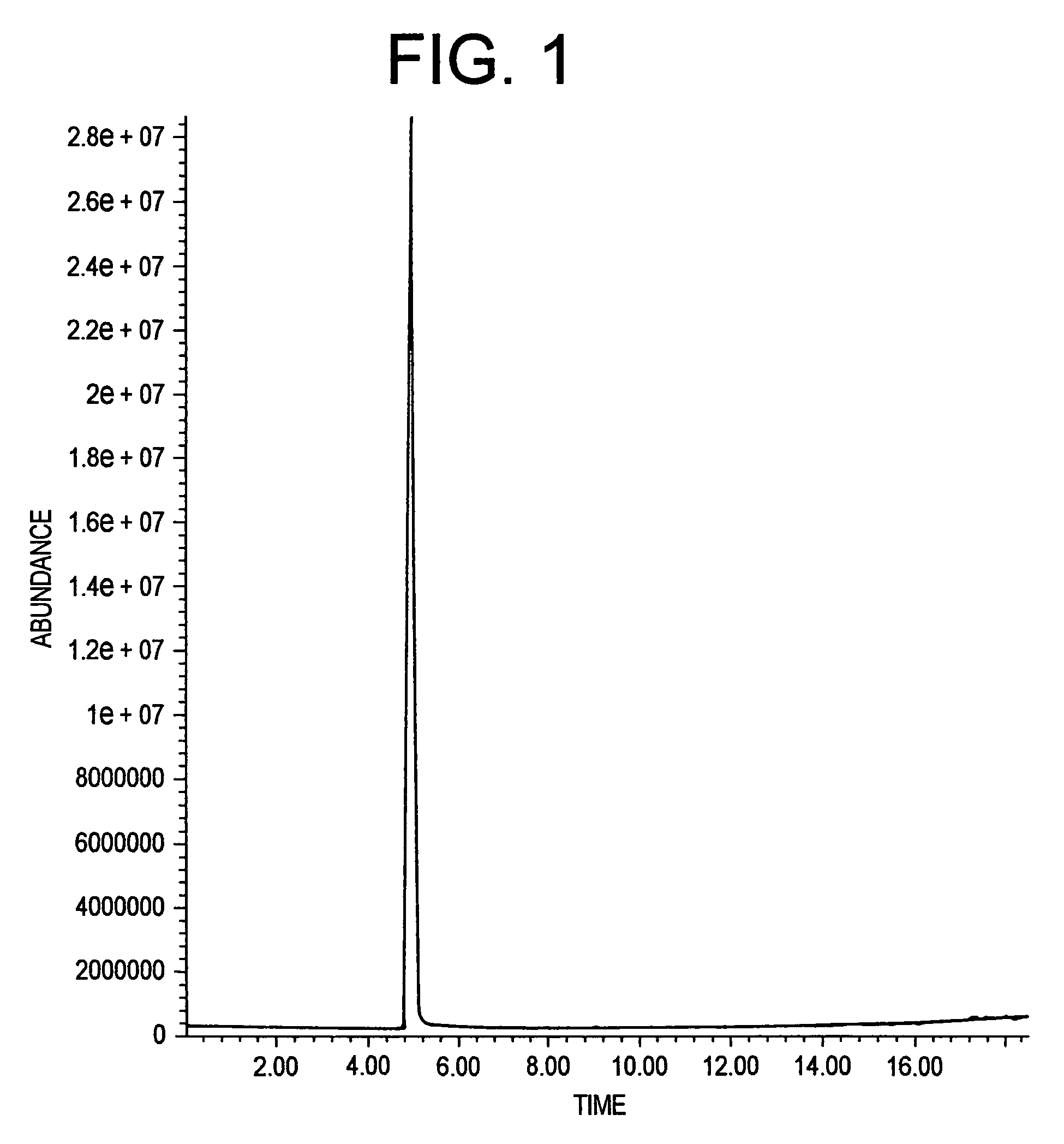
[0053]A large peak was found at a retention time of 4.7 minutes (FIG. 1). This substance, also found in the blank, was found to be a volatile substance given off by septa when heated to 151° C. and the...
PUM
| Property | Measurement | Unit |
|---|---|---|
| volume ratio | aaaaa | aaaaa |
| volume ratio | aaaaa | aaaaa |
| volume ratio | aaaaa | aaaaa |
Abstract
Description
Claims
Application Information
 Login to View More