Supercharge Your Innovation With Domain-Expert AI Agents!

High capacity adsorption media and method of producing

a high-capacity, adsorption media technology, applied in the direction of ion-exchange water/sewage treatment, other chemical processes, separation processes, etc., can solve the problems of health risks, reduce the mcl to 10 ppb, and conventional ion-exchange resins do not provide the specificity to economically remove low concentrations of arseni

Inactive Publication Date: 2008-05-06
BATTELLE ENERGY ALLIANCE LLC
View PDF16 Cites 19 Cited by
  • Summary
  • Abstract
  • Description
  • Claims
  • Application Information

AI Technical Summary

Benefits of technology

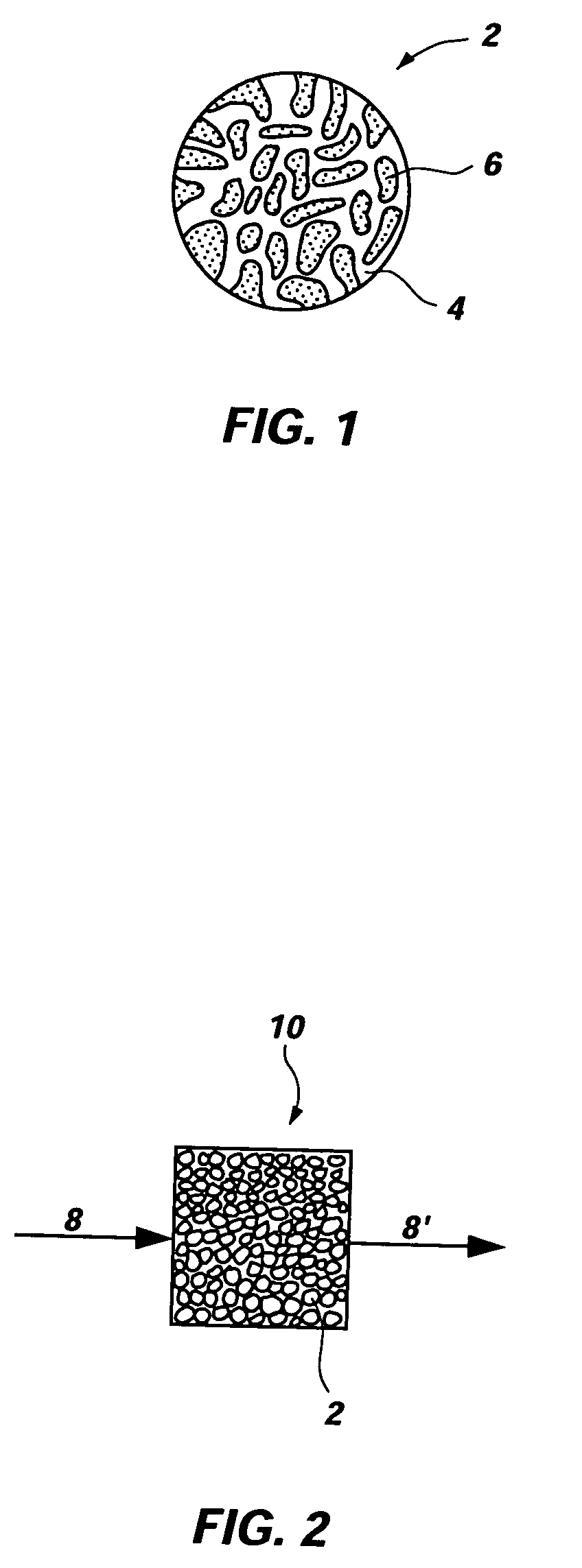
[0011]The present invention also relates to a method of removing a constituent from a feed stream. The method comprises providing an adsorption medium having at least one metal hydroxide dispersed in a PAN matrix. The adsorption medium may have from approximately 10% by weight to approximately 85% by weight of a metal in the form of an elemental metal and the at least one metal hydroxide and from approximately 15% by weight to approximately 90% by weight of the PAN. The adsorption medium is contacted with a feed stream comprising at least one constituent, such as a feed stream comprising arsenic, selenium, antimony, or mixtures thereof. The adsorption medium is used to remove oxyanions or oxyacids of arsenic, selenium, or antimony from the feed stream. The adsorption medium may reduce the amount of arsenic present in the feed stream to less than approximately 50 parts per billion, such as less than approximately 10 parts per billion.
[0012]The present invention also relates to an adsorption medium having increased metal loading. The adsorption medium comprises a PAN matrix and at least one metal hydroxide. The adsorption medium has from approximately 10% by weight to approximately 85% by weight of a metal in the form of an elemental metal and the at least one metal hydroxide and from approximately 15% by weight to approximately 90% by weight of the PAN. The metal hydroxide may be substantially homogenously dispersed in the PAN matrix. The adsorption medium may comprise at least approximately 50% by weight of the elemental metal and the at least one metal hydroxide.

Problems solved by technology

However, even trace amounts of arsenic have been shown to have health risks, which led the EPA to reduce the MCL to 10 ppb.
While many techniques for removing arsenic from water supplies are known, conventional ion exchange resins do not provide the specificity to economically remove low concentrations of arsenic.
Since many water supplies in the United States, such as groundwater, surface water, or wells, have low concentrations of arsenic, these techniques are not effective to remove the arsenic.
In addition, many of these techniques are not selective for arsenic over other ions.
While these metal oxide or metal hydroxide granules are more selective for arsenic, they have a low porosity and, therefore, have a low capacity for arsenic and poor kinetic properties.
The capacity of the sorbent for arsenic is limited by the total number of sulfonic acid sites on the cation exchange beads.
However, the foregoing process of preparing this ion exchange resin is problematic because it is complicated and the halogenated solvents used in the process are difficult to dispose of.
However, small and mid-sized municipalities and other communities as well as rural areas do not have centralized water treatment facilities.
It is estimated that over four thousand municipal water supplies and tens of thousand of private drinking water supplies, primarily in the western United States, would not meet the new MCL standard of 10 ppb arsenic.
However, many small and mid-sized municipalities, as well as private users, cannot afford to build such facilities.

Method used

the structure of the environmentally friendly knitted fabric provided by the present invention; figure 2 Flow chart of the yarn wrapping machine for environmentally friendly knitted fabrics and storage devices; image 3 Is the parameter map of the yarn covering machine
View more

Image

Smart Image Click on the blue labels to locate them in the text.
Viewing Examples
Smart Image
  • High capacity adsorption media and method of producing
  • High capacity adsorption media and method of producing

Examples

Experimental program
Comparison scheme
Effect test

example 1

Preparation of Solid Beads Having Ferric Hydroxide Incorporated in a PAN Matrix

[0036]Solid beads of the adsorption medium 2 were prepared by dissolving approximately 70 g / L of iron oxide into concentrated nitric acid to form the metal solution. PAN was then dissolved in the metal solution to form the PAN-metal solution having approximately 3 wt % to approximately 5 wt % PAN. The PAN-metal solution was then sprayed through an air / nozzle device into an alkaline quenching bath having 3M NaOH to form the solid beads. The solid beads were removed from the alkaline quenching bath, rinsed with ethanol, dried at a temperature of approximately 60° C., and screened to obtain a desired size fraction of the solid beads. Solid beads having PAN and ferric hydroxide were produced. The solid beads had approximately 30% Fe(III).

example 2

Determination of Equilibrium Arsenic Capacity

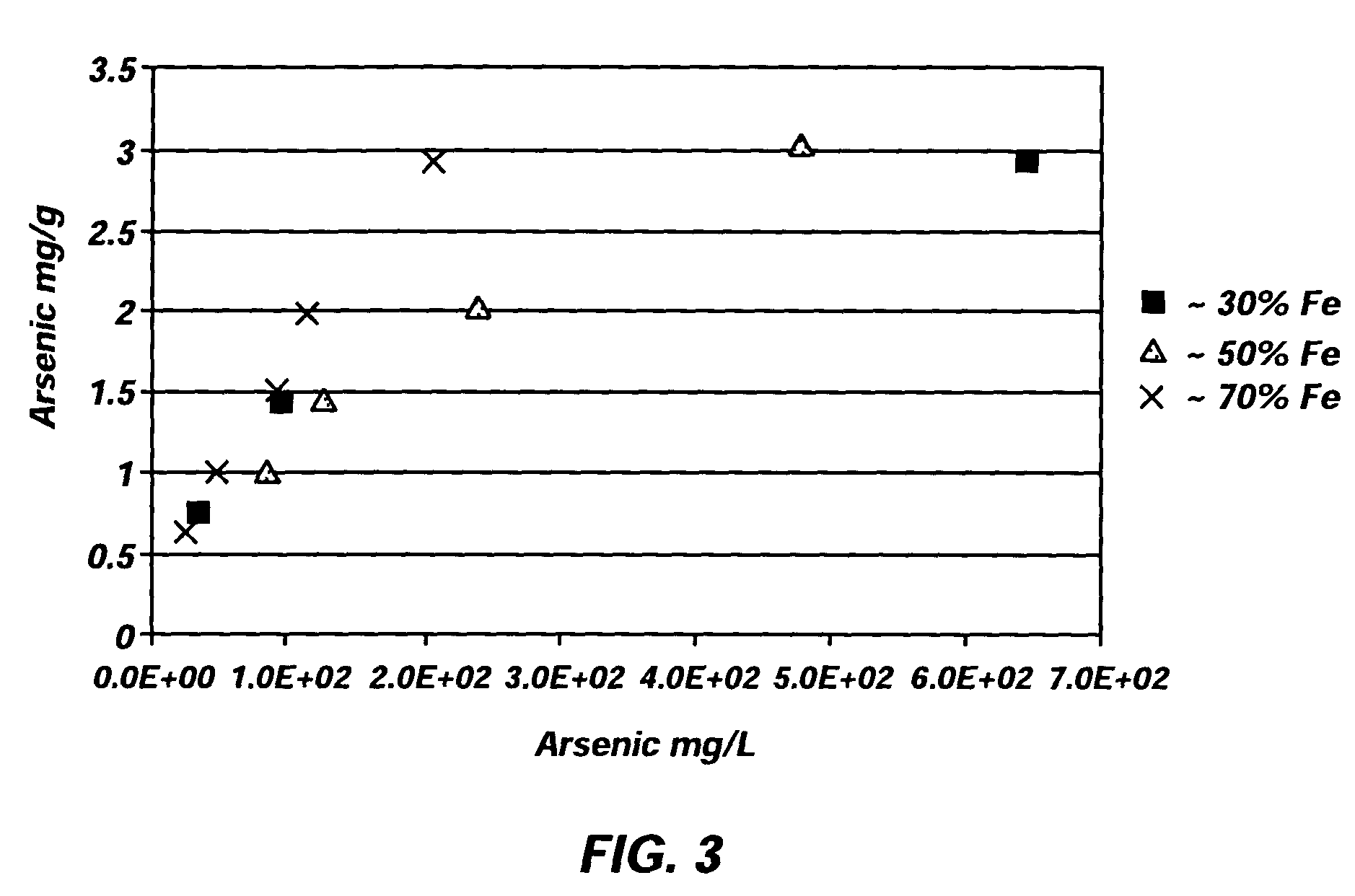
[0037]The solid beads described in Example 1 were tested to determine equilibrium arsenic capacity at various feed concentrations. A known weight of the solid beads was contacted with a water sample having a specific arsenic concentration. Contacts between the solid beads and the water sample were repeated using different weights of the solid beads to obtain a plot of equilibrium arsenic concentration in the solid phase versus equilibrium arsenic concentration in the liquid phase. These plots are referred to as equilibrium isotherms. FIG. 3 shows iron loadings ranging from 30 wt % to 70 wt %. These equilibrium isotherms provide data at or near the low arsenic concentrations that exist in potable water in the United States. As FIG. 3 shows, at 70% iron loading, the adsorption medium 2 provides an arsenic loading of approximately 3 mg / g with 20 ppb arsenic in the feed stream 8. Since the concentration of arsenic is very low in the feed stre...

the structure of the environmentally friendly knitted fabric provided by the present invention; figure 2 Flow chart of the yarn wrapping machine for environmentally friendly knitted fabrics and storage devices; image 3 Is the parameter map of the yarn covering machine
Login to View More

PUM

PropertyMeasurementUnit
concentrationaaaaaaaaaa
wt %aaaaaaaaaa
wt %aaaaaaaaaa
Login to View More

Abstract

A method of producing an adsorption medium to remove at least one constituent from a feed stream. The method comprises dissolving at least one metal compound in a solvent to form a metal solution, dissolving polyacrylonitrile into the metal solution to form a PAN-metal solution, and depositing the PAN-metal solution into a quenching bath to produce the adsorption medium. The at least one constituent, such as arsenic, selenium, or antimony, is removed from the feed stream by passing the feed stream through the adsorption medium. An adsorption medium having an increased metal loading and increased capacity for arresting the at least one constituent to be removed is also disclosed. The adsorption medium includes a polyacrylonitrile matrix and at least one metal hydroxide incorporated into the polyacrylonitrile matrix.

Description

GOVERNMENT RIGHTS[0001]The United States Government has certain rights in this invention pursuant to Contract No. DE-AC07-99ID13727 and Contract No. DE-AC07-05ID14517 between the United States Department of Energy and Battelle Energy Alliance, LLC.FIELD OF THE INVENTION[0002]The present invention relates to an adsorption medium that may be used to remove an undesirable constituent from a water supply. More specifically, the present invention relates to an adsorption medium that includes polyacrylonitrile and a metal hydroxide or metal oxide.BACKGROUND OF THE INVENTION[0003]Water supplies contaminated with arsenic (As) are a major health and environmental concern in the United States and worldwide. Arsenic is a naturally occurring element that is present in rocks or soils. Over time, the arsenic leaches from the rocks or soils into groundwater, surface water, wells, or other sources of drinking water. This arsenic contamination is referred to as indigenous arsenic contamination. Arse...

Claims

the structure of the environmentally friendly knitted fabric provided by the present invention; figure 2 Flow chart of the yarn wrapping machine for environmentally friendly knitted fabrics and storage devices; image 3 Is the parameter map of the yarn covering machine
Login to View More

Application Information

Patent Timeline
no application Login to View More
Patent Type & Authority Patents(United States)
IPC IPC(8): B01J20/02B01D15/00B01J20/06B01J20/26B01J20/28B01J20/32C02F1/28
CPCB01D15/00B01J20/0229B01J20/06B01J20/28026C02F1/285C02F1/288B01J20/261B01J20/264B01J20/3085B01J20/3293B01J2220/46C02F2101/103C02F2101/106B01J2220/62
Inventor TRANTER, TROY J.HERBST, R. SCOTTMANN, NICHOLAS R.TODD, TERRY A.
Owner BATTELLE ENERGY ALLIANCE LLC
Features
  • R&D
  • Intellectual Property
  • Life Sciences
  • Materials
  • Tech Scout
Why Patsnap Eureka
  • Unparalleled Data Quality
  • Higher Quality Content
  • 60% Fewer Hallucinations
Social media
Patsnap Eureka Blog
Learn More