Unlock instant, AI-driven research and patent intelligence for your innovation.
Hot compressing tooth hair comb
What is Al technical title?
Al technical title is built by PatSnap Al team. It summarizes the technical point description of the patent document.
a hair comb and hot compressing technology, applied in the field of hair grooming accessories, can solve the problems of increasing the overall time and effort required to treat the full head of hair, difficult, if not impossible, to exert even pressure or heat on the harvested hair, etc., to reduce the amount of time required, eliminate repeating strokes
Inactive Publication Date: 2008-12-02
LOVELY STRANDS
View PDF18 Cites 2 Cited by
Summary
Abstract
Description
Claims
Application Information

AI Technical Summary
This helps you quickly interpret patents by identifying the three key elements:
Problems solved by technology
Method used
Benefits of technology
"The present invention is a new type of hair styling comb that can press and heat hair with consistent delivery in a time efficient manner. It has a unique design that allows for a high degree of maneuverability and achieves a greater variety of final hairstyles. The comb has actuator-triggered teeth that collapse together like miniature flat irons, delivering consistent heat and pressure application throughout the full bulk and length of all the hair. The comb's teeth surround the pressing teeth, acting as a barrier to prevent accidental burning of the scalp. The invention can be opened and closed like a regular pressing comb, and it has a folding gate and leaf spring arrangement to synchronize the compressing-collapse of the teeth. Overall, the invention improves the efficiency and effectiveness of hair styling."
Problems solved by technology
In this field one desired look is to possess straight and styled hair, however that often becomes an overwhelming task when first presented with a head of curly or bristly hair.
For instance, the amount of hair captured by flatirons widely varies, thus capturing large volume hair locks that absorb heat and pressure unevenly through the bulk by way of the outer strands receiving more than the inner strands.
Distribution of heat and pressure is distributed more evenly when smaller locks of hair are captured, but that increased the overall time and effort required to treat the full head of hair.
And pressing combs, such as those disclosed in U.S. Pat. Nos. 3,742,964 to Newbern and U.S. Pat. No. 4,126,143 to Schroeder, have a score of fixed teeth acting to harvest a score of small-volume locks, however it is difficult, if not impossible to exert even pressure or heat on the harvested hair.
There are a limited number of strokes the comb's user may employ that are limited within the range of drawing hair sideways through the comb teeth, to twisting it—much in the way spaghetti stays on a fork after twirling it onto the fork tines.
Both categories of combs necessarily incur repetitive strokes that typically repeat treatment on post-treated strands.
What is more, each category type lacks the ability to treat hair strands close to their root.
Method used
the structure of the environmentally friendly knitted fabric provided by the present invention; figure 2 Flow chart of the yarn wrapping machine for environmentally friendly knitted fabrics and storage devices; image 3 Is the parameter map of the yarn covering machine
View more
Image
Smart Image Click on the blue labels to locate them in the text.
Viewing Examples
Smart Image
Click on the blue label to locate the original text in one second.
Reading with bidirectional positioning of images and text.
Smart Image
Examples
Experimental program
Comparison scheme
Effect test
Embodiment Construction
[0021]For the purpose of promoting an understanding of the principles of the invention, reference will now be made to the embodiments illustrated in the drawings and specific language will be used to describe the same. It will nevertheless be understood that no limitation of the scope of the invention is thereby intended, such alterations and further modifications in the illustrated device, and such further applications of the principles of the invention as illustrated therein being contemplated as would normally occur to one skilled in the art to which the invention relates.
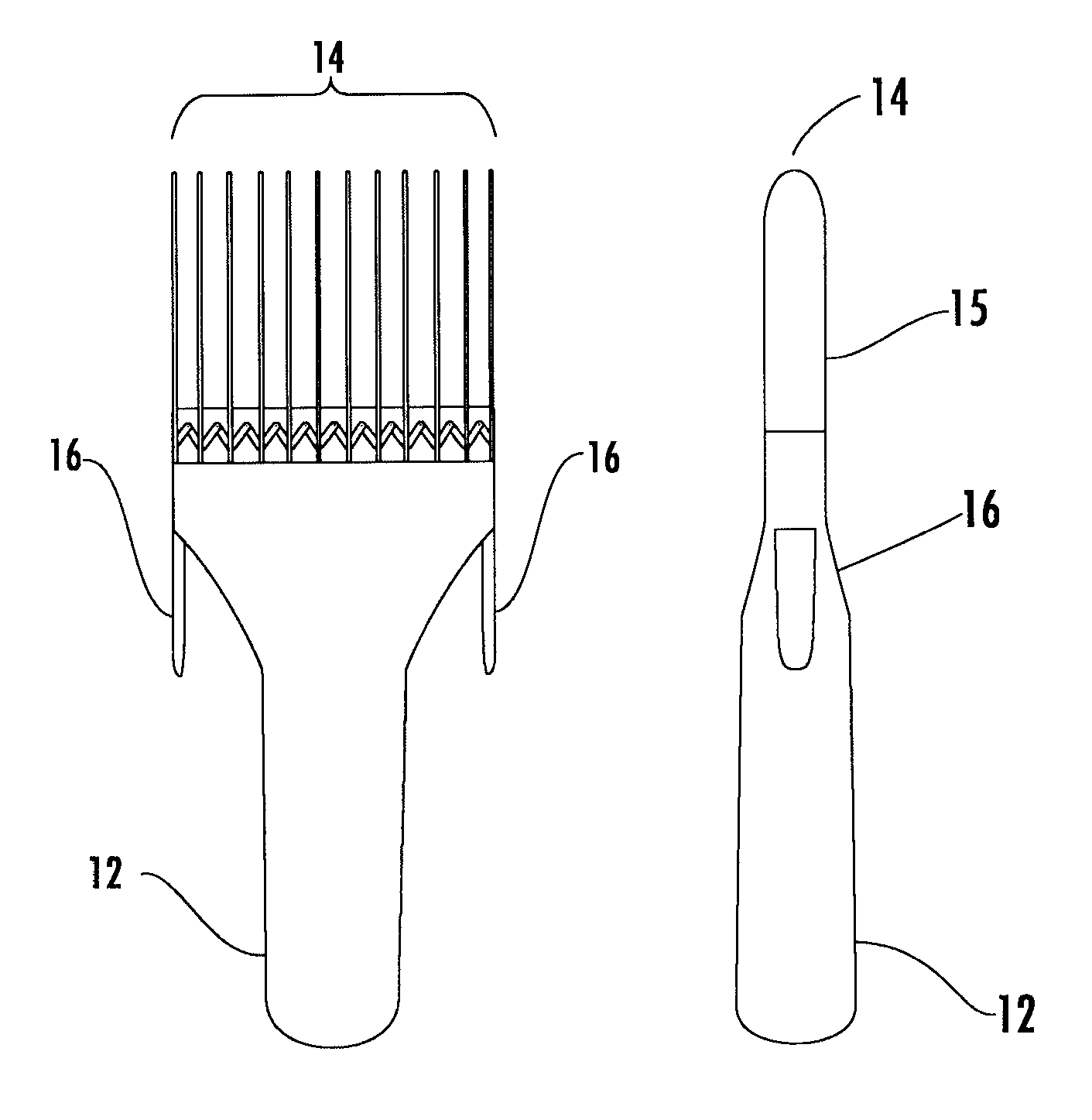
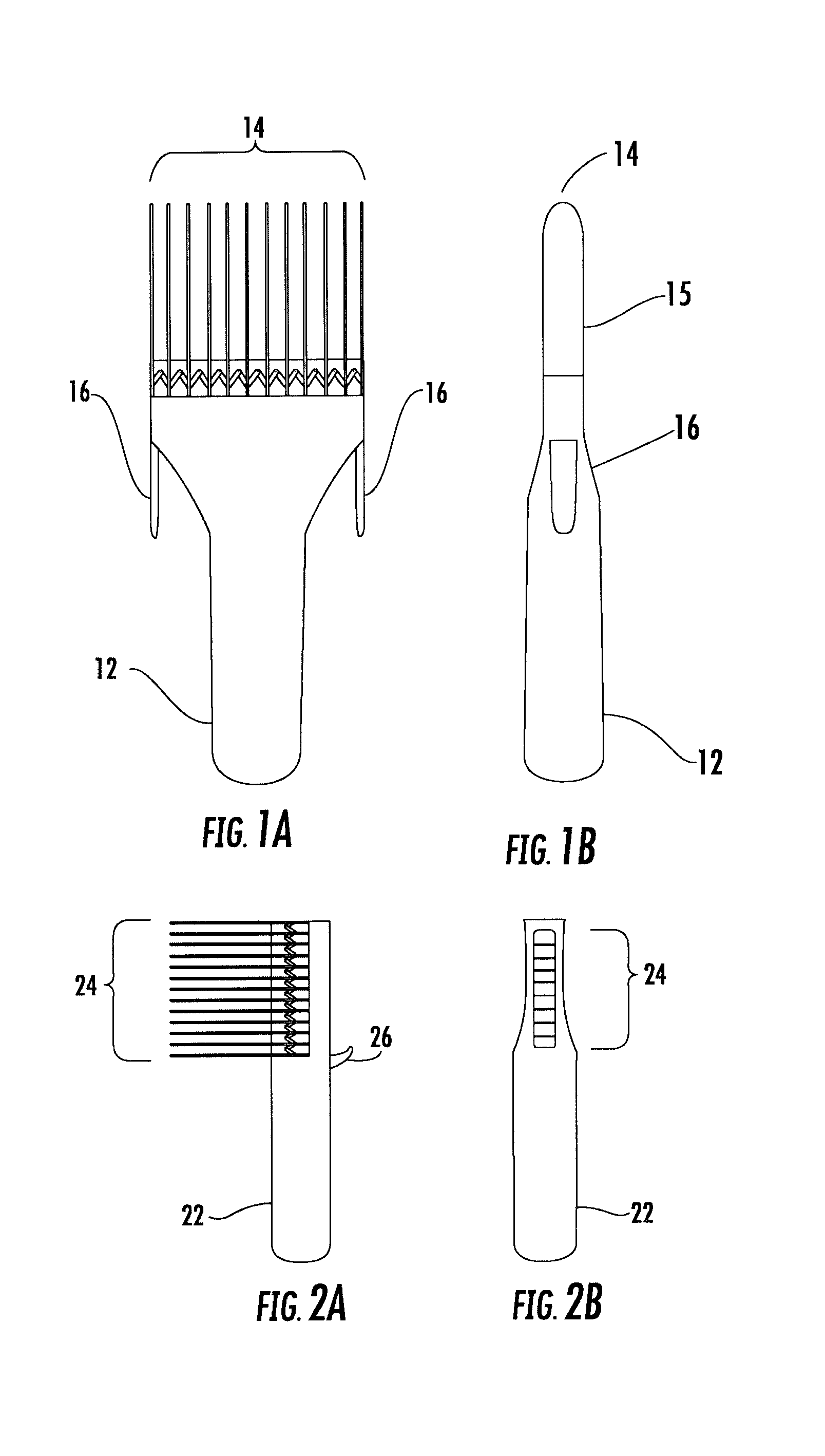
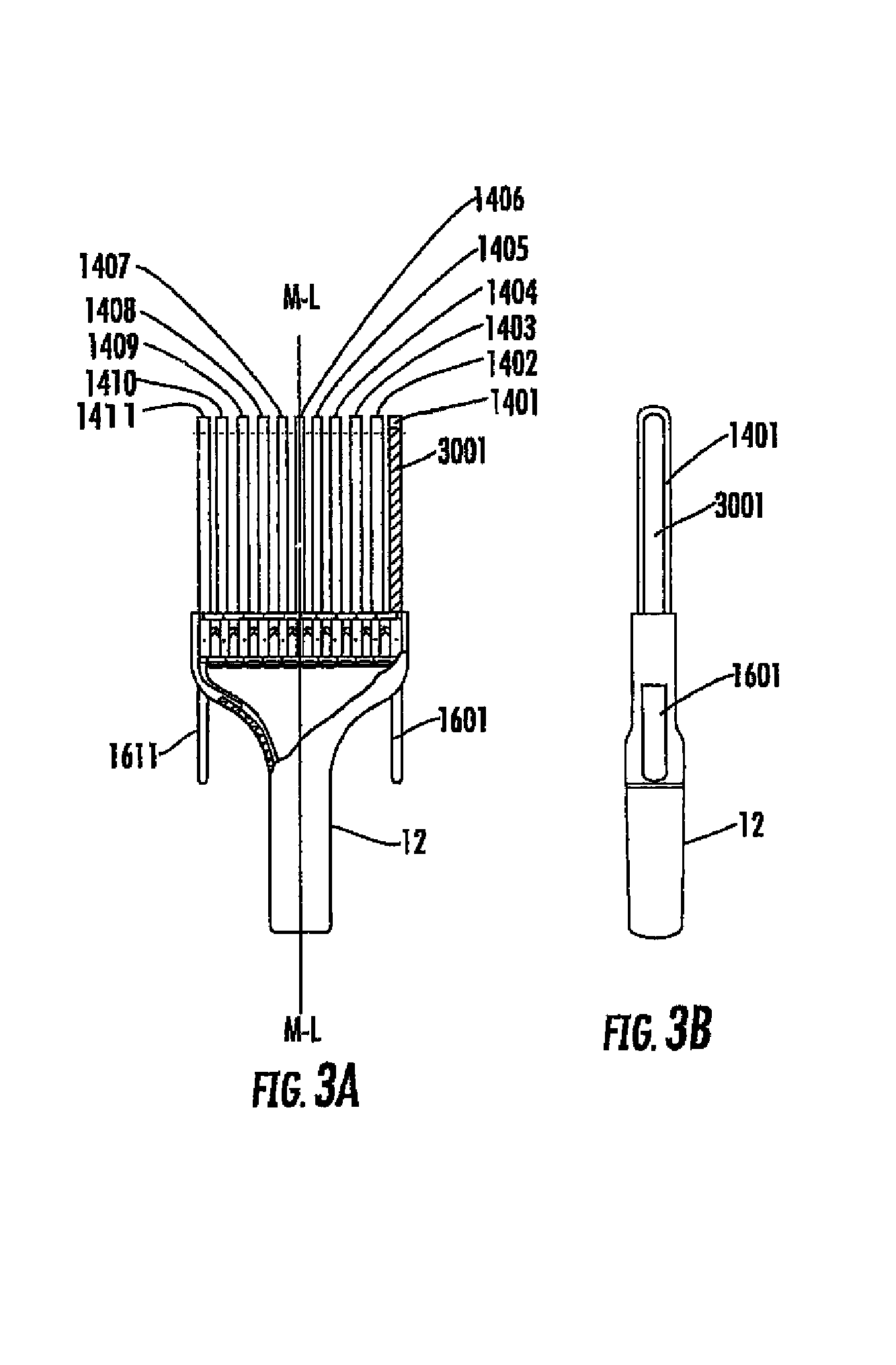
[0022]FIGS. 1A and 1B show the preferred embodiment of the invention in the overall shape of a hair pick, having a row set of combing teeth 14 parallel to the longitudinal midline M-L axis of a body-handle 12, and furthermore having a set of triggers 16. In an alternative configuration a row set of combing teeth 24 is perpendicular to a body-handle 22, and further having a singular trigger 26.
[0023]The preferred...
the structure of the environmentally friendly knitted fabric provided by the present invention; figure 2 Flow chart of the yarn wrapping machine for environmentally friendly knitted fabrics and storage devices; image 3 Is the parameter map of the yarn covering machine
Login to View More
PUM
Login to View More
Abstract
A hair comb having hot compressing teeth, which in an open mode are shrouded by cooler combing teeth designed to encapsulate hair, and in a triggered mode collapse toward each other to compress the hair confined between the cooler teeth. The compressing teeth are mounted to a collapsible mechanism actuated by the comb's user. Various means may be utilized to transfer thermal energy to the heated teeth, and to allow the combing teeth to remain at a lower temperature.
Description
BACKGROUND OF THE INVENTION[0001]This invention is in the field of hair grooming accessories. In this field one desired look is to possess straight and styled hair, however that often becomes an overwhelming task when first presented with a head of curly or bristly hair. The effects of compression and heat application to straighten this type of hair are well known, and have been incorporated in a variety of prior grooming accessories.[0002]Consider the earlier electrically heated teeth on combs shown in the U.S. Pat. Nos. 3,760,821 and 4,702,265 issued to W. T. Weddington, U.S. Pat. Nos. 1,034,859 issued to G. Anderson, U.S. Pat. No. 1,536,669 issued to C. Grant, U.S. Pat. No. 2,590,447 issued to S. R. Nord, Jr., et al. Other types of heated combs and pressing devices are shown in U.S. Pat. Nos. 1,523,461 issued to J. Swan; U.S. Pat. No. 1,861,040 issued to J. E. B. Williams; U.S. Pat. No. 2,406,490 issued to D. A. Day; U.S. Pat. No. 2,545,885 issued to H. F. Jackson; U.S. Pat. No. ...
Claims
the structure of the environmentally friendly knitted fabric provided by the present invention; figure 2 Flow chart of the yarn wrapping machine for environmentally friendly knitted fabrics and storage devices; image 3 Is the parameter map of the yarn covering machine
Login to View More
Application Information
Patent Timeline
Application Date:The date an application was filed.
Publication Date:The date a patent or application was officially published.
First Publication Date:The earliest publication date of a patent with the same application number.
Issue Date:Publication date of the patent grant document.
PCT Entry Date:The Entry date of PCT National Phase.
Estimated Expiry Date:The statutory expiry date of a patent right according to the Patent Law, and it is the longest term of protection that the patent right can achieve without the termination of the patent right due to other reasons(Term extension factor has been taken into account ).
Invalid Date:Actual expiry date is based on effective date or publication date of legal transaction data of invalid patent.