Unlock instant, AI-driven research and patent intelligence for your innovation.

Methods and systems for avoidance of partial pulse interference in radar

a technology of partial pulse interference and radar, applied in the direction of instruments, measurement devices, climate sustainability, etc., can solve the problems of severe partial pulse interference, range sidelobes that can overwhelm data from valid ranges, and inherent drawbacks, so as to maintain pulse energy and an acceptable signal-to-noise ratio

Inactive Publication Date: 2009-02-24
HONEYWELL INT INC
View PDF7 Cites 2 Cited by
  • Summary
  • Abstract
  • Description
  • Claims
  • Application Information

AI Technical Summary

Benefits of technology

The present invention is about a system and method for reducing interference in radar. It works by transmitting two consecutive radar pulses and then receiving the reflected echoes from those pulses. The system then processes the echoes to separate them from each other and combine them to avoid interference while maintaining the energy of the pulses and the quality of the signal to noise ratio. This results in a more accurate and reliable radar system.

Problems solved by technology

Although pulse compression is powerful, it has an inherent drawback because it requires longer pulses to achieve the equivalent peak power signal to noise ratio (SNR) of a system not using pulse compression.
This can lead to severe partial pulse interference at close ranges.
When partial pulses are processed by the pulse compression portion of the receiver, it results in range side-lobes that can overwhelm data from valid ranges which are greater than the pulse length.
For airborne weather radar, partial pulse interference can cause false detections.

Method used

the structure of the environmentally friendly knitted fabric provided by the present invention; figure 2 Flow chart of the yarn wrapping machine for environmentally friendly knitted fabrics and storage devices; image 3 Is the parameter map of the yarn covering machine
View more

Image

Smart Image Click on the blue labels to locate them in the text.
Viewing Examples
Smart Image
  • Methods and systems for avoidance of partial pulse interference in radar
  • Methods and systems for avoidance of partial pulse interference in radar
  • Methods and systems for avoidance of partial pulse interference in radar

Examples

Experimental program
Comparison scheme
Effect test

Embodiment Construction

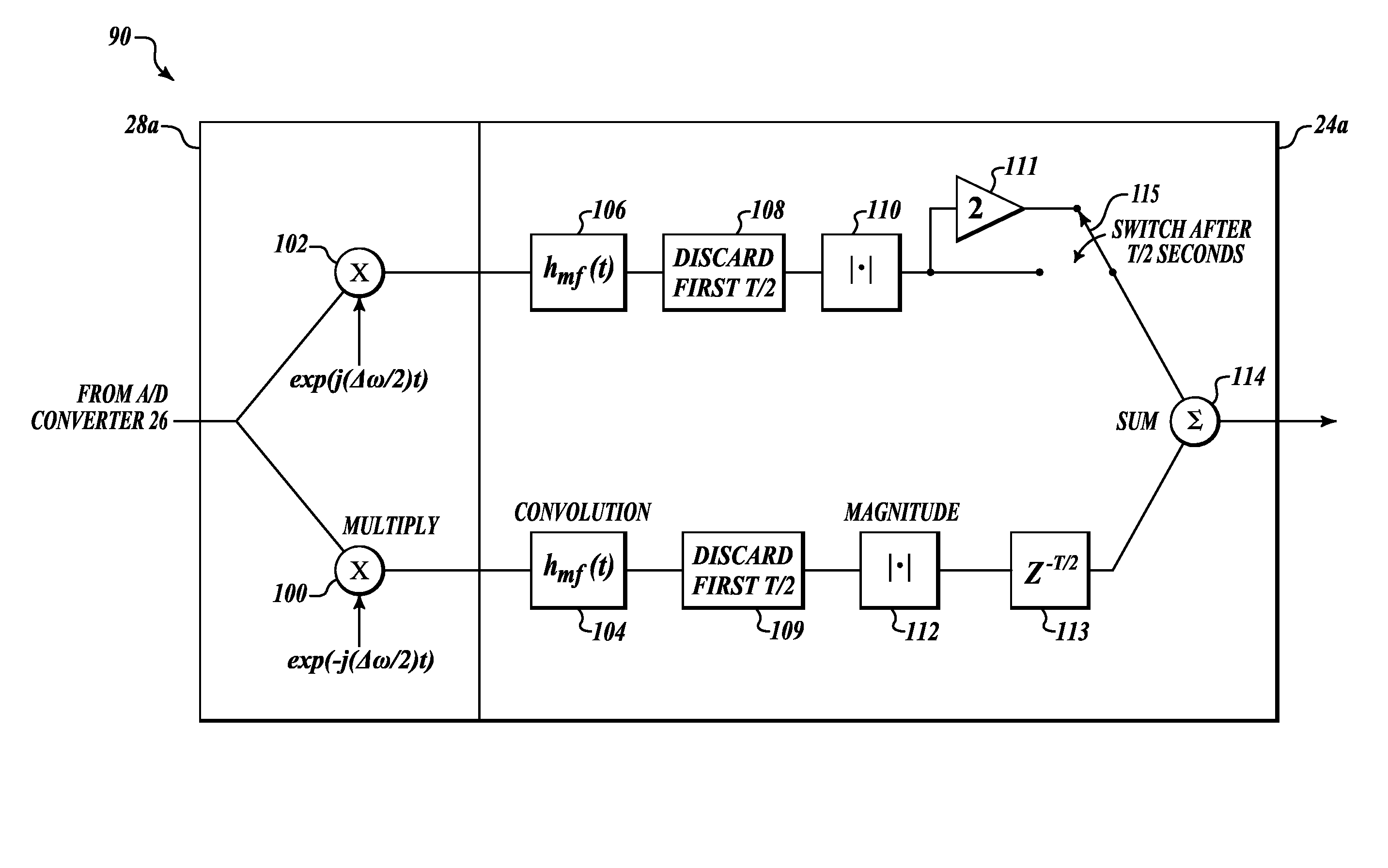
[0010]FIG. 1 is a schematic illustration of a system 10 for avoiding partial pulse interference for pulse compressed radar in accordance with an embodiment of the present invention. The system 10 includes a radar processor 20 to generate two consecutive pulses which are transmitted by a transmitter and receiver device 40. The generated pulses are each approximately of duration T / 2, where T represents a pulse duration ordinarily used for pulse compressed radar at a given range. Echoes corresponding to the transmitted pulses are also received by the transmitter and receiver device 40 which are then processed into useable image data by the radar processor 20. The system 10 can be used to improve the performance of airborne weather radar systems such as Honeywell's RDR-4000 and RDR-4000M products for example.

[0011]FIG. 2 is a schematic diagram showing additional detail for the system 10 of FIG. 1. The radar processor 20 includes a control processor 22 in data communication with a Digita...

the structure of the environmentally friendly knitted fabric provided by the present invention; figure 2 Flow chart of the yarn wrapping machine for environmentally friendly knitted fabrics and storage devices; image 3 Is the parameter map of the yarn covering machine
Login to View More

PUM

No PUM Login to View More

Abstract

Systems and methods for avoidance of partial pulse interference in radar. The systems and methods include a radar processor for generating control signals that direct the generation and transmission of two consecutive radar pulses using a waveform and pulse train generator and transmitter. The systems and methods also include receiving reflected echoes corresponding to the transmitted pulses using a receiver and processing the echoes using an analog to digital converter, filter, and digital signal processor to separate echoes from each pulse, process them, and combine the results to avoid partial pulse interference while maintaining pulse energy and an acceptable signal to noise ratio.

Description

BACKGROUND OF THE INVENTION[0001]Pulse compression for airborne weather radar has several advantages. Among these is the ability to provide excellent radar detection performance using a low power transmitter, which allows much lower system cost. Although pulse compression is powerful, it has an inherent drawback because it requires longer pulses to achieve the equivalent peak power signal to noise ratio (SNR) of a system not using pulse compression. This can lead to severe partial pulse interference at close ranges. Partial pulse interference is caused by radar returns from ranges closer than a pulse length from the radar. The radar receiver is turned on after the pulse transmission, so close in returns do not contain complete pulse histories. When partial pulses are processed by the pulse compression portion of the receiver, it results in range side-lobes that can overwhelm data from valid ranges which are greater than the pulse length. The amount of interference is highly dependen...

Claims

the structure of the environmentally friendly knitted fabric provided by the present invention; figure 2 Flow chart of the yarn wrapping machine for environmentally friendly knitted fabrics and storage devices; image 3 Is the parameter map of the yarn covering machine
Login to View More

Application Information

Patent Timeline
no application Login to View More
Patent Type & Authority Patents(United States)
IPC IPC(8): G01S13/95G01S13/28G01S7/28
CPCG01S13/106G01S13/30G01S13/953Y02A90/10
Inventor HOLMBERG, BART A.
Owner HONEYWELL INT INC