

Method and communication system for implementing calling tapping at flash
a communication system and flash technology, applied in the field of communication technology, can solve the problems of increasing memory overhead, inability to implement the above subscribe/notify solution for voice message event packets, and inability to implement the voice message event packet scheme based on subscribe/notify mechanism, etc., to facilitate user operations and use, facilitate generalization, and simplify the processing flow of network elements
- Summary
- Abstract
- Description
- Claims
- Application Information
AI Technical Summary
Benefits of technology
Problems solved by technology
Method used
Image

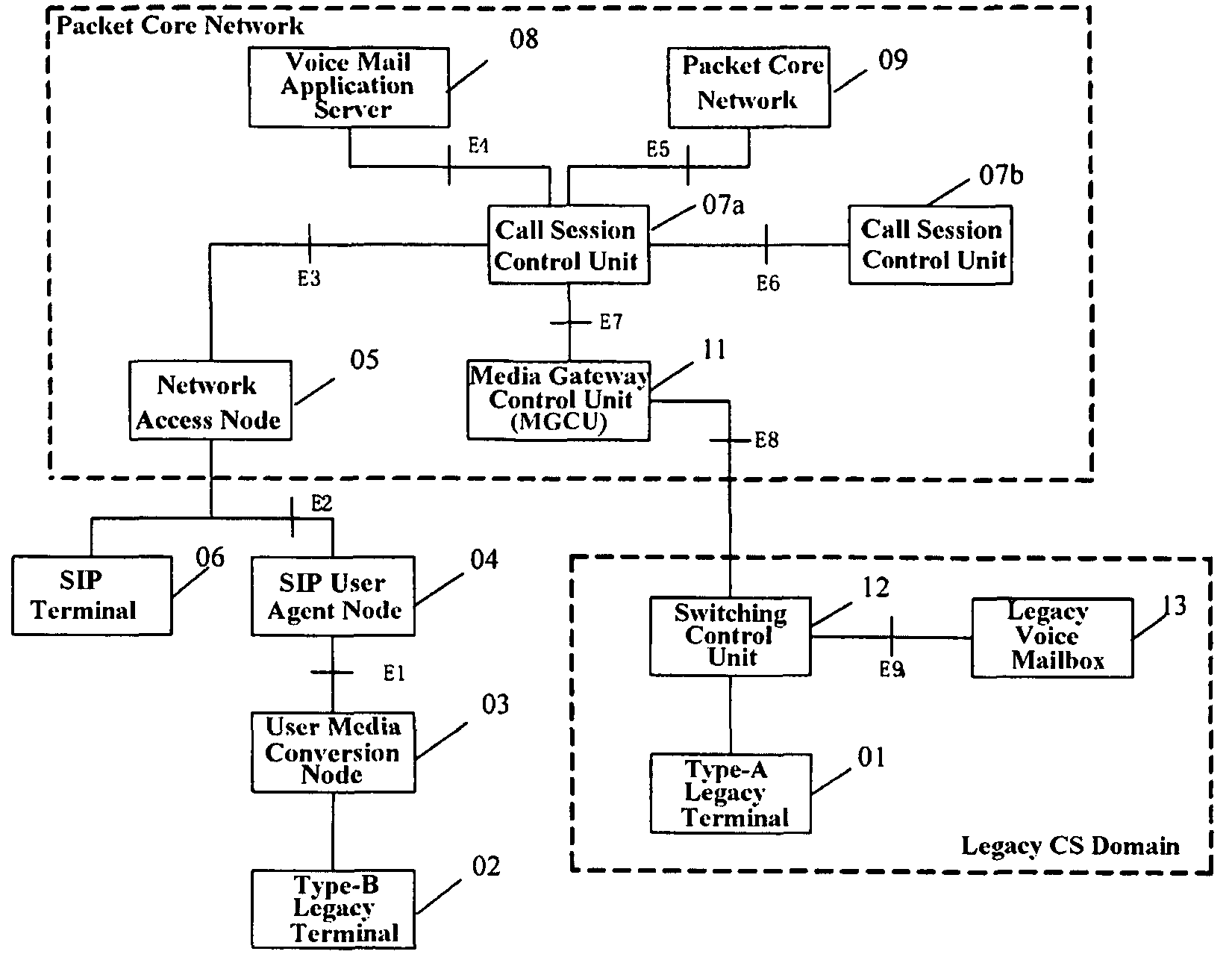


Examples
embodiment 1
[0109]Case 1: User in PS domain, with voice mailbox in PS domain.
[0110]The user in PS domain may be an SIP terminal or a type-B legacy terminal, who has activated voice mail service, with Calling Tapping at Flash service activated by default; The Calling Tapping at Flash service flow is shown in FIG. 2.
[0111]A. Processing flow for user as SIP terminal user in PS domain:
[0112](10) When there is a new voice message for a user in the voice mailbox of the user, the Voice Mail Application Server sends a MESSAGE message, with the user's voice message information indicated in the body of the MESSAGE message; there contains a defined MIME media type body in the body of the MESSAGE message; an instance is as follows:[0113]MessageSummary Media Type
[0114]The medial type can be defined as follows:[0115]Media type name: application[0116]Media subtype name: MessageSummary-Information[0117]Required parameters: version[0118]Optional parameters: base[0119]Encoding scheme: XML
[0120]The parameters for...
embodiment 2
[0161]Case 2: User in legacy CS domain, with voice mailbox in PS domain, and the subscribed voice mailbox is a Voice Mail Application Server in the PS domain. As shown in FIG. 3, the processing flow is as follows:
[0162](700) When there is a new voice message for the user, the Voice Mail Application Server sends a MESSAGE message, with the user's voice message information described in an MIME body in the body of the MESSAGE message.
[0163](710) The call session control unit forwards the MESSAGE message.
[0164](720) The MGCU receives and parses the MESSAGE message, abstracts the MIME body, converts the MIME body into MessageWaitingNotification parameter in ISUP signaling, and sends the parameter via an Initial Address Message (IAM) message.
[0165](730) The switching control unit receives and parses the IAM message, abstracts the MessageWaitingNotification parameter and learns that there is a new voice message for the user, and treats the IAM message appropriately in accordance with the u...
embodiment 3
[0171]Case 3: User in PS domain, with voice mailbox in legacy CS domain.
[0172]The user (SIP terminal or type-B legacy terminal) are in PS domain, while the voice mailbox for the user is in the legacy CS domain. In the following flow instance, the user in PS domain is an SIP terminal (for a type-B legacy terminal, please refer to the processing flow of SIP user agent node and supplementary service control unit in the above case 1). As shown in FIG. 4 (the switching control unit is omitted between the legacy voice mailbox and the MGCU), the processing flow is as follows:
[0173](900) When there is a new voice message for a user in the voice mailbox of the user, the voice mailbox initiates a call by sending a IAM message via ISUP signaling, with a MessageWaitingNotification parameter carried in the IAM message to indicate the user's voice message information.
[0174](910) The MGCU receives and parses the IAM message, abstracts the MessageWaitingNotification parameter from the IAM message, ...
PUM
 Login to View More
 Abstract
Description
Claims
Application Information
 Login to View More