Systems and methods for operating wireless networks

US8121604B1Inactive Publication Date: 2012-02-21NEXTEL COMMUNICATIONS
15 Cites 74 Cited by

Patent Information

Authority / Receiving Office
US · United States
Current Assignee / Owner
Publication Date
2012-02-21
Estimated Expiration
Not applicable · inactive patent

Smart Images

  • Figure 1
    Figure 1
  • Figure 2
    Figure 2
  • Figure 3
    Figure 3
Patent Text Reader

Abstract

Systems and methods for wireless networks with inner and outer cells are provided. A base station determines an amount of traffic on an inner and outer cell. When the traffic exceed a predetermined threshold value, traffic is adjusted on the inner or outer cell. Traffic can be adjusted by handing off some of the traffic from the inner cell to the outer cell, from the outer cell to the inner cell, between sectors of the inner or outer cells and / or by handing off traffic to a proximately located base station.
Need to check novelty before this filing date? Find Prior Art

Description

[0001] The present application claims priority under 35 U.S.C. §119 to U.S. Provisional Application No. 60 / 658,370, filed Mar. 4, 2005, the entire disclosure of which is herein expressly incorporated by reference.BACKGROUND OF THE INVENTION

[0002] The popularity of wireless networks has resulted in a desire for wireless network operators to increase the capacity of their networks. One way to increase capacity is to use more frequencies over the air interface between base stations and mobile stations. However, most frequencies are allocated by governments bodies and most, if not all, available frequencies have been allocated. Another way to increase capacity is to add cell stations by decreasing the size of existing cells. However, adding base stations requires time consuming and expensive zoning approvals from local government bodies. It also requires additional costs for the equipment for the additional base stations, as well as costs associated with leasing space for the equipment.SU...

Examples

Embodiment Construction

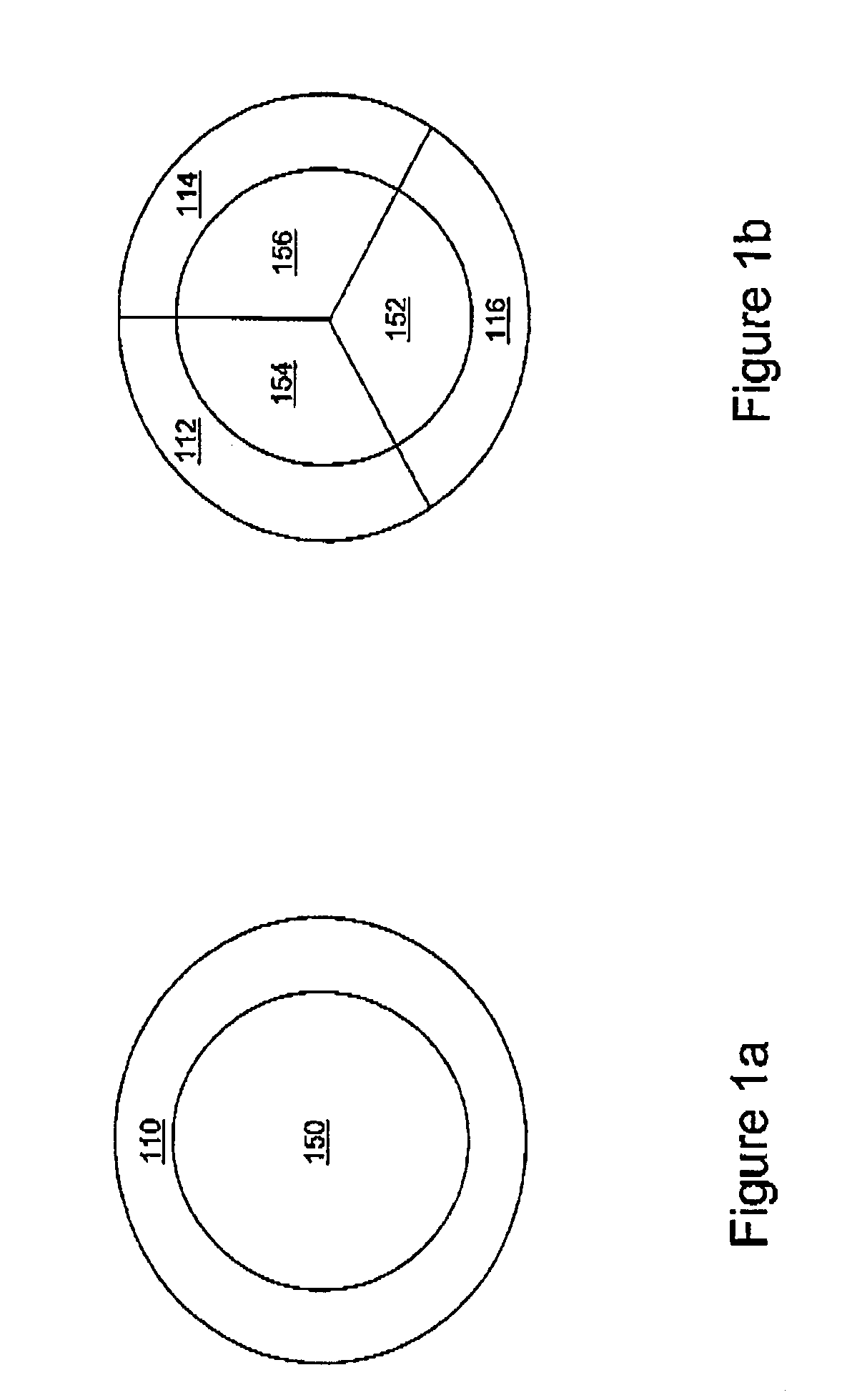
[0010]FIGS. 1a and 1b illustrate exemplary inner and outer cell arrangements in accordance with the present invention. Specifically, FIG. 1a illustrates an exemplary single sector base station with an outer cell 110 and an inner cell 150. The inner and outer cells 110 and 150 are generated by a single base station, thereby eliminating the additional expenses associated with adding base stations. Specifically, existing antennas and base station radios can be divided between the inner and outer cells 110 and 150, further reducing additional equipment costs. FIG. 1b illustrates an exemplary three sector inner and outer cell arrangement in accordance with the present invention. The outer cell includes sectors 112-116 and the inner cell includes sectors 152-156. In some implementations the sectors can be supported by three antennas, where two antennas are receiving antennas and one antenna is a transmit / receive antenna. Although FIGS. 1a and 1b illustrate only two concentric cells, the b...