

Device for detecting a flaw in a component
a technology for components and flaws, applied in the field of devices for detecting flaws in components, can solve the problems of insufficient contribution of sound energy to flaw detection, negative effect on flaw assessment,
- Summary
- Abstract
- Description
- Claims
- Application Information
AI Technical Summary
Benefits of technology
Problems solved by technology
Method used
Image

Examples
Embodiment Construction
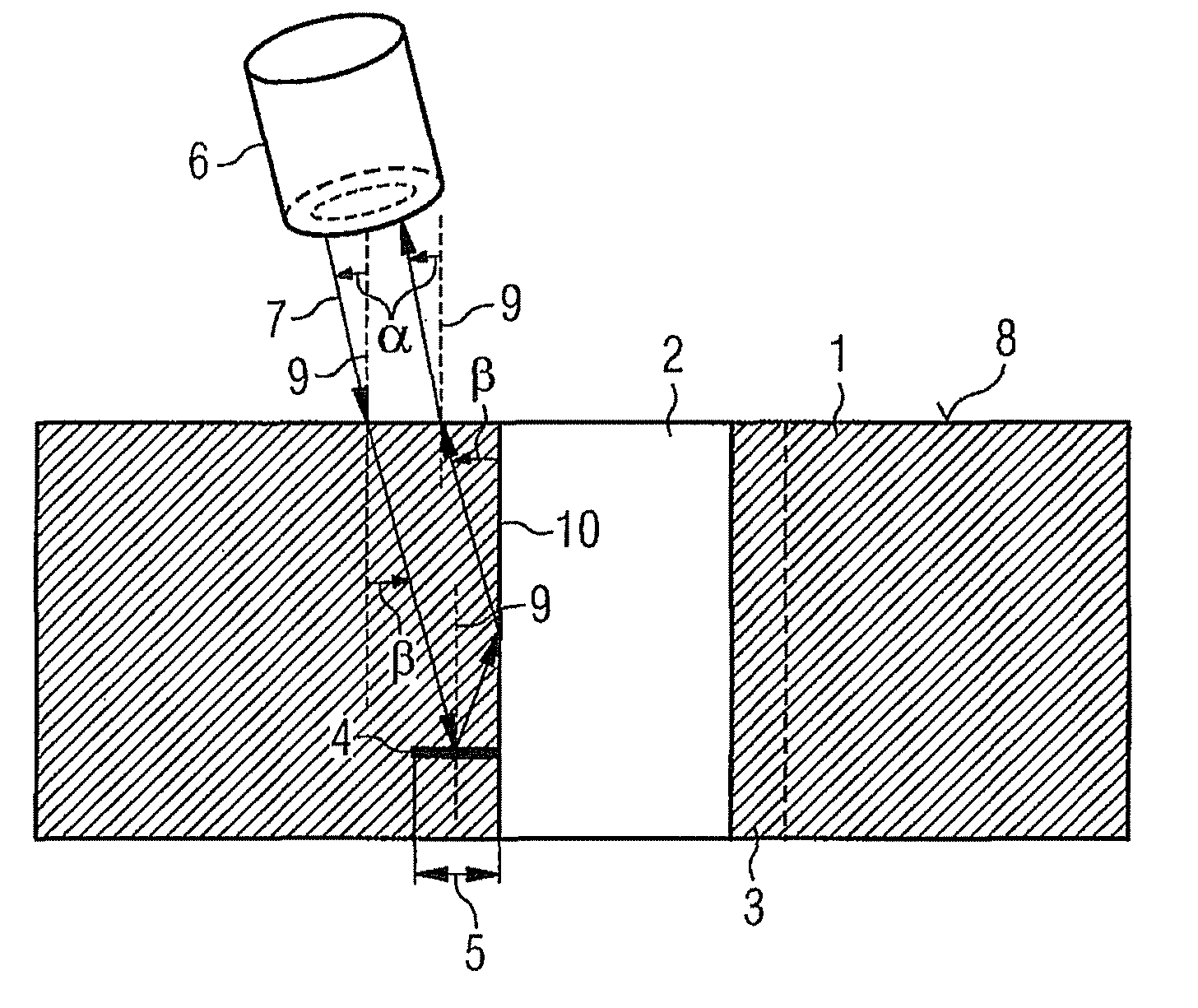
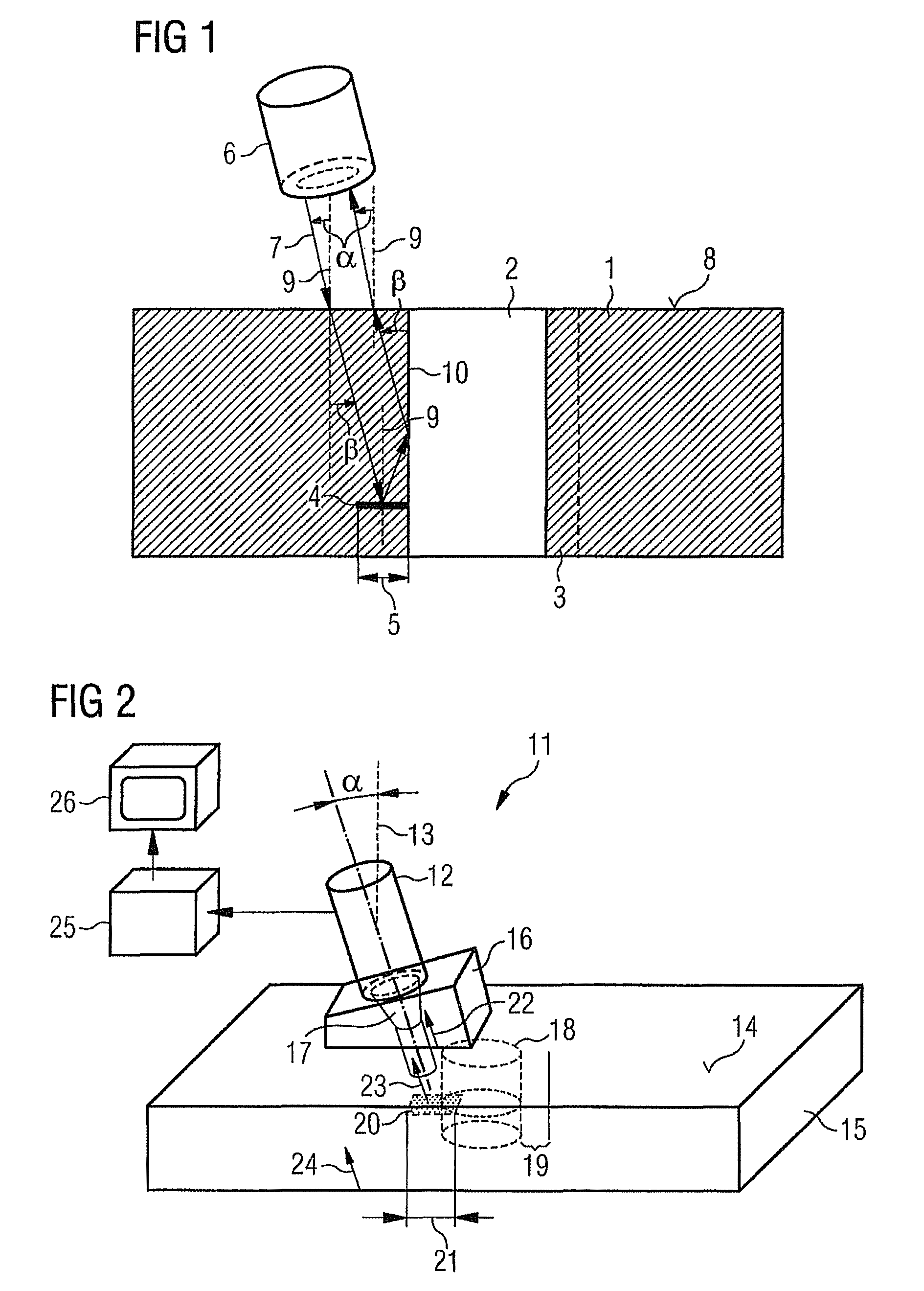
[0052]FIG. 1 is a schematic view of the operation of a device formed according to the invention.
[0053]A cylindrical hole 2 is formed in a component 1. The component 1 is preferably any composite component generally formed from a carbon-fibre-reinforced epoxy resin. There is delamination 4 to be detected having a width 5 in a bearing region 3 of the hole 2. The term “delamination” refers to a region in which reinforcing fibre layers have become detached or separated from the surrounding polymer matrix. These air-filled delamination regions may be formed during the process of manufacturing the component 1 or when the holes are formed. In both cases, the mechanical loading capacity of a connection between the component 1 and an attachment, formed for example by introducing bolts or rivets into the hole 1, is detrimentally affected, so therefore delamination in the region of holes in composite components must be able to be reliably detected in a continuous test process.
[0054]Ultrasound ...
PUM
| Property | Measurement | Unit |
|---|---|---|
| angle of incidence | aaaaa | aaaaa |
| pulse frequency | aaaaa | aaaaa |
| frequency | aaaaa | aaaaa |
Abstract
Description
Claims
Application Information
 Login to View More