5H-thioeno(3,4-c)pyrrole-4,6-dione derivatives and their use as tumor necrosis factor inhibitors
Active Publication Date: 2012-05-22
TIANJIN HEMAY BIO TECH CO LTD
View PDF11 Cites 5 Cited by
Summary
Abstract
Description
Claims
Application Information
AI Technical Summary
This helps you quickly interpret patents by identifying the three key elements:
Problems solved by technology
Method used
Benefits of technology
Problems solved by technology
The storage of silicon-containing particles can cause silicosis.
Method used
the structure of the environmentally friendly knitted fabric provided by the present invention; figure 2 Flow chart of the yarn wrapping machine for environmentally friendly knitted fabrics and storage devices; image 3 Is the parameter map of the yarn covering machine
View more
Image
Smart Image Click on the blue labels to locate them in the text.
Viewing Examples
Smart Image
Click on the blue label to locate the original text in one second.
Reading with bidirectional positioning of images and text.
Smart Image
Examples
Experimental program
Comparison scheme
Effect test
example 1
Thiophene-3,4-dicarbonitrile
[0238]
[0239]To a 2000 mL three-necked flask under inert gas, equipped with a mechanic stirrer, and a reflux condenser, 96.80 g of 3,4-dibromothiophene, 104 g cuprous cyanide, and 100 mL anhydrous DMF were added. After refluxing for 4 h, the reaction mixture was cooled down to room temperature; and a solution obtained by dissolving 400 g of FeCl3.6H2O in 700 mL of hydrochloric acid (1.7 M) was added into the reaction mixture and allowed to react for 30 min at 60-70° C. After the reaction mixture was fully cooled, 500 mL DCM was added. The reaction mixture was divided into 300 mL portions and extracted with DCM (2×300 mL). The DCM layers were combined. The extracts were divided into 600 mL portions, washed successively with 2×50 mL 6N hydrochloric acid, water, saturated Na2CO3 aq., and brine; dried over anhydrous MgSO4, filtered, and evaporated to dryness to obtain a yellow solid. The solid was washed with a mixture of ethyl acetate:petroleum ether=1:1, and...
example 2
Thiophene-3,4-dicarboxylic acid
[0240]
[0241]To a 500 mL round bottom flask equipped with an electromagnetic stirrer and a reflux condenser, 15.978 g of 3,4-dicyanothiophene, 43.997 g KOH, and 174 mL glycol were added; and the mixture was refluxed for 4 h. After the reaction mixture was cooled, 350 mL water was added, and the aqueous layer was extract with ether (2×100 mL). The layers were separated, the aqueous layer was cooled down in an ice bath, and excess strong hydrochloric acid was added until a white precipitate appeared. The solid was filtered and dissolved in 2000 mL of ether. The aqueous layer was extracted with ether (3×300 mL). Organic layers were combined, dried over anhydrous MgSO4, filtered, and evaporated to dryness. 15 g of white solid was obtained and recrystallized from water. 1H NMR (DMSO-d6): δ 10.35 (brs, 2H, COOH), 8.17 (s, 2H); MS (m / z): 171 (M−1)+.
example 3
Thieno(3,4-c)furan-1,3-dione
[0242]
[0243]To a 250 mL round bottom flask under inert atmosphere, equipped with an electromagnetic stirrer, and a reflux condenser, 15 g of thieno-3,4-dicarboxylic acid and 120 mL of acetic anhydride were added. The mixture was refluxed for 3 h, evaporated to dryness to remove solvent. 13 g of deep brown solid were obtained.
the structure of the environmentally friendly knitted fabric provided by the present invention; figure 2 Flow chart of the yarn wrapping machine for environmentally friendly knitted fabrics and storage devices; image 3 Is the parameter map of the yarn covering machine
Login to View More
PUM
Property
Measurement
Unit
temperature
aaaaa
aaaaa
temperature
aaaaa
aaaaa
humidity
aaaaa
aaaaa
Login to View More
Abstract
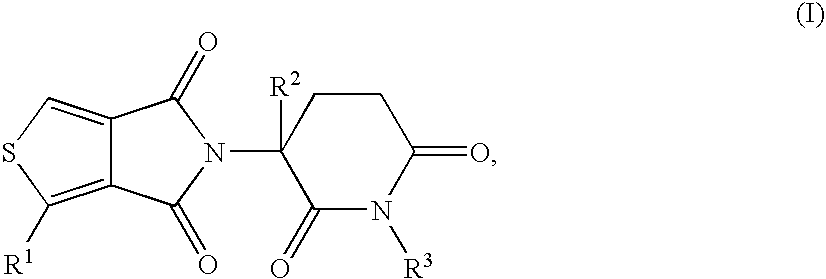
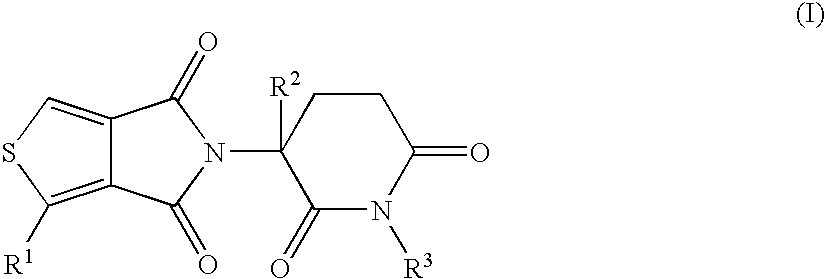
Taught are derivatives of 5H-thioeno(3,4-c)pyrrole-4,6-dione, their organic, and inorganic salts, methods of synthesis of these derivatives, and their application as active pharmaceutical-ingredients useful as inhibitors of TNFα, the derivative being represented by the general formula (I):in which R1 represents H, C1-6alkyl, OR4, OC(O)R5, NO2, NHC(O)R6, or NR7R8; R2 represents H, a halogen, or C1-6alkyl; R3 represents H, methyl, isopropyl, allyl, benzyl, CH2CO2(C1-6alkyl), or CH2(CH2)nR9; R4, R5, R6, R7, and R8 each independently and at each occurrence represents H, or C1-6alkyl; R9 represents H, C1-6alkyl, OH, OC1-6alkyl, NH2, NHC1-6alkyl, N(C1-6alkyl)2, or CO2(C1-6alkyl); and n represents 1, 2, 3, or 4.
Description
CROSS-REFERENCE TO RELATED APPLICATIONS[0001]This application is a continuation of International Patent Application No. PCT / CN2006 / 002413 with an international filing date of Sep. 15, 2006, designating the United States, now pending, and further claims priority benefits to Chinese Patent Application No. 200510015209.6, filed on Sep. 27, 2005. The contents of these specifications are incorporated herein by reference.BACKGROUND OF THE INVENTION[0002]1. Field of the Invention[0003]This invention relates to 5H-thioeno(3,4-c)pyrrole-4,6-dione derivatives which are active as inhibitors of tumor necrosis factor (TNF) released by cells, the preparation of these derivatives, as well as their application as pharmaceutically-active ingredients.[0004]2. Description of the Related Art[0005]Tumor necrosis factor-alpha (TNFα) is a cytokine, mainly produced by mononuclear macrophages. It causes inflammation, fever, cardiovascular dysfunction, hemorrhage, blood coagulation and a series of acute reac...
Claims
the structure of the environmentally friendly knitted fabric provided by the present invention; figure 2 Flow chart of the yarn wrapping machine for environmentally friendly knitted fabrics and storage devices; image 3 Is the parameter map of the yarn covering machine
Login to View More
Application Information
Patent Timeline
Application Date:The date an application was filed.
Publication Date:The date a patent or application was officially published.
First Publication Date:The earliest publication date of a patent with the same application number.
Issue Date:Publication date of the patent grant document.
PCT Entry Date:The Entry date of PCT National Phase.
Estimated Expiry Date:The statutory expiry date of a patent right according to the Patent Law, and it is the longest term of protection that the patent right can achieve without the termination of the patent right due to other reasons(Term extension factor has been taken into account ).
Invalid Date:Actual expiry date is based on effective date or publication date of legal transaction data of invalid patent.


 Login to View More