
Technique for estimation of confidence interval for probability of defect rediscovery
a technology of confidence interval and probability, applied in the direction of pulse technique, instruments, computing models, etc., can solve the problems of defect rediscovery and many customers not installing the fix
- Summary
- Abstract
- Description
- Claims
- Application Information
AI Technical Summary
Benefits of technology
Problems solved by technology
Method used
Image

Examples
case 2
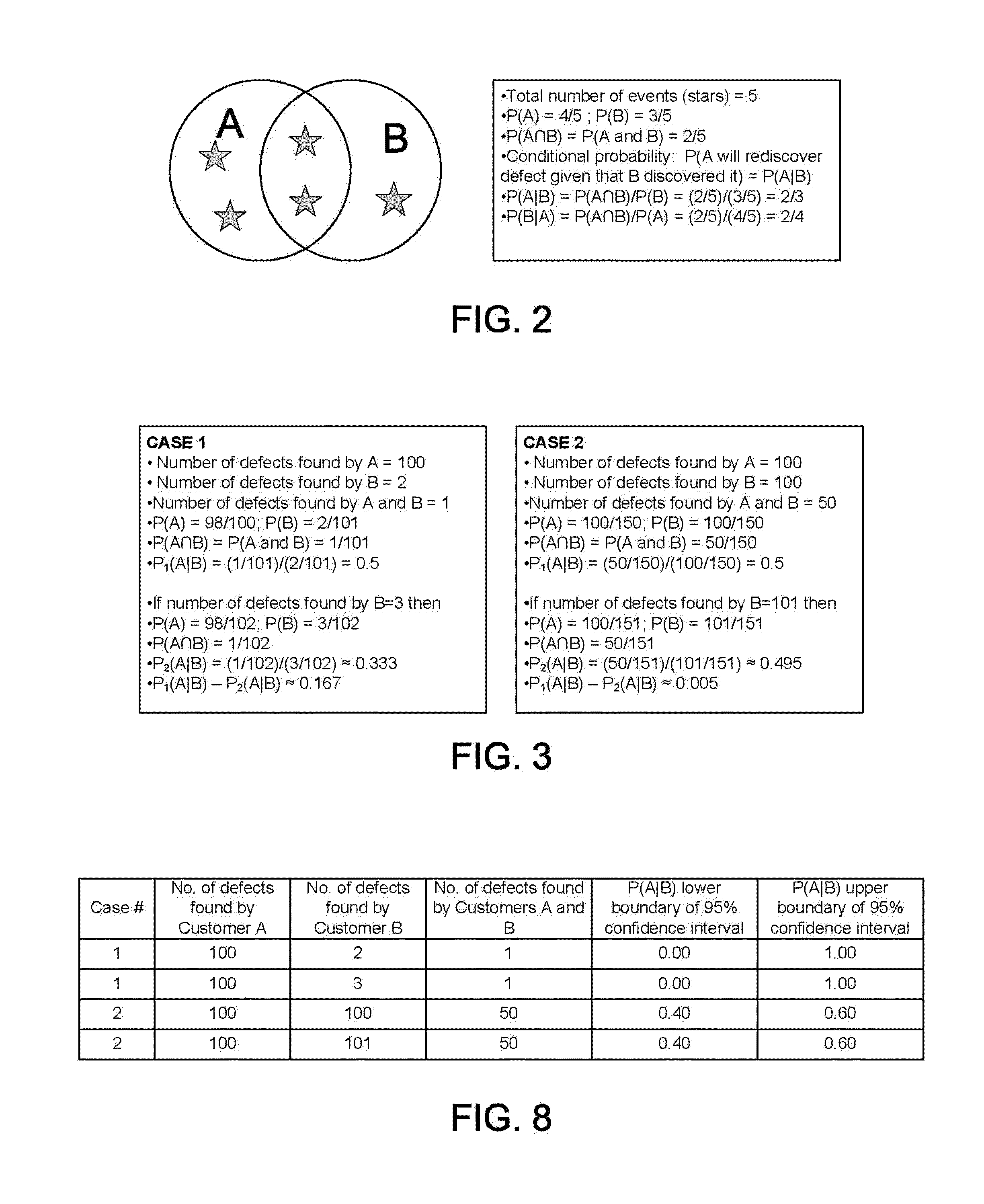
[0036 illustrates a larger dataset. In Case 2, the number of defects found by customer A is 100, and the number of defects found by customer B is 100. The number of defects found by customers A and B is 50. This leads to the probabilities: P(A)=100 / 150; P(B)=100 / 150; and P(A∩B)=50 / 150. The conditional probability is thus:
[0037]P1(A❘B)=50 / 150100 / 150=0.5.
If the number of defects found by customer B=101, then this leads to the probabilities: P(A)=100 / 151; P(B)=101 / 151; and P(A∩B)=50 / 151. The conditional probability is thus:
[0038]P2(A❘B)=50 / 151101 / 151=0.495.
The difference between P1 and P2 is approximately 0.005. As illustrated, the change in P(A|B) for the small dataset in Case 1 is more dramatic than for the larger dataset in Case 2.
[0039]Formal analysis of CI can be performed using z-statistics. However, z-statistics assumes that the data is normally distributed. If the dataset if not normally distributed, then by the Law of Large Numbers, it converges to normal distribution for a ...
case 1
[0049]In this embodiment, cases are defined to include:[0050]Case 1=software product defects found by customer A 108 but not found by customer B 109);[0051]Case 2=software product defects found by customer A 108 and customer B 109; and[0052]Case 3=software product defects found by customer B 109 but not found by customer A 108.
Thus, cases=┌1,2,3┐ (line 5). The probabilities of the cases are also determined as:
[0053]p_cases=⌈a-bl,bl,c-bl⌉(line6).
[0054]The function 500 next determines the conditional probability array (prob_arr[i]) by calling the calculateConditinalProbability function (line 8). The values of p_cases and cases are passed to the calculateConditinalProbability function as parameters. The calling of the calculateConditinalProbability function is repeated N times, i.e., to achieve the predetermined number of bootstrapping draws (line 7).
[0055]FIG. 6A illustrates an embodiment of the calculateConditinalProbability function. The calculateConditinalProbability function 6...
PUM
 Login to View More
 Abstract
Description
Claims
Application Information
 Login to View More