
Method for detaching cultured cells, cell detachment device used in said method for detaching cultured cells, and incubator
a cell detachment and cultured cell technology, applied in the field of cell detachment device used in the detachment of cultured cells, incubator, etc., can solve the problems of risk of contamination of cells, cells and non-desired cells, and the difficulty of selective detachment of cells on the scaffold
- Summary
- Abstract
- Description
- Claims
- Application Information
AI Technical Summary
Benefits of technology
Problems solved by technology
Method used
Image

Examples
example 1
[0068]This example is to make an explanation of an example in which a cell adhesion factor for forming a scaffold is composed of a single wall nanotube.
1. Preparation of a Solution Containing a Cell Adhesion Factor:
[0069]A solution containing the cell adhesion factor was prepared by mixing carboxylmethyl cellulose sodium salt (CMC-Na) with a single-walled carbon nanotube (SWNT). In this example, CMC-Na was added as a dispersing agent for the single-walled carbon nanotube and it does not function as a cell adhesion factor. Therefore, in this example, the cell adhesion factor consisted solely of the single-walled carbon nanotube.
[0070]The solution containing the cell adhesion factor was prepared in the following specific way. To 10 ml of water was added 1 mg of SWNT (Meijo Nanocarbon K.K.), and 3 mg of CMC-Na (Kishida Chemical K.K.) was added. The resulting mixture was then subjected to ultrasonic treatment for 120 minutes using a bath-type sonicater (Branson 5510) for dispersing the ...
example 2
[0113]This example is to explain an example where the cell adhesion factor forming the scaffold is structured with a mixture of the SWNT with a collagen.
1. Hydrophilization Treatment of SWNT:
[0114]The SWNT structuring a part of the cell adhesion factor was hydrophilized with ozone. The SWNT (HIPCO®, CNI) was spread uniformly over on the inner bottom of a dish (TRADE FLAT MARK). The dish was then placed in a UV ozone cleaner and irradiated with ultraviolet light for 10 minutes in the presence of oxygen, followed by stirring with a spatula and repeating this operations six times to perform the hydrophilization of the SWNT.
2. Preparation of Cell Adhesion Factor:
[0115]In this example, a mixture of collagen with SWNT was used as the cell adhesion factor.
[0116]The mixture was prepared by adding 2.2 mg of SWNT hydrophilized as above with 3 mg of collagen (Nitta Gelatin K.K.; pH 3, 0.3% Cellmatrix Type I-A) to 10 ml of water, and the resulting mixture was subjected to ultrasonic treatment f...
example 3
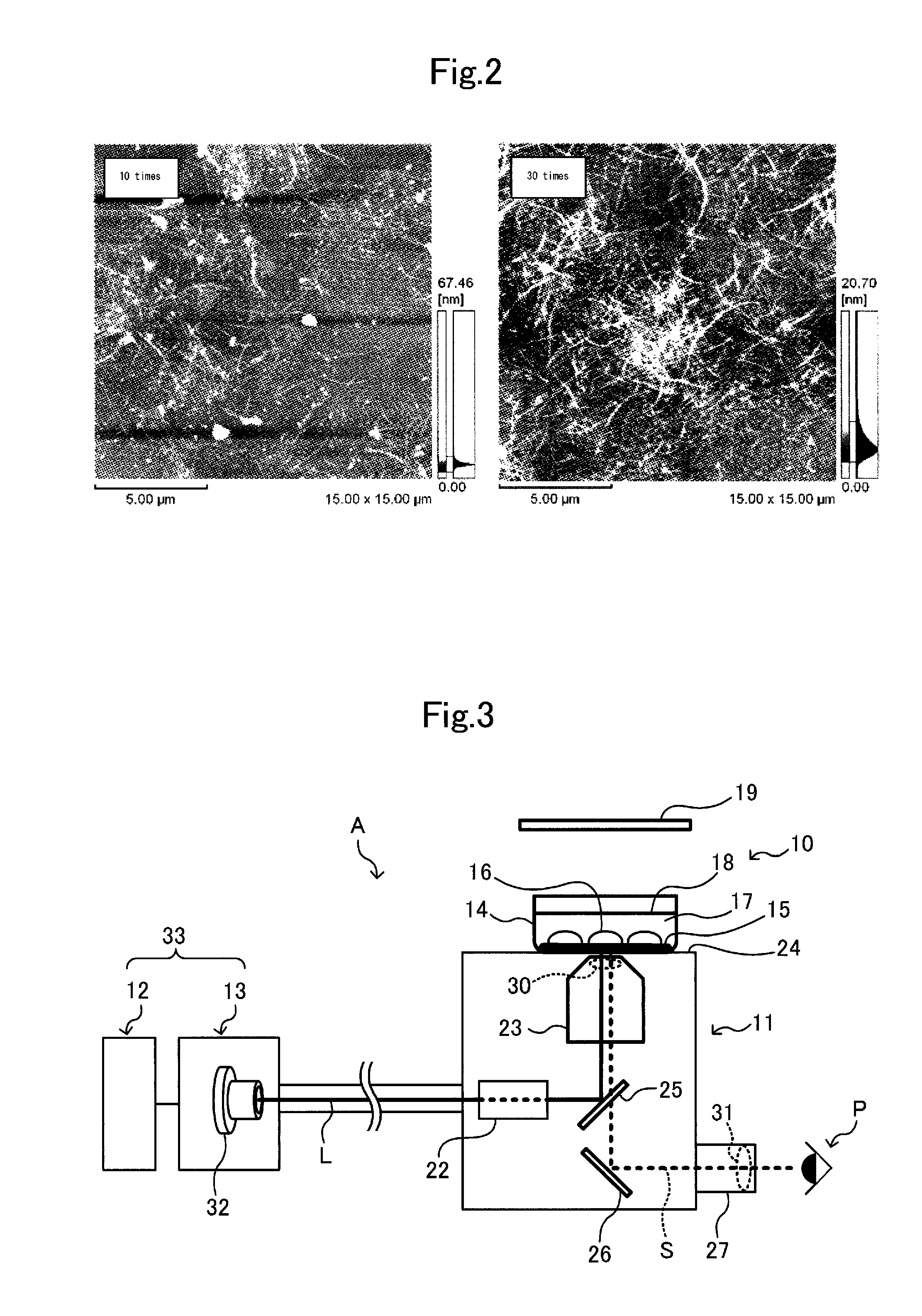
[0127]This example indicates an example in which a single cell was irradiated with the laser beams and caused to adhere to a rear surface of a dish lid, followed by a selective collection of the adhered single cell. In this example, the cell adhesion factor and the incubator were prepared in substantially the same manner as done in Example 1. A description of them is omitted herefrom accordingly.
Example of collection of cell upon irradiation with laser beams having different wavelengths:
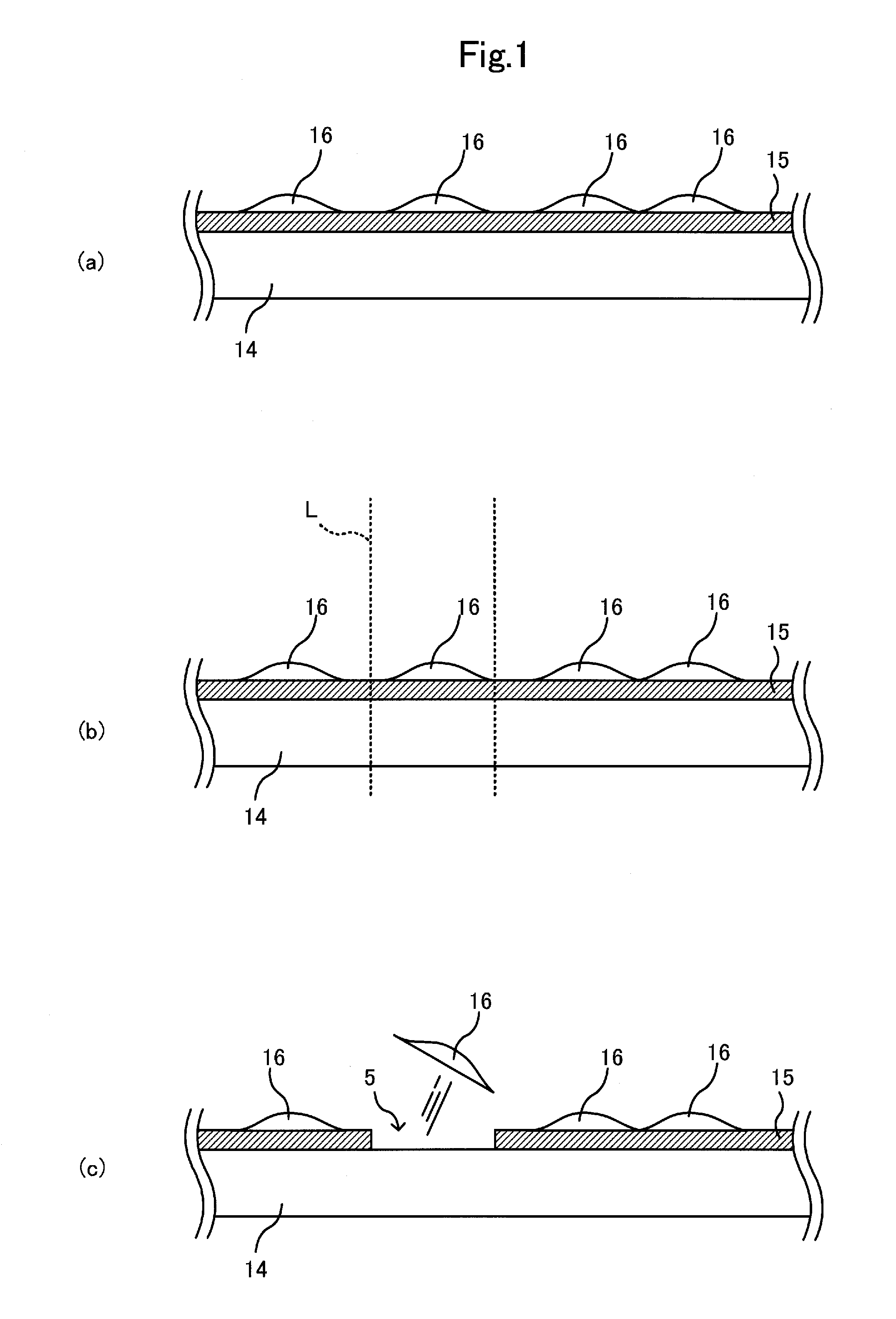
[0128]HeLa cells were incubated in a dish, and the laser beams having different wavelengths were sent from the cell detachment device A upon a site of the scaffold of the dish, in which the number of the cell adhered thereto was set to only one cell, thereby detaching the single cell adhered to the scaffold.
[0129]As the wavelengths of the laser beams, there were used herein three different laser beams having a wavelength of 254 nm (an ultraviolet laser beam), 785 nm (a visual laser beam), and 1,064 n...
PUM
| Property | Measurement | Unit |
|---|---|---|
| depth | aaaaa | aaaaa |
| depth | aaaaa | aaaaa |
| depth | aaaaa | aaaaa |
Abstract
Description
Claims
Application Information
 Login to View More