
Allomone repulsive and kairomone attractive compositions for controlling arachnids
a technology of allomones and attractive compositions, applied in the direction of drug compositions, antiparasitic agents, detergent compounding agents, etc., can solve the problems of difficult treatment of skin diseases in dogs, annoy humans, and mortality in young or very old individuals, and achieve enhanced mite stickiness and feeding behavior.
- Summary
- Abstract
- Description
- Claims
- Application Information
AI Technical Summary
Benefits of technology
Problems solved by technology
Method used
Image

Examples
example 1
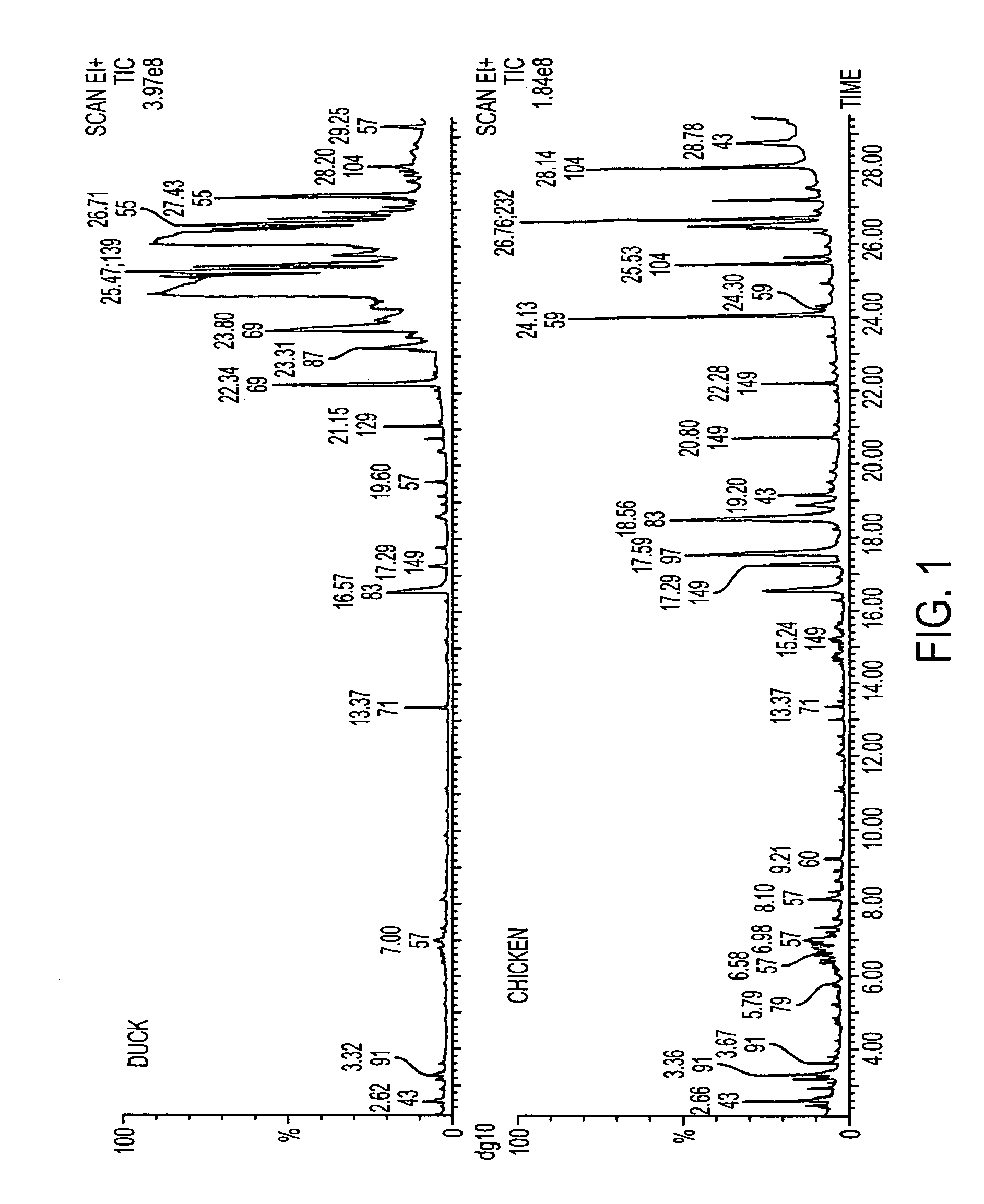
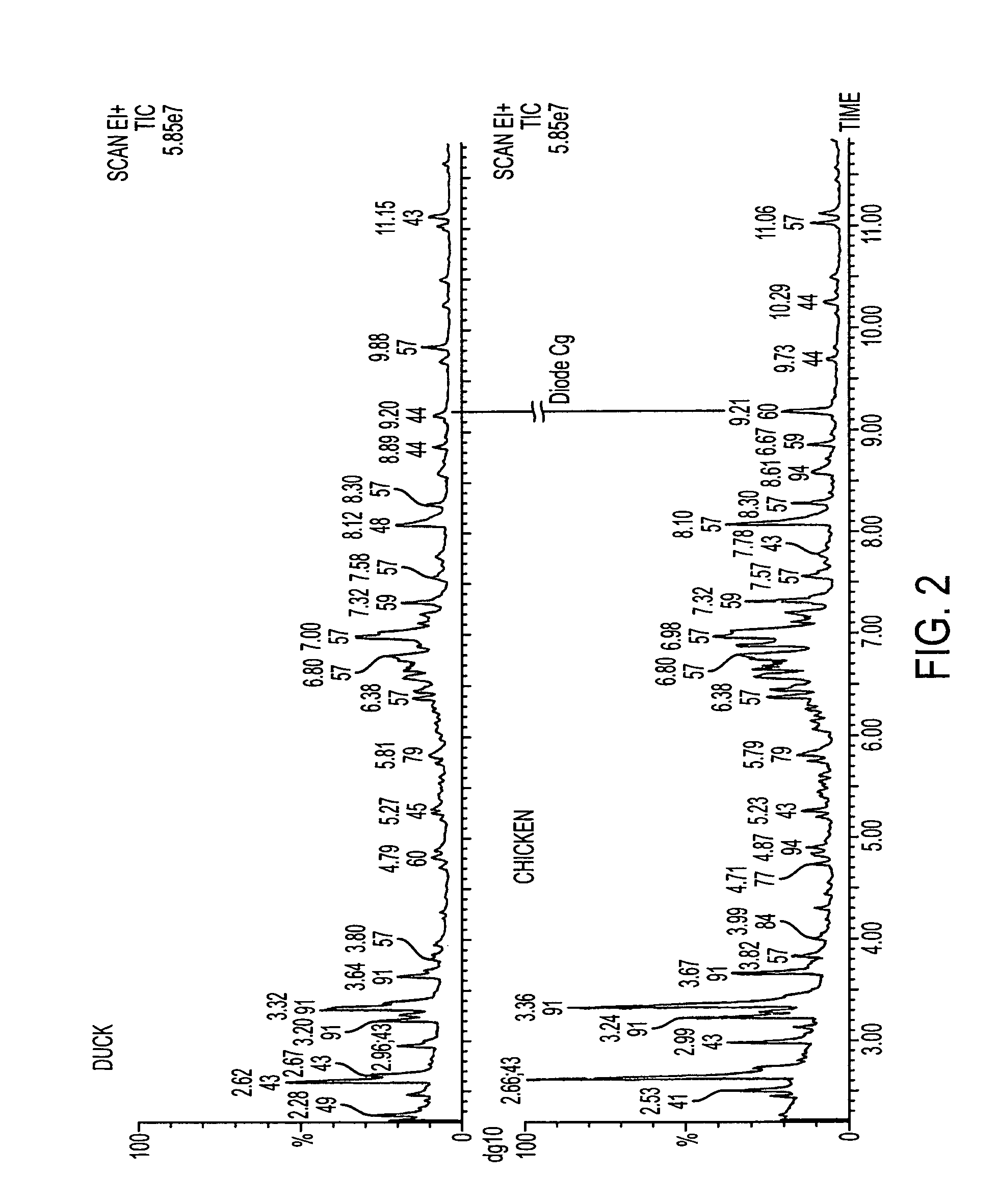
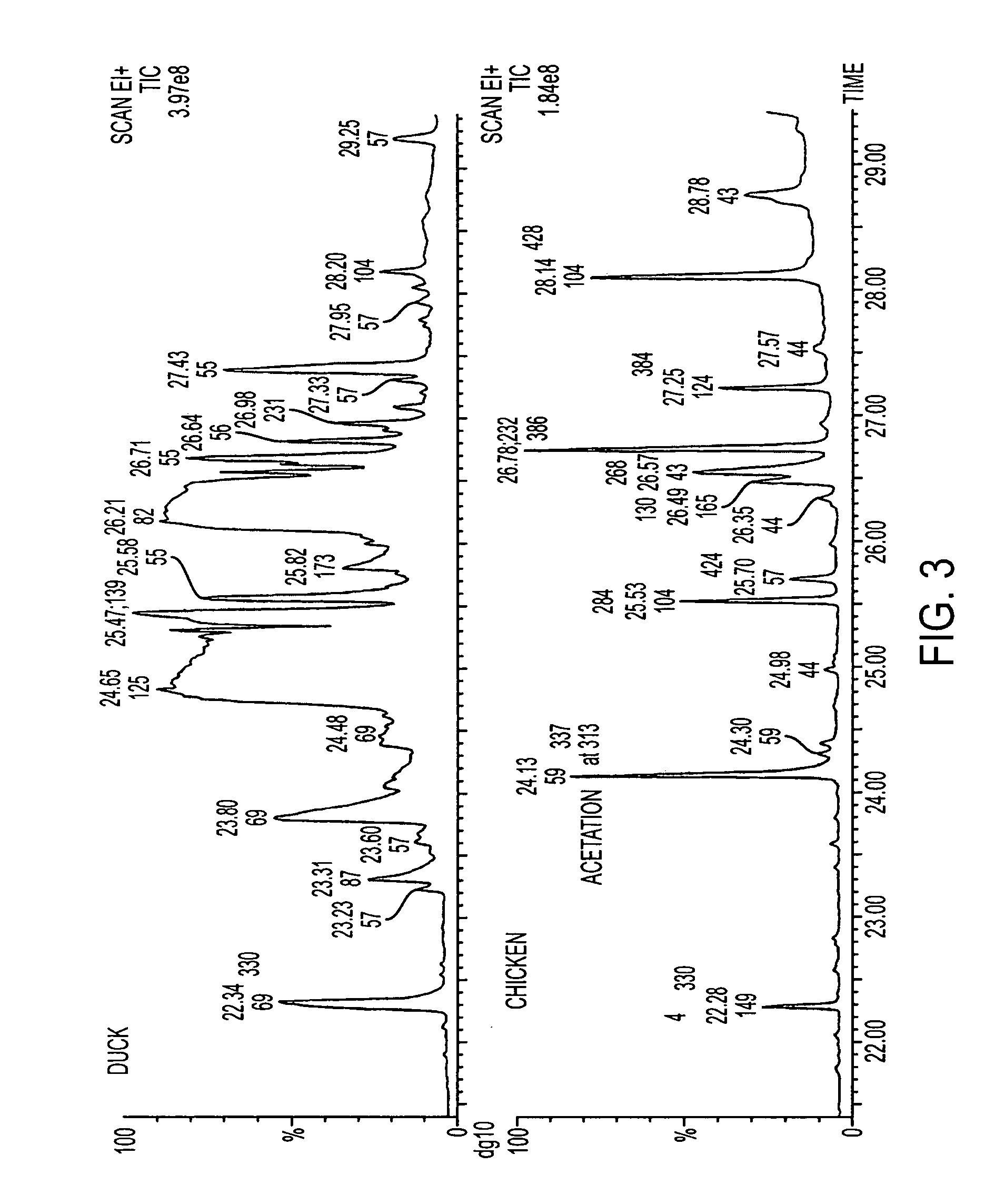
[0100]Isolation and Analysis to Identify Allomones and Kairomones from Chickens and Ducks
[0101]The samples were obtained from ducks and chickens by applying a sterile compress to the uropygial gland or tail gland and secretions from this gland were collected on the compress. The compress was immediately placed in a flask containing 10 ml of dichloromethane and the flask was agitated several times such that the secretion was deabsorbed.
[0102]After obtaining the samples from 10 ducks and 16 chickens 5 ml of solvent (acetonitrile and dichloromethane) was taken from each of the samples of the same series to form a combined sample. The combined sample of 15 ml was then concentrated by ten by evaporating under a stream of air to 1.5 ml.
[0103]The sample was then analyzed by gas chromatography / mass spectroscopy (GC / MS) using a Turbo Mass GC / MS from Perkin-Elmer. The column utilized was a JW type DB 5 MS having a length of 30 m a width of 0.25 mm and a film of 0.25 μm. The split used was 1 / 2...
example 2
[0119]Selection of Choice of Solvents
[0120]The molecules present on the skin are essentially liposoluble and to extract them it is necessary to use an organic solvent. However, organic solvents are extremely irritating to the skin and risk to alter the cutaneous texture, which could induce a modification of behavior in a parasite. Therefore, the following experiments were performed to test different solvents and to identify those which do not after the cutaneous texture of the skin, as well as being less noxious for the skin as well as the parasite or arachnid.
[0121]Four different solvents were tested; namely chloroform, diethyl ether, acetone and 60% ethanol. For each solvent the variation of the amount of feeding Dermanyssus gallinae was undertaken for an excised patch of chicken skin washed with the particular solvent and the natural skin.
[0122]Each skin was washed three times with 0.5 ml of solvent. In a first group, the skin was washed in vitro and then fed to the arachnids (De...
example 3
[0124]Tests with the Extracts
[0125]The skin of chickens and ducks was utilized in this example to search for the presence of kairomones and allomones in these two different birds. The skin of the ducks and chickens were washed with 0.5 ml 60% ethanol three times and the aliquots from these washings were collected. 0.5 ml of the washing aliquots were then redeposited on the same skin another three times and an one hour period was maintained between each washing to permit the alcohol to evaporate. After the three last washing, the skin was washed once with 0.5 ml of deionized water.
[0126]Extracts from the uropygial gland or tail gland were deposited on the chicken skin or duck skin washed with ethanol. These extracts were diluted 1 / 20 prior to being deposited. This dilution takes into account the volume of the raw secretion that was found settled throughout the entire body.
[0127]Dermanyssus gallinae (30 per tube) were applied to either the chicken skin or the duck skin. Three tubes we...
PUM
| Property | Measurement | Unit |
|---|---|---|
| thick | aaaaa | aaaaa |
| width | aaaaa | aaaaa |
| width | aaaaa | aaaaa |
Abstract
Description
Claims
Application Information
 Login to View More