Display control method and device for finder device
a technology of display control and finder device, which is applied in the direction of exposure control, television systems, instruments, etc., can solve the problems of camera shake, difficult to watch the liquid crystal display panel itself, and inability to confirm an image of a subj
- Summary
- Abstract
- Description
- Claims
- Application Information
AI Technical Summary
Benefits of technology
Problems solved by technology
Method used
Image



Examples
third embodiment
[0076]FIG. 11 is a view for explaining the invention. In a digital camera, when an image is taken and then image processing thereof is completed, the taken image is displayed on the LCD 40 or the EVF display device 61 in FIG. 2. This is called preview display. For example, the taken image is displayed for about 2 seconds as shown in FIG. 11. The time is not limited to 2 seconds. For example, the taken image may be displayed till next pushing-down of the shutter button.
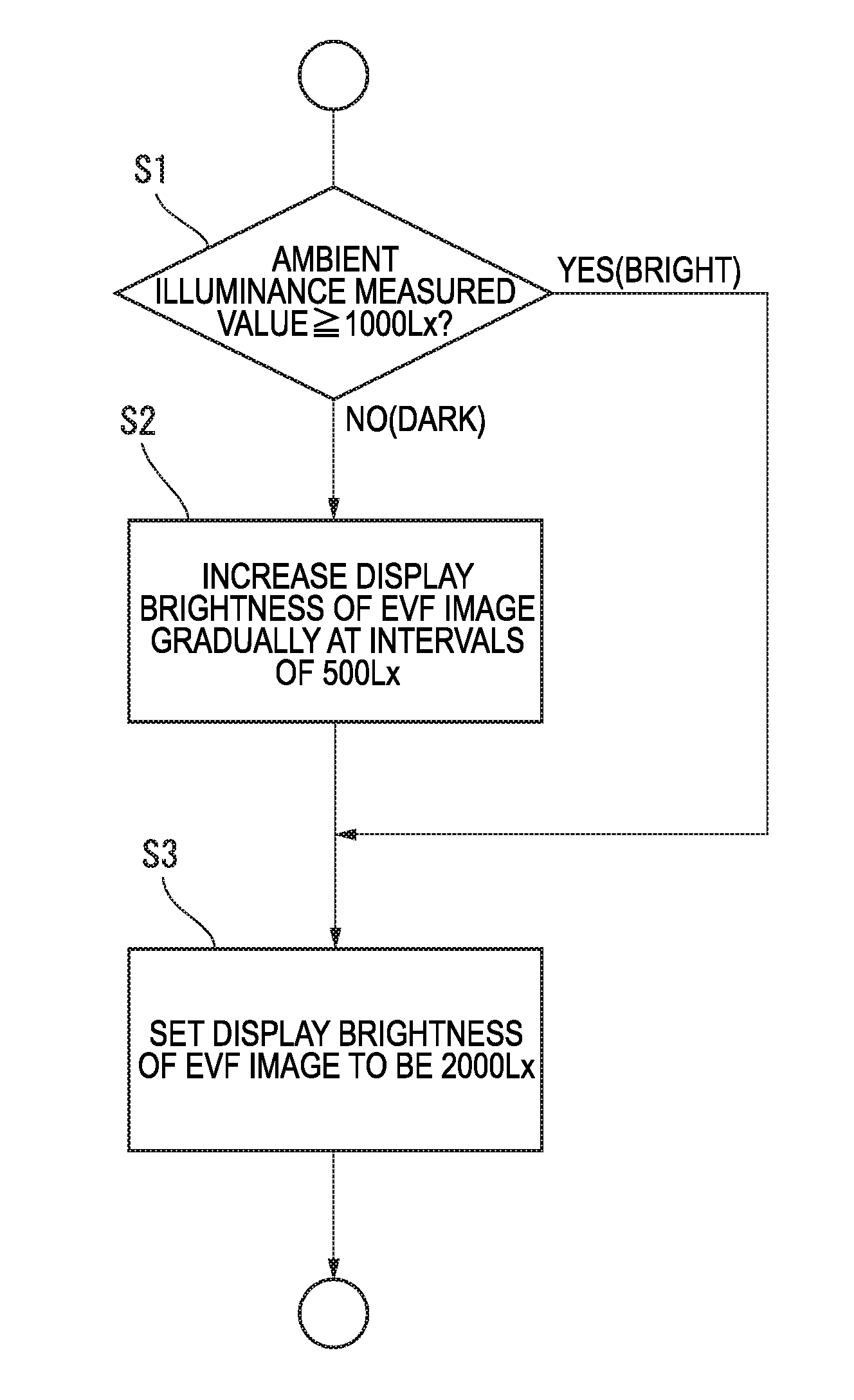
[0077]When this preview display is performed by the finder device 15, there is a possibility that a photographer viewing the finder will be dazzled when the photographer views the preview display with 2000 Lx suddenly. Therefore, as shown in a lower half of FIG. 11, when preview display is performed on the EVF display device 61, brightness is increased stepwise gradually so that preview display with 2000 Lx is performed for 2 seconds finally. In this manner, preview display easy to see can be performed.
[0078]Incidental...
fourth embodiment
[0079]FIG. 12 is a flow chart showing a processing procedure in a brightness display control method according to the invention. In a single lens reflex digital camera, an optical image of a subject via an imaging lens is displayed in a finder. An EVF image can be displayed in the finder in the same manner as in the aforementioned embodiments.
[0080]The finder device 15 is equipped with an eye sensor which detects the photographer's viewing the finder to perform the following display control.
[0081]First, the camera waits for the eye sensor's detecting the photographer's eye (step S21). When the photographer's eye is detected, the flow of processing goes to next step S22. In the step S22, determination is made as to whether ambient illuminance is at least required brightness such as 1000 Lx or not. When determination is made that the camera is under a dark environment lower than 1000 Lx (determination results in No), the flow of processing goes to next step S23.
[0082]In the step S23, t...
PUM
 Login to View More
 Abstract
Description
Claims
Application Information
 Login to View More