
Hand pointing estimation for human computer interaction
a technology of human computer and hand pointing, which is applied in the field of hand pointing estimation of human computer interaction, can solve problems such as the potential large number of parameters of models
- Summary
- Abstract
- Description
- Claims
- Application Information
AI Technical Summary
Benefits of technology
Problems solved by technology
Method used
Image

Examples
Embodiment Construction
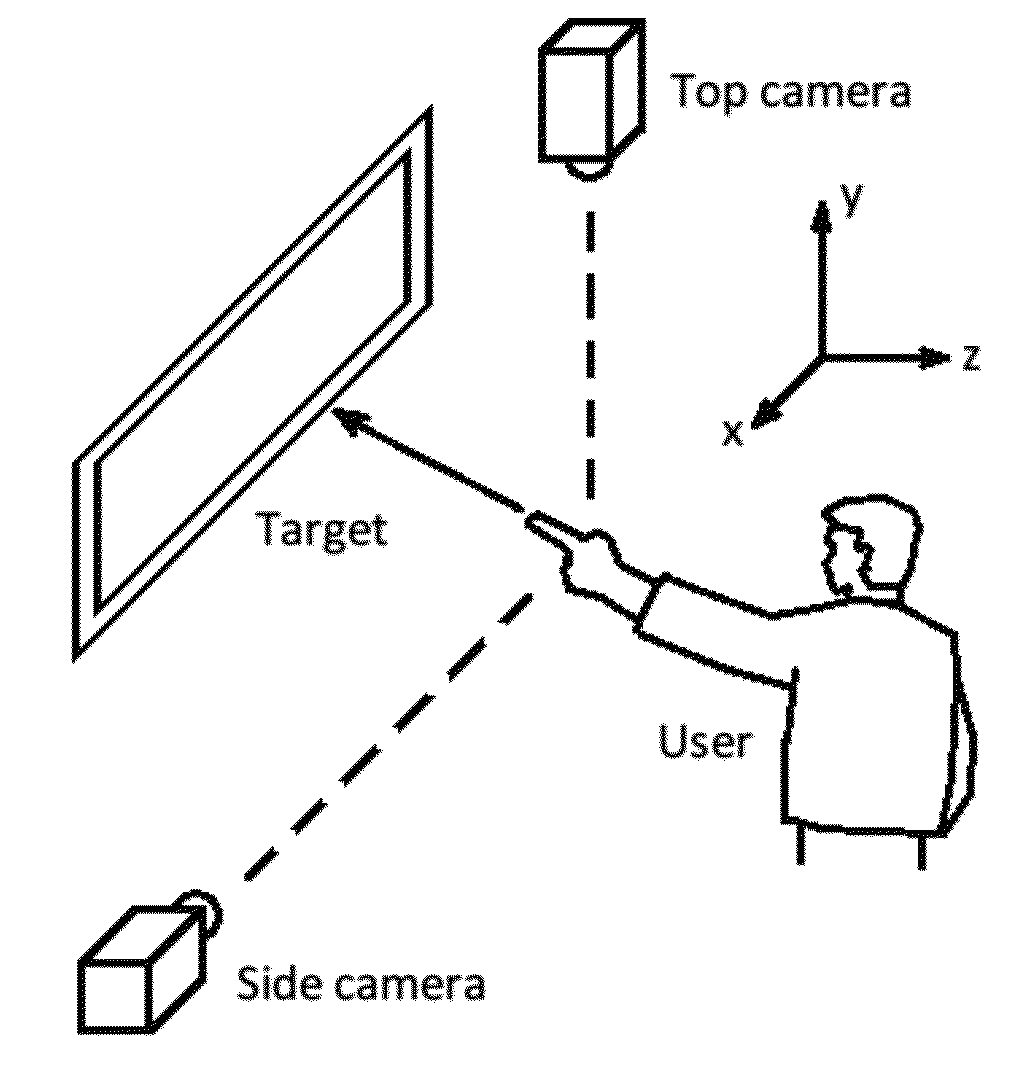
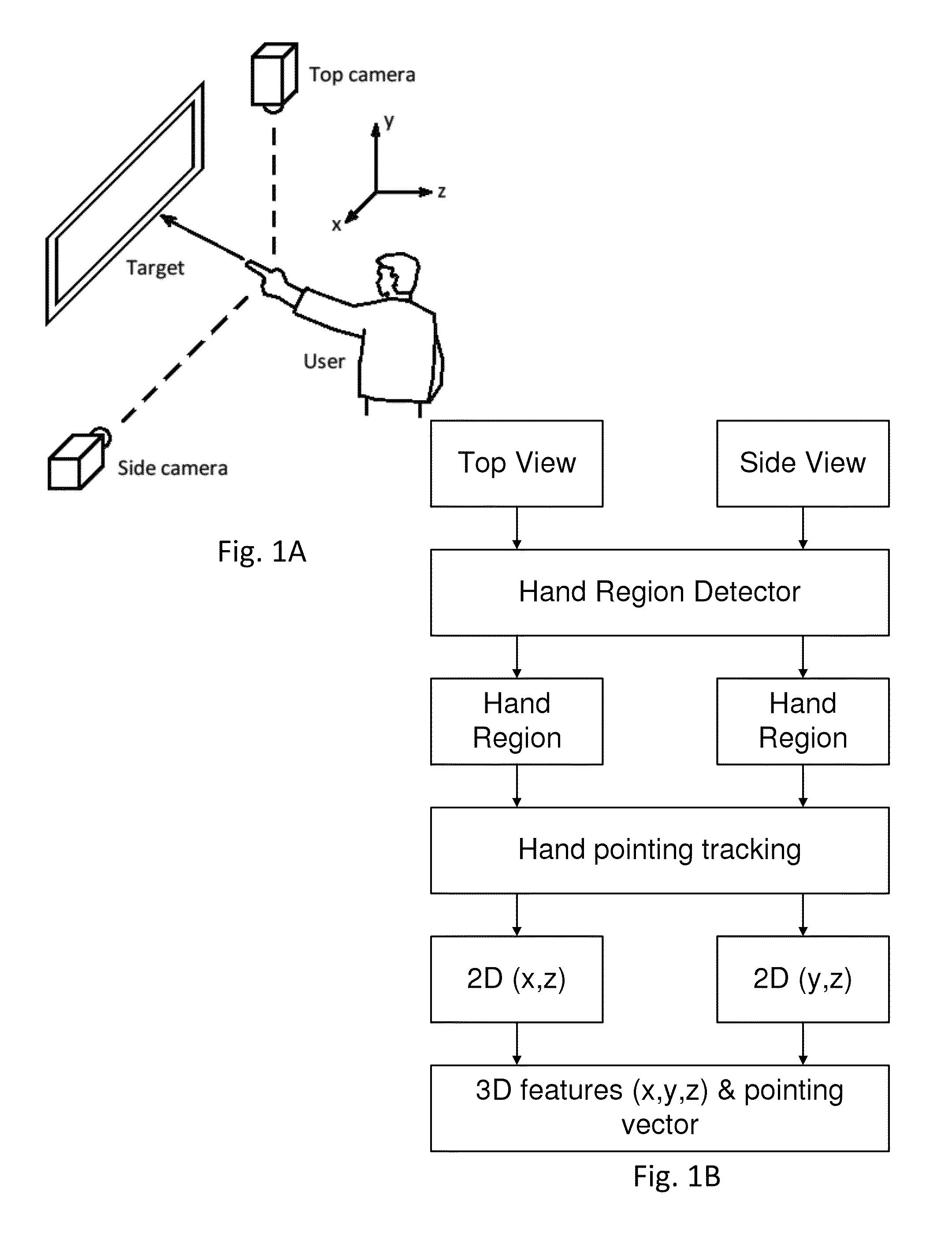
[0051]In a preferred embodiment, two regular cameras are set up in orthogonal positions, one on the top of the user, and the other to the left side.
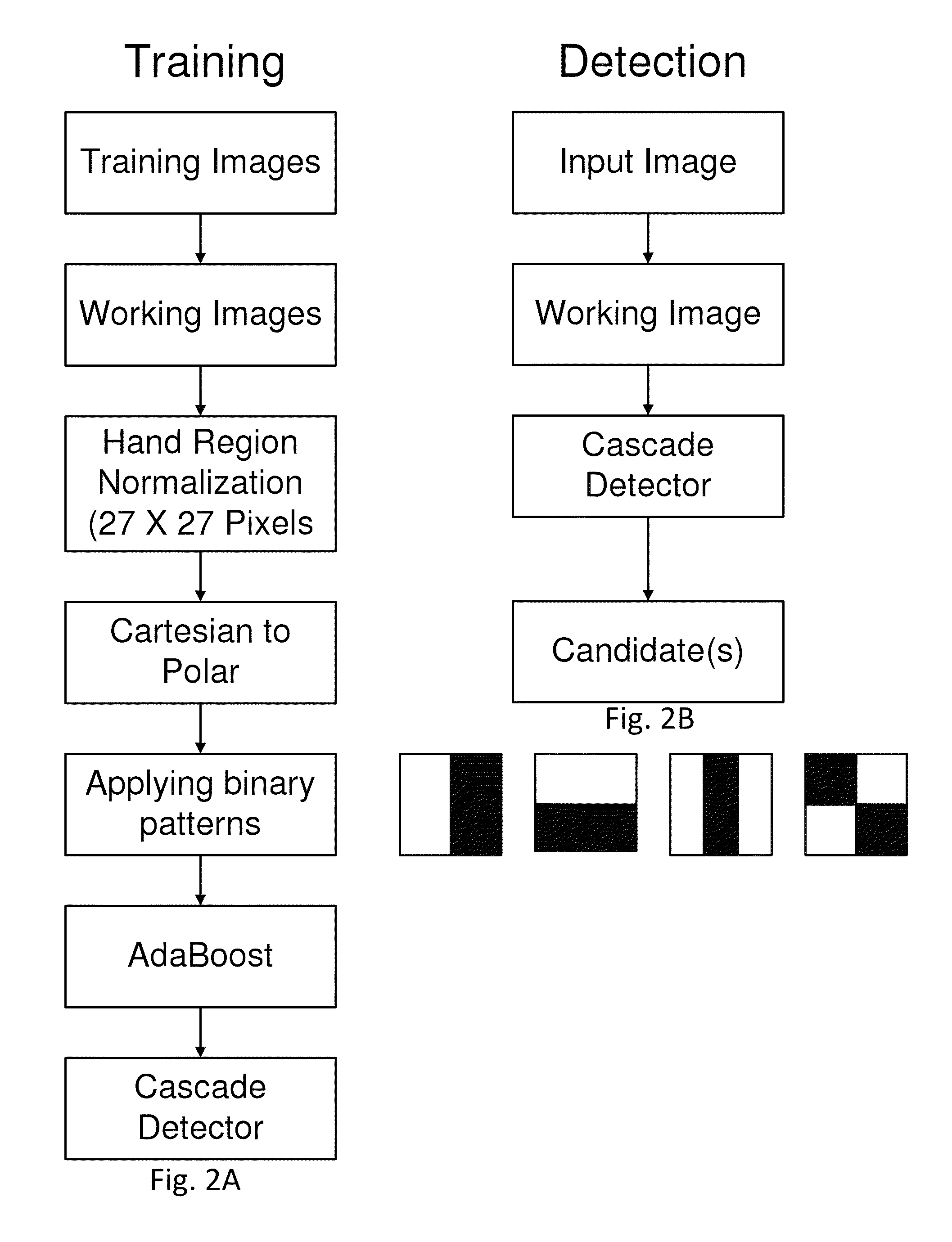
[0052]FIGS. 1A and 1B show the major components of the system. Unlike binary-pattern based approaches [5, 10] which are limited to a certain degree of hand rotation, a hand-image warping approach is preferably provided to transform the original hand image to a polar-coordinate plane in order to make the hand detection invariant to orientation.
[0053]According to a preferred embodiment, two cascade detectors are applied based on binary pattern features and AdaBoost [15] for two views' hand region detection. Then, the Active Appearance Model (AAM) [3] is used to track the finger points to identify the direction of hand pointing. While AAM is more commonly used for face tracking, as employed herein it is extended to track landmark features of hands. The 3D orientation of a pointing finger in 2D space may then be inferred. This is done via tw...
PUM
 Login to View More
 Abstract
Description
Claims
Application Information
 Login to View More