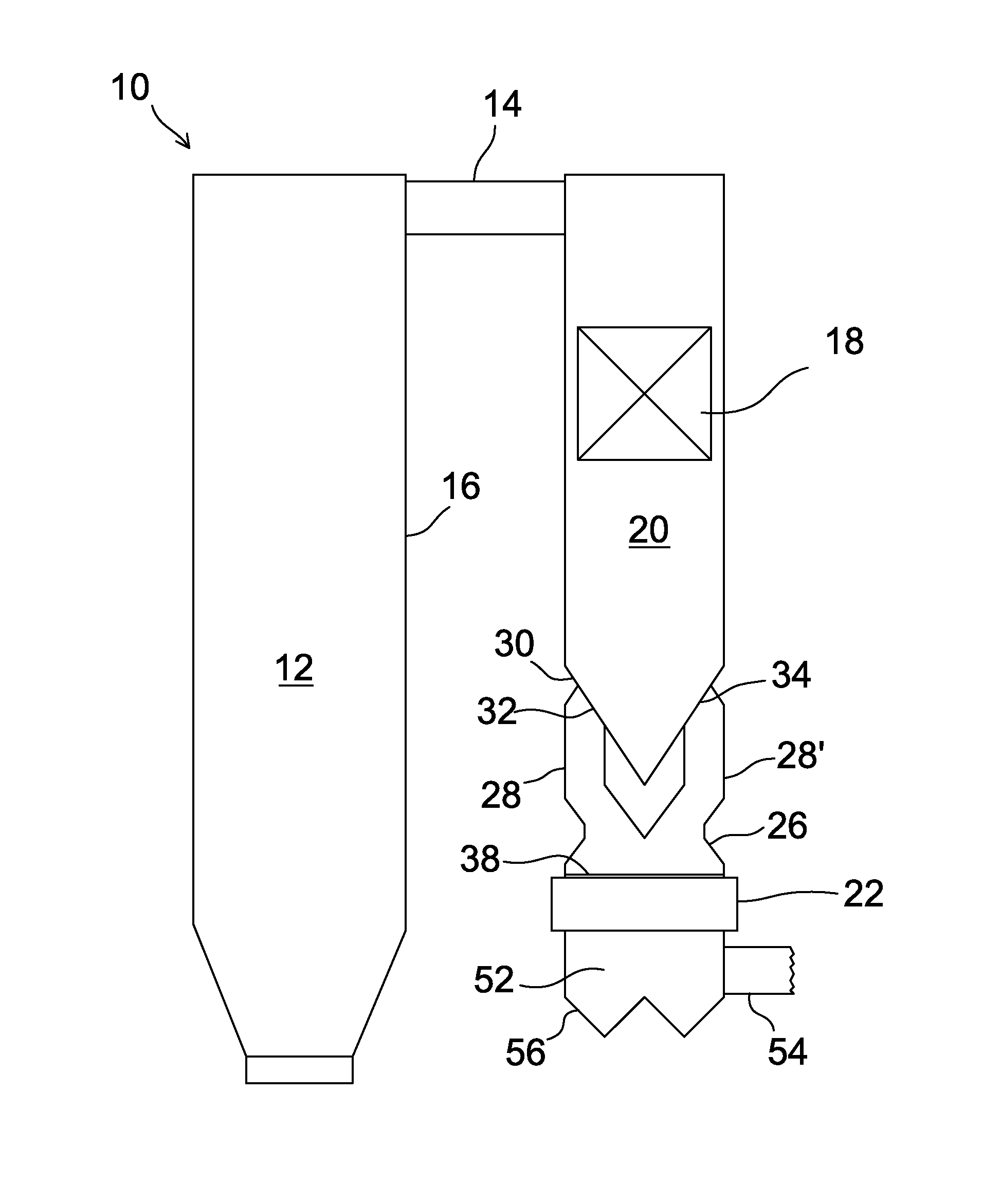
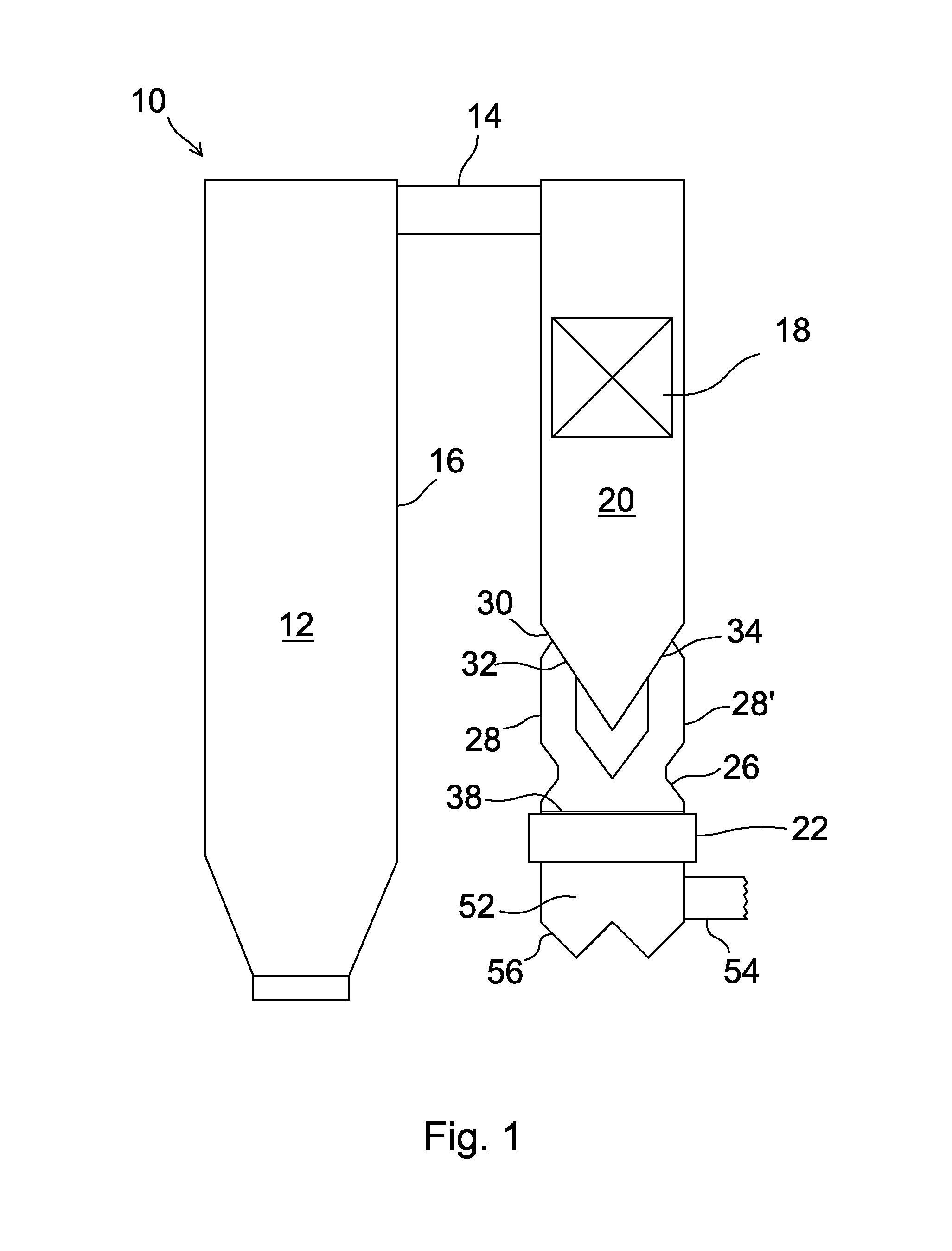
[0018]The portions of the inlet channels for flue gas connected to the opposite sides of the back pass, especially, to the front portion and rear portion thereof, render it possible to connect the pre-heater for combustion air to the back pass symmetrically, in a compact and operationally efficient way. The portions of the channel symmetrically connected to the back pass provide that the flow of the flue gas and the particles entrained therewith in the back pass are even and symmetric, which is why the lower portion of the back pass can easily be designed so that the wearing thereof is relatively mild. Furthermore, the ash hopper in the lower portion of the back pass can be designed in such a way that the separation of the particles from the flue gas flow to the ash hopper is especially efficient.
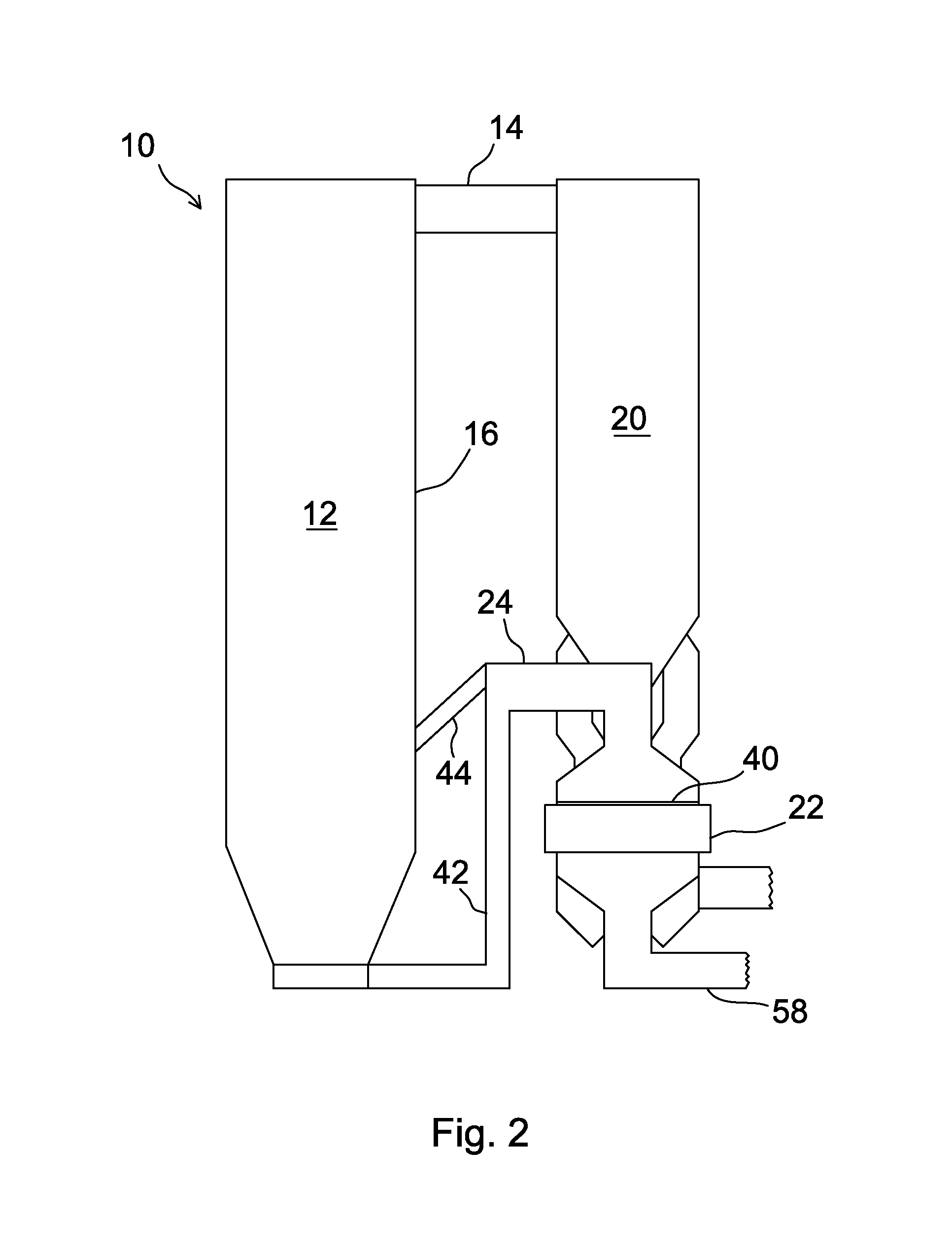
[0019]The arrangement in accordance with the conventional technique, in which the inlet channel for flue gas leading to the pre-heater for combustion air is connected merely to the rear portion of the back pass, almost inevitably results in the pre-heater for combustion air being relatively far from the furnace. The channels for the flue gas and the combustion air thereby become relatively long and complicated. The symmetrical arrangement of the channel portions of the back pass offers a possibility to such an embodiment of the present invention, in which the inlet channel for flue gas is, preferably, at least partially, more preferably, mainly, and most preferably, completely, underneath the back pass. The inlet channel for flue gas underneath the back pass can thereby be preferably realized in such a way that it is completely, or at least mainly, vertical. The absence of horizontal channel portions decreases the accumulation of ash in the inlet channel, whereby the dimensioning weight of the channel decreases, and the costs caused by the channel remain low.
[0020]A pre-heater for combustion air, arranged according to the invention can be arranged relatively close to the furnace, whereby an especially compact structure is provided, in which the channel for flue gas and combustion air remain relatively short. Owing to the compact structure, it is possible to provide a relatively small building for the thermal power boiler, whereby the costs remain low.
[0023]According to a preferred embodiment of the present invention, the pre-heater for combustion air is arranged in such a way that the outlet connection for combustion air is at least partially, most preferably, complete, outside the area underneath the back pass. When the outlet connection for combustion air is outside the area underneath the back pass, the flow channel, or flow channels, of combustion air can be led to the furnace via a most advantageous route. It is not necessary to especially form extensions or special bends in the flow channel for combustion air leading to the furnace, so-called feed channels for combustion air, in order to pass the back pass or the flue gas channel. The shortness of the air channels and the simple geometry thereof diminish the pressure loss in the channels, whereby the power consumption of the blowers for combustion air diminishes or, alternatively, the cross section of the air channels can be diminished, thus, minimizing their costs.
[0024]When the thermal power boiler comprises only one pre-heater for combustion air, the outlet connection for combustion air of the pre-heater can preferably be located, with respect to the inlet connection for flue gas, either to the furnace side or opposite to the furnace, whereby the inlet connection for flue gas and the outlet connection for combustion air are arranged one after the other in the direction of the normal of the rear wall of the furnace. Most preferably, the outlet connection for combustion air and the inlet connection for flue gas are, however, arranged one after the other in the direction of the horizontal cross section of the rear wall of the furnace, whereby the inlet channel for combustion air can preferably be arranged as a whole beside the back pass, as seen from the furnace. Thereby, the inlet channel for combustion air can extend towards the furnace without the necessity of bends to pass the back pass.


 Login to View More
  Login to View More