
Process for preparing zinc oxide nano-stick
A technology of zinc oxide nanorods and zinc chloride, applied in the fields of nanostructure manufacturing, zinc oxide/zinc hydroxide, nanotechnology, etc., can solve the problems of long reaction time and achieve the effect of rapid preparation
- Summary
- Abstract
- Description
- Claims
- Application Information
AI Technical Summary
Problems solved by technology
Method used
Image

Examples
Embodiment 1
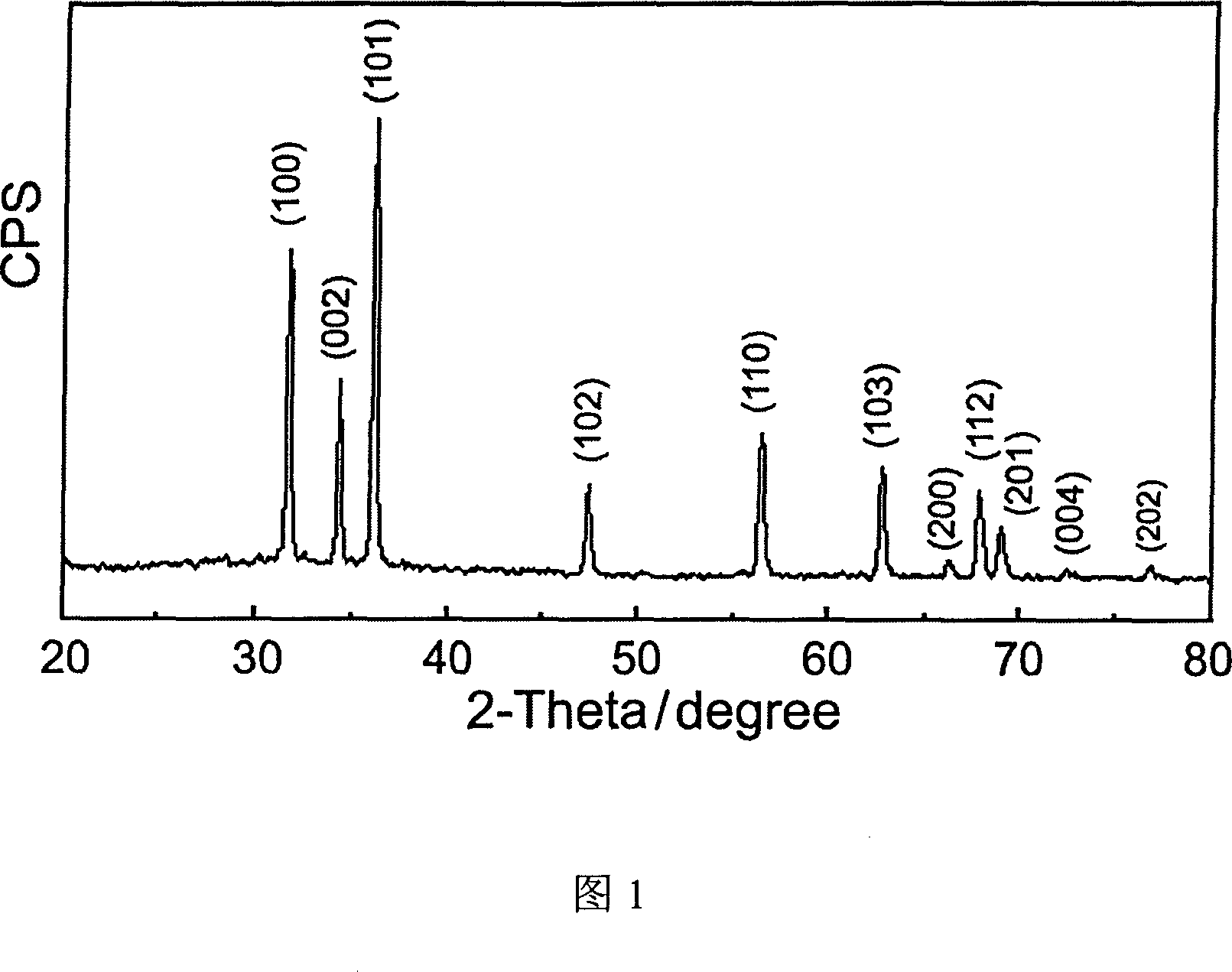
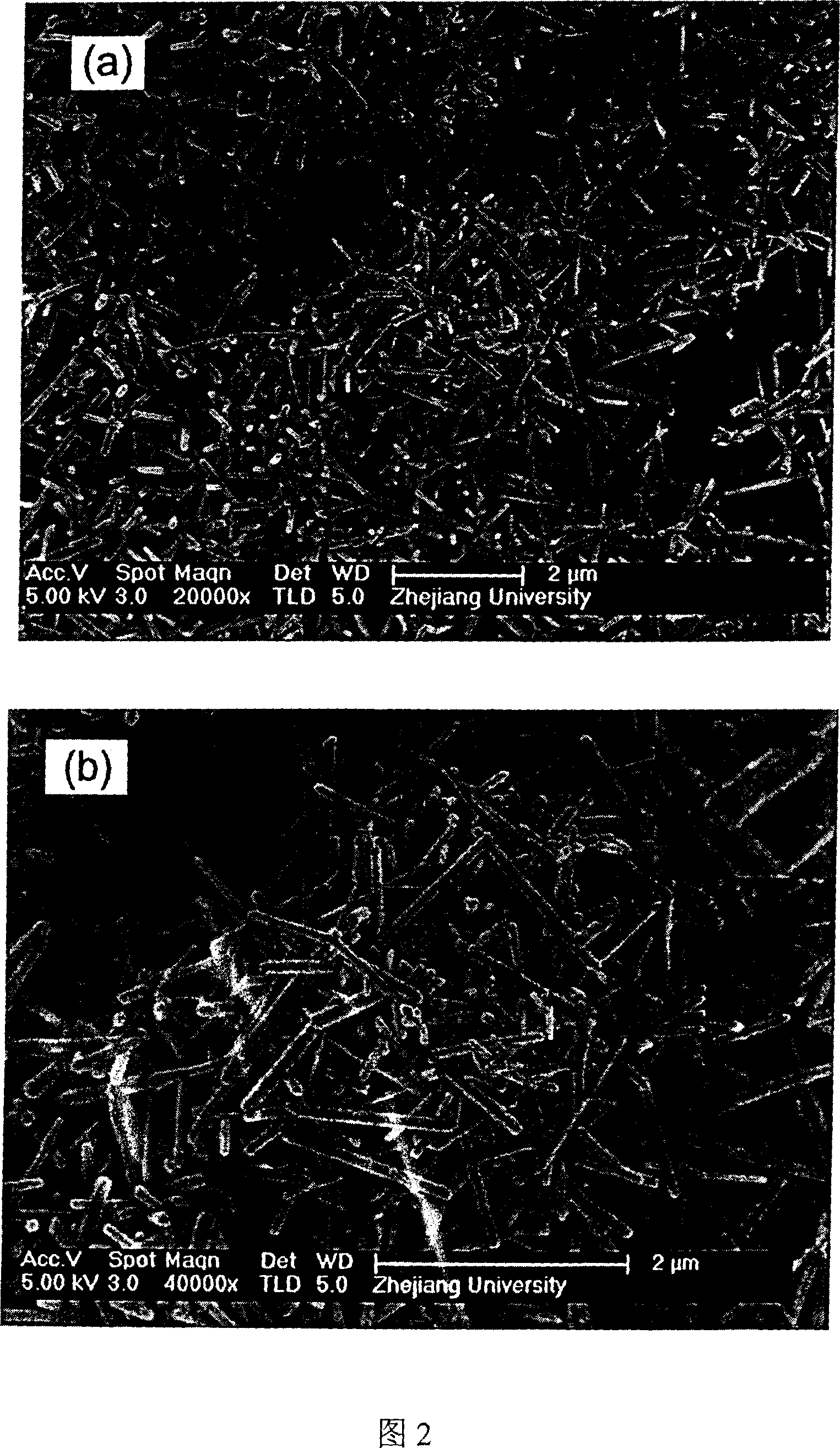
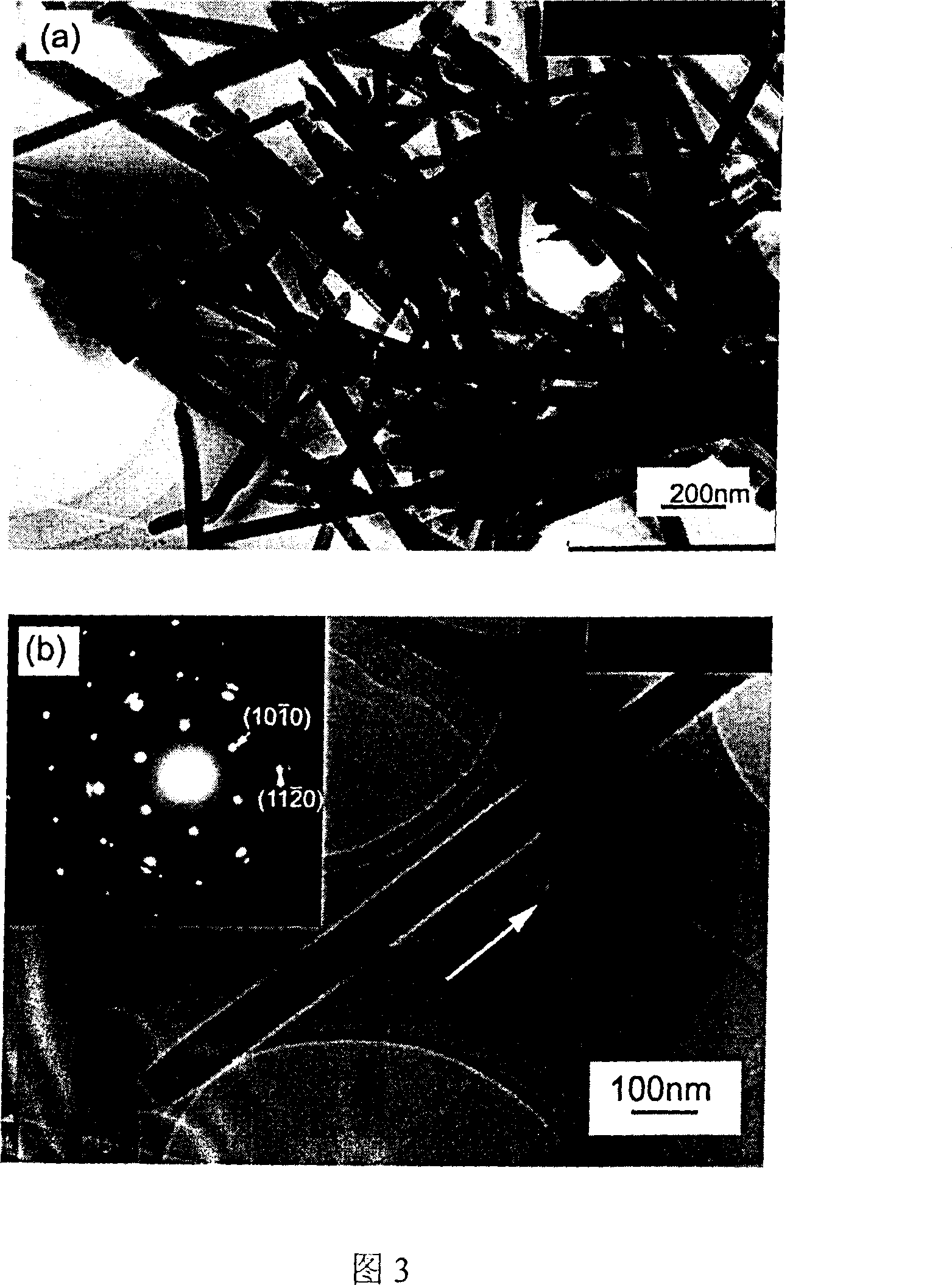
[0016] 0.87 g of zinc chloride (ZnCl 2 ) and 0.64 g of 85% hydrazine hydrate (N 2 h 4 ·H 2 0) Put into 160 milliliters of deionized water respectively, after magnetic stirring for 10 minutes, put the above-mentioned prepared solution into the polytetrafluoroethylene lining of the autoclave, the lining volume is 200 milliliters, that is, the filling degree is 80% . The solution was treated at 150° C. for 8 hours, and the treated solution was centrifuged and dried to obtain ZnO nanorods with a diameter of about 70 nanometers and a length of 2-4 micrometers. Figure 1 is the XRD spectrum of the ZnO nanorods, which is completely consistent with the ZnO standard card (JCPDS no.76-0704), indicating that the product is pure zinc oxide. Fig. 2 is a scanning electron micrograph of the ZnO nanorod, and it can be seen from Fig. 2 that the obtained product is a relatively regular nanorod. Fig. 3 is a transmission electron micrograph of the ZnO nanorod, and it can be seen from Fig. 3 t...
Embodiment 2
[0018] 0.87 g of zinc chloride (ZnCl 2 ) and 0.64 g of 85% hydrazine hydrate (N 2 h 4 ·H 2 0) Put into 160 milliliters of deionized water respectively, after magnetic stirring for 10 minutes, put the above-mentioned prepared solution into the polytetrafluoroethylene lining of the autoclave, the lining volume is 200 milliliters, that is, the filling degree is 80% . The solution was treated at 250° C. for 24 hours, and the treated solution was centrifuged and dried to obtain ZnO nanorods with a diameter of about 70 nanometers and a length of 2-4 micrometers. Different from Example 1, the product obtained in Example 2 exhibits a sword-shaped structure, and its scanning electron microscope photo is shown in FIG. 4 .
Embodiment 3
[0020] 0.87 g of zinc chloride (ZnCl 2 ) and 2.56 grams of 85% hydrazine hydrate (N 2 h 4 ·H 2 0) Put into 160 ml of deionized water respectively, and after magnetically stirring for 10 minutes, put the above prepared solution into the polytetrafluoroethylene lining of the autoclave, the volume of the lining is 200 ml, that is, the filling degree is 90% . The solution was treated at 120° C. for 3 hours, and the treated solution was centrifuged and dried to obtain ZnO nanorods with a diameter of about 70 nanometers and a length of 2-4 micrometers. Different from Examples 1 and 2, the surface of the product obtained in Example 3 is relatively rough, and its scanning electron microscope photo is shown in FIG. 5 .
PUM
| Property | Measurement | Unit |
|---|---|---|
| diameter | aaaaa | aaaaa |
| length | aaaaa | aaaaa |
| length | aaaaa | aaaaa |
Abstract
Description
Claims
Application Information
 Login to View More