
Sole member
A component and bottom surface technology, applied in the directions of soles, footwear, applications, etc., can solve the problems such as the inability to fully suppress the deterioration of deformable knee joint disease, the inability to fully relieve the impact force of the heel, and the inability to achieve the effect of wearing comfort, etc. Effects of deterioration of osteoarthritis deformity, prevention of osteoarthritis deformity, and comfortable walking
- Summary
- Abstract
- Description
- Claims
- Application Information
AI Technical Summary
Problems solved by technology
Method used
Image

Examples
Embodiment Construction
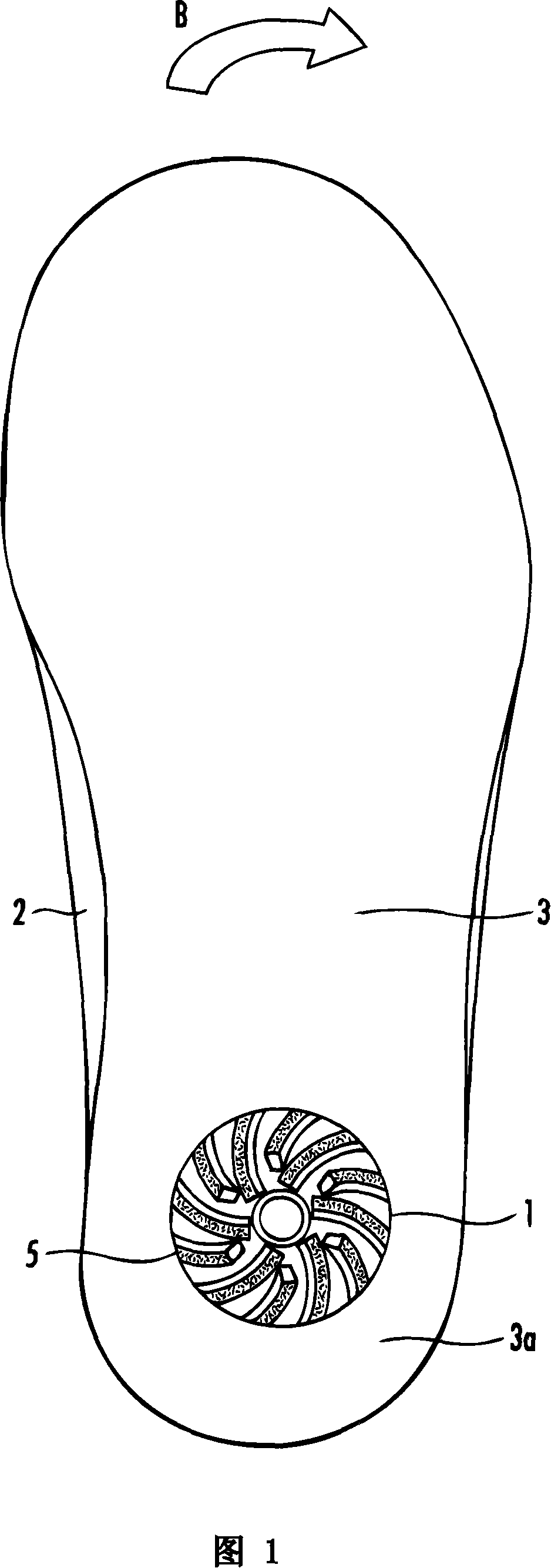
[0033] An embodiment of the present invention will be described with reference to FIGS. 1 to 4 . As shown in FIG. 1 , a sole member 1 according to the present embodiment is attached to a ground of a shoe 2 , that is, a heel 3 a of a sole 3 .
[0034] First, the structure of the sole member 1 will be described.
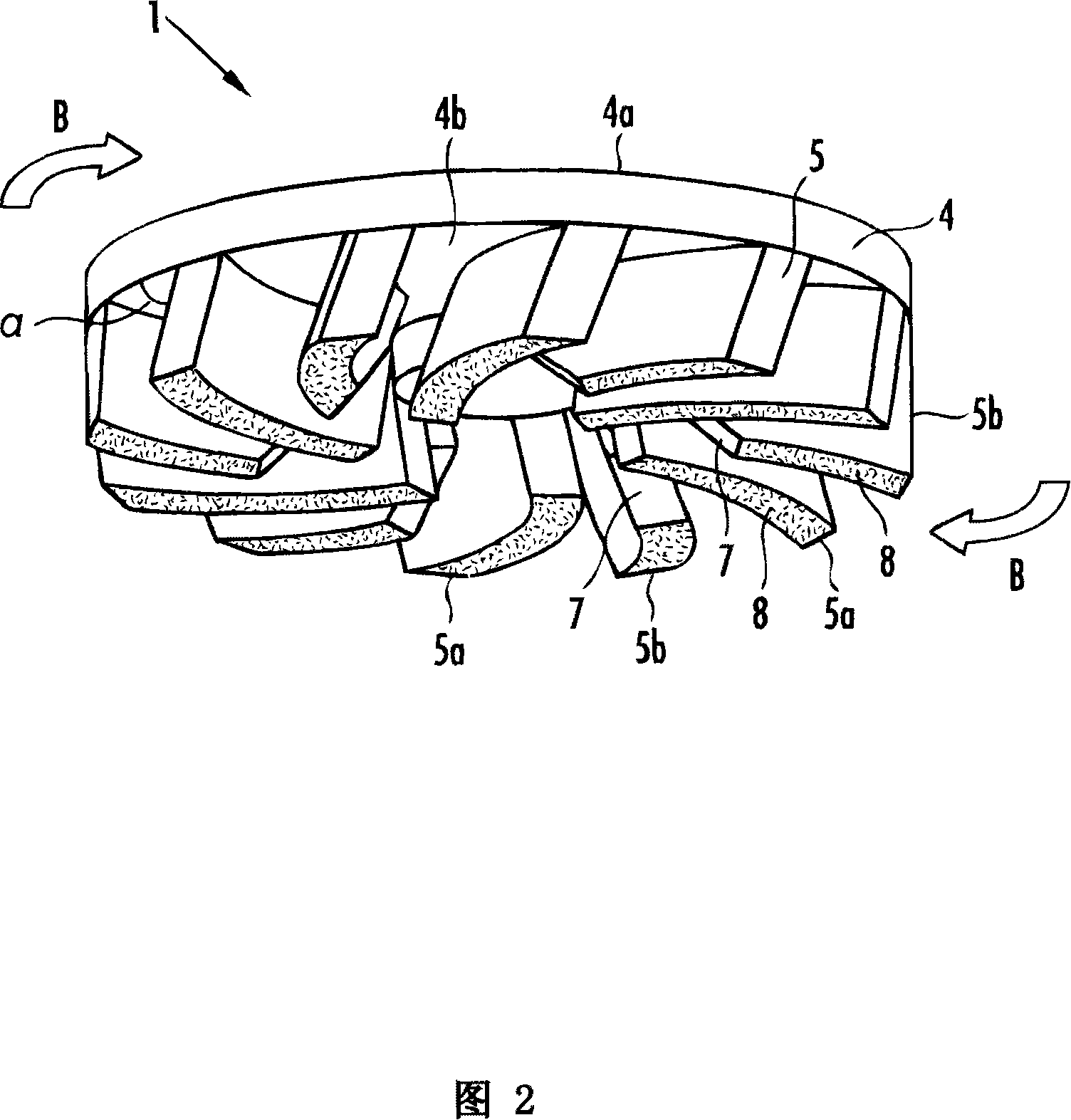
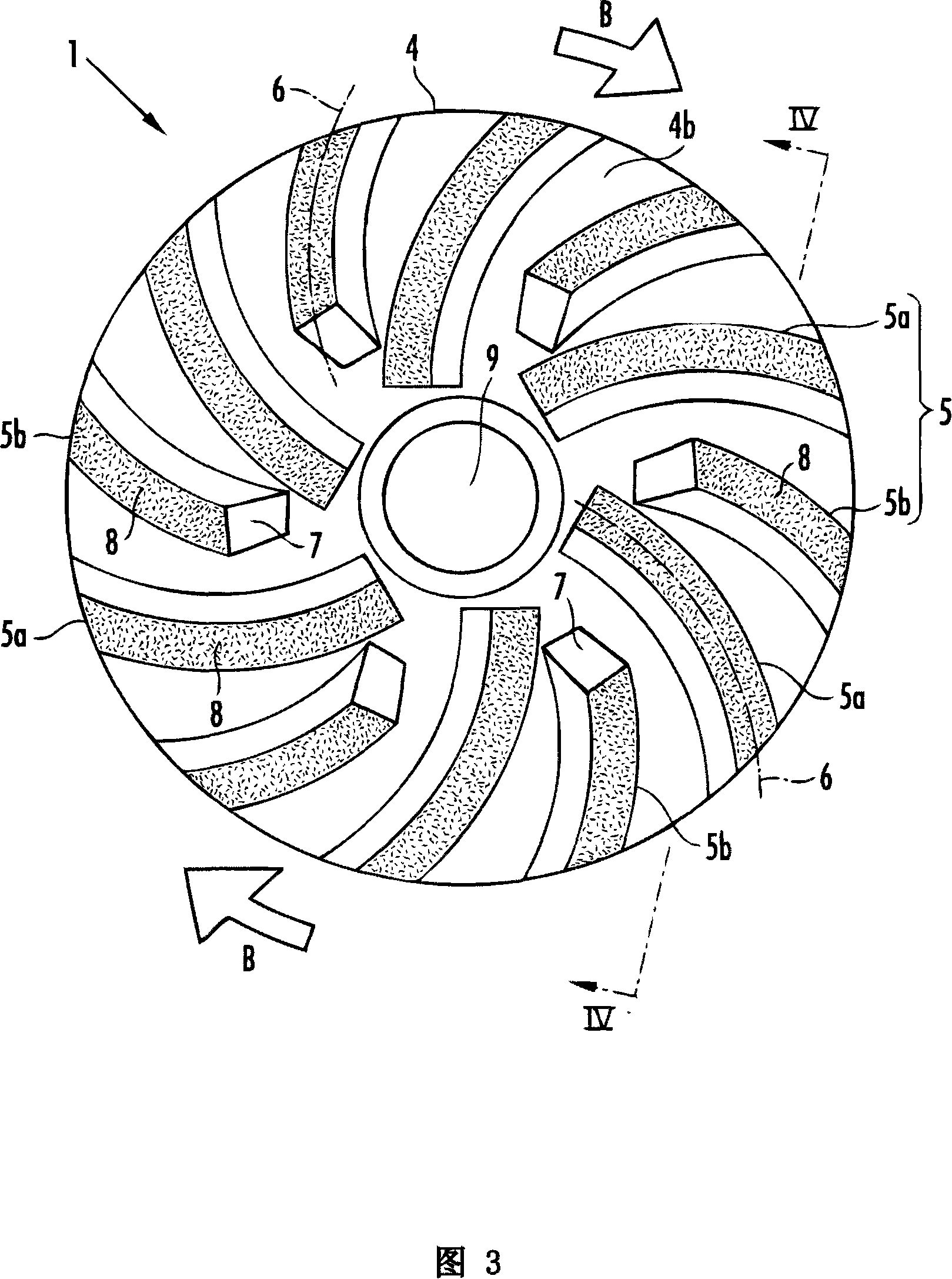
[0035]The sole member 1 is molded from a rubber composition such as natural rubber or synthetic rubber. As shown in FIGS. 2 and 3 , it has a base 4 and a plurality of ribs 5 (a plurality of first ribs 5 a and a plurality of second ribs 5 b ). The base 4 is in the shape of a flat disc, and its top surface 4a is joined with the sole 3 to form a single body.
[0036] As shown in FIG. 4 , each rib 5 is provided integrally with the bottom surface 4 b of the base 4 , and protrudes while being inclined toward the landing direction (downward). As shown in FIG. 3 , the ribs 5 extend radially, are arranged at predetermined intervals in the circumferential direction, and are c...
PUM
 Login to View More
 Abstract
Description
Claims
Application Information
 Login to View More