Electrolysis solution and electrolytic capacitor using the same
What is AI technical title?
AI technical title is built by PatSnap AI team. It summarizes the technical point description of the patent document.
A technology of electrolyte and electrolyte, which is applied in the direction of electrolytic capacitors, capacitors, circuits, etc., and can solve problems such as open circuits of capacitors
Inactive Publication Date: 2008-10-22
SANYO CHEM IND LTD +1
View PDF2 Cites 2 Cited by
Summary
Abstract
Description
Claims
Application Information
AI Technical Summary
This helps you quickly interpret patents by identifying the three key elements:
Problems solved by technology
Method used
Benefits of technology
Problems solved by technology
However, in electrolytic capacitors using conventional electrolyte solutions, the heat of a solder reflow furnace (for example, 260°C) causes decarboxylation of carboxylic acid anions, so there is a problem of open circuits in the capacitors.
Method used
the structure of the environmentally friendly knitted fabric provided by the present invention; figure 2 Flow chart of the yarn wrapping machine for environmentally friendly knitted fabrics and storage devices; image 3 Is the parameter map of the yarn covering machine
View more
Image
Smart Image Click on the blue labels to locate them in the text.
Viewing Examples
Smart Image
Click on the blue label to locate the original text in one second.
Reading with bidirectional positioning of images and text.
Smart Image
Examples
Experimental program
Comparison scheme
Effect test
manufacture example 1
[0078] [Manufacture of 1,2,3,4-tetramethylimidazolinium 4-methylphthalate (A-1)]
[0079] In a 1 L stirred autoclave made of SUS, 270.0 g of dimethyl carbonate and 98-0 g of 1,2,4-trimethylimidazoline were filled and reacted at a reaction temperature of 130° C. for 24 hours. After the reaction, the autoclave was cooled, and the reaction solution was analyzed by liquid chromatography. The conversion rate of 1,2,4-trimethylimidazoline was 95.0%. Unreacted materials and by-product methanol produced during the reaction were distilled off to obtain 180 g of 1,2,3,4-tetramethylimidazolinium methyl carbonate (a-1). Next, 30.0 g of the obtained 1,2,3,4-tetramethylimidazolinium methyl carbonate was dissolved in 200.0 g of methanol, and 78.6 g of 4-methylphthalic acid was slowly added, and the reaction was violent, resulting in carbon dioxide gas. Deaeration was performed at 80° C. / 20 mmHg to remove methanol to obtain 48.0 g of 1,2,3,4-tetramethylimidazolinium·4-methylphthalate (A-1)....
manufacture example 2
[0081] [Manufacture of 1,2,3,4-tetramethylimidazolinium 4-ethylphthalate (A-2)]
[0082] Except that 84.7 g of 4-ethylphthalic acid was used instead of 78.6 g of 4-methylphthalic acid, the same procedure as in Production Example 1 was carried out to obtain 1,2,3,4-tetramethylimidazolinium 4- 50.2 g of ethyl phthalate (A-2).
manufacture example 3
[0084] [Manufacture of 1,2,3,4-tetramethylimidazolinium 4-methoxyphthalate (A-3)]
[0085] Except that 85.6 g of 4-methoxyphthalic acid was used instead of 78.6 g of 4-methylphthalic acid, 1,2,3,4-tetramethylimidazolinium 4 was obtained in the same manner as in Production Example 1. - 50.5 g of methoxyphthalate (A-3).
the structure of the environmentally friendly knitted fabric provided by the present invention; figure 2 Flow chart of the yarn wrapping machine for environmentally friendly knitted fabrics and storage devices; image 3 Is the parameter map of the yarn covering machine
Login to View More
PUM
Login to View More
Abstract
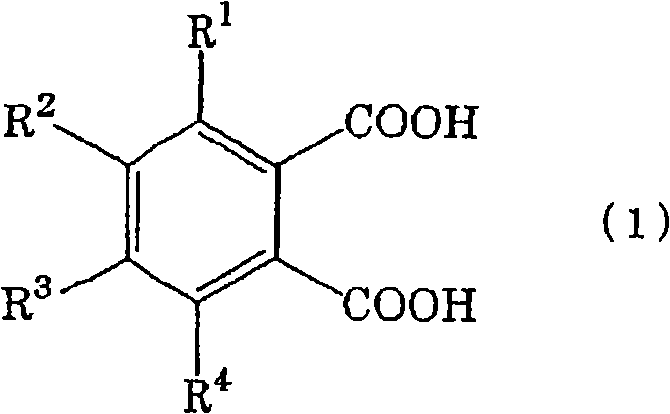
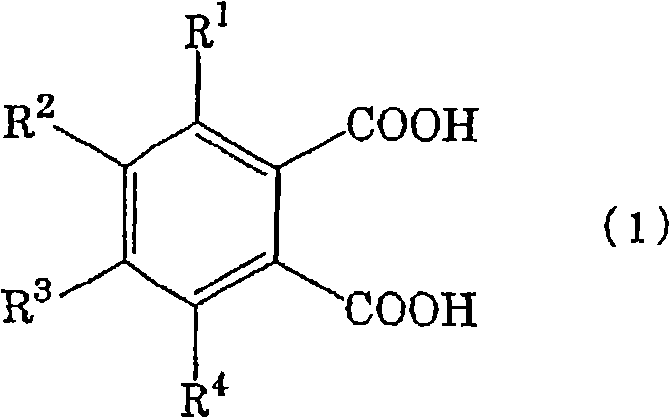
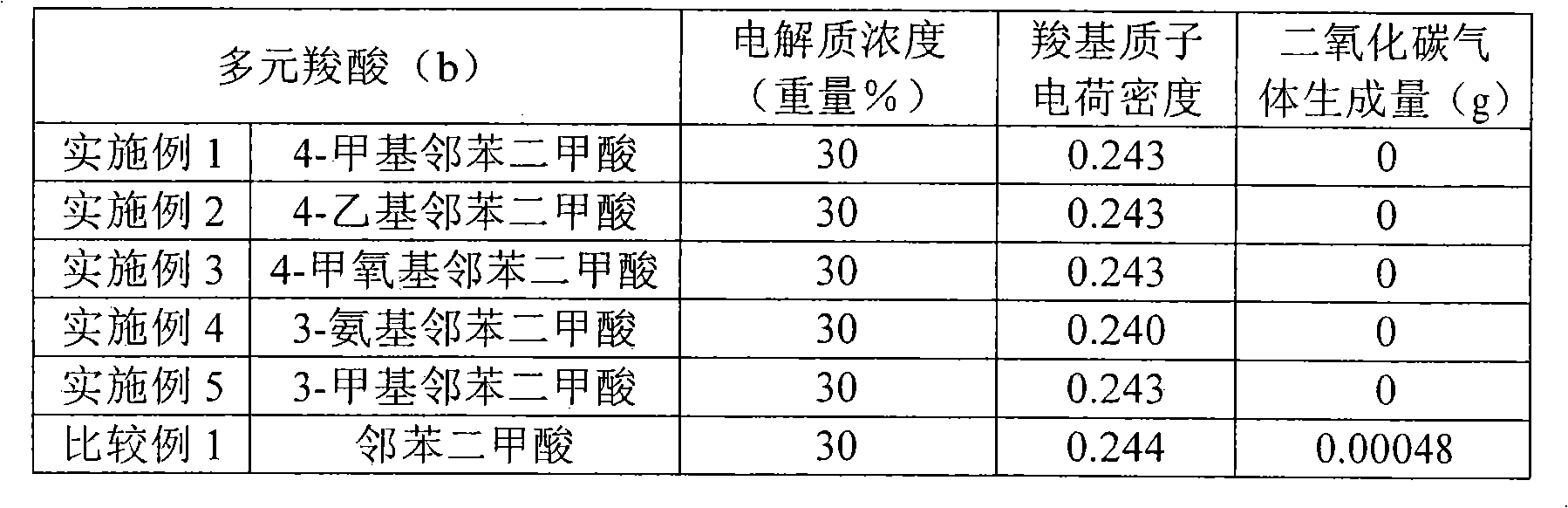
This invention provides an electrolyte anion having a high decomposition temperature that can suppress decarboxylation of an electrolyte anion in an electrolysis solution for an electrolytic capacitor in a lead-free solder reflow process and can prevent valve opening of the capacitor. The electrolysis solution comprises, as an electrolyte, a salt (A) comprising an onium cation (a) and a polycarboxylic acid (b) anion and is characterized in that the charge of the proton part in the carboxyl group in the polycarboxylic acid (b) calculated by the AM1 method in a quantum mechanical calculation software CAChe is not more than 0.243. A polycarboxylic acid (b) represented by general formula (1) is particularly preferred. In the Chemical formula (1), R<1> to R<4>, which may be the same or different, represent hydrogen, a functional group or an optionally functional group-containing hydrocarbon group having 1 to 3 carbon atoms, provided that at least one of R<1> to R<4> represents an electron donating group.
Description
technical field [0001] The present invention relates to an electrolytic solution for electrolytic capacitors and an electrolytic capacitor using the same. Background technique [0002] Conventionally, as an electrolytic solution for electrolytic capacitors, electrolytes such as ammonium salts of carboxylic acids typified by maleic acid and citraconic acid dissolved in γ-butyrolactone or ethylene glycol are known (e.g. Patent Document 1), an electrolytic solution in which a quaternized carboxylate salt of a compound having an alkyl-substituted amidine group is dissolved in γ-butyrolactone or ethylene glycol (for example, Patent Document 2), and the like. [0003] In recent years, lead-free soldering has been promoted in order to reduce the amount of environmentally hazardous substances used. In order to cope with this lead-free soldering, it is necessary to increase the temperature in the reflow process to 260°C. However, in electrolytic capacitors using conventional electr...
Claims
the structure of the environmentally friendly knitted fabric provided by the present invention; figure 2 Flow chart of the yarn wrapping machine for environmentally friendly knitted fabrics and storage devices; image 3 Is the parameter map of the yarn covering machine
Login to View More
Application Information
Patent Timeline
Application Date:The date an application was filed.
Publication Date:The date a patent or application was officially published.
First Publication Date:The earliest publication date of a patent with the same application number.
Issue Date:Publication date of the patent grant document.
PCT Entry Date:The Entry date of PCT National Phase.
Estimated Expiry Date:The statutory expiry date of a patent right according to the Patent Law, and it is the longest term of protection that the patent right can achieve without the termination of the patent right due to other reasons(Term extension factor has been taken into account ).
Invalid Date:Actual expiry date is based on effective date or publication date of legal transaction data of invalid patent.



 Login to View More
  Login to View More