
Coupling permeation efficiency optimization system of near field scanning optical microscope (NSOM)
A near-field scanning optics, transmission efficiency technology, applied in the field of scanning probe microscopy, to achieve the effect of optimized efficiency, easy operation and simple structure
- Summary
- Abstract
- Description
- Claims
- Application Information
AI Technical Summary
Problems solved by technology
Method used
Image

Examples
Embodiment 1
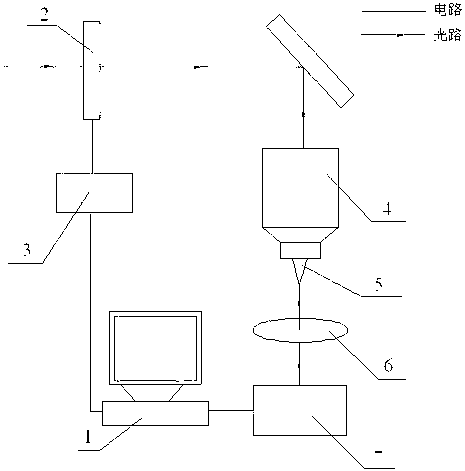
[0028] like figure 1 Shown is a near-field scanning optical microscope coupling transmission efficiency optimization system, including a computer 1, a detector 7, a collecting mirror 6, a probe 5, a focusing mirror 4, a spatial light modulation instrument 2 and a driver 3, the computer 1 , the detector 7, the spatial light modulator 2 and the driver form a closed loop. The detector 7 is a photomultiplier tube. The spatial light modulation instrument 2 is used to modulate the light field distribution, including the phase, polarization and amplitude distribution of the light field.
[0029] According to the different properties of the probe, the spatial light modulation instrument 2 used is divided into the following two types:
[0030] The first type: due to the process, the phase mask can achieve higher parameters such as duty cycle, transmittance, and resolution than SLM, so for the probe 5 with small individual differences, the spatial light modulation instrument 2 is the...
PUM
 Login to View More
 Abstract
Description
Claims
Application Information
 Login to View More