
Water treatment method and device based on photoautotroph film
A water treatment device and photoautotrophic technology are applied in the field of water treatment to achieve the effects of high light utilization rate, controllable hydraulic retention time and good environmental benefits
Inactive Publication Date: 2011-06-08
HOHAI UNIV +1
View PDF2 Cites 4 Cited by
- Summary
- Abstract
- Description
- Claims
- Application Information
AI Technical Summary
Problems solved by technology
There is no domestic report on the application of photoautotrophic biofilm technology in the field of water treatment, and there is no application of photoautotrophic biofilm technology to water treatment methods
Method used
the structure of the environmentally friendly knitted fabric provided by the present invention; figure 2 Flow chart of the yarn wrapping machine for environmentally friendly knitted fabrics and storage devices; image 3 Is the parameter map of the yarn covering machine
View moreImage
Smart Image Click on the blue labels to locate them in the text.
Smart ImageViewing Examples

Examples
Experimental program
Comparison scheme
Effect test
Embodiment 1
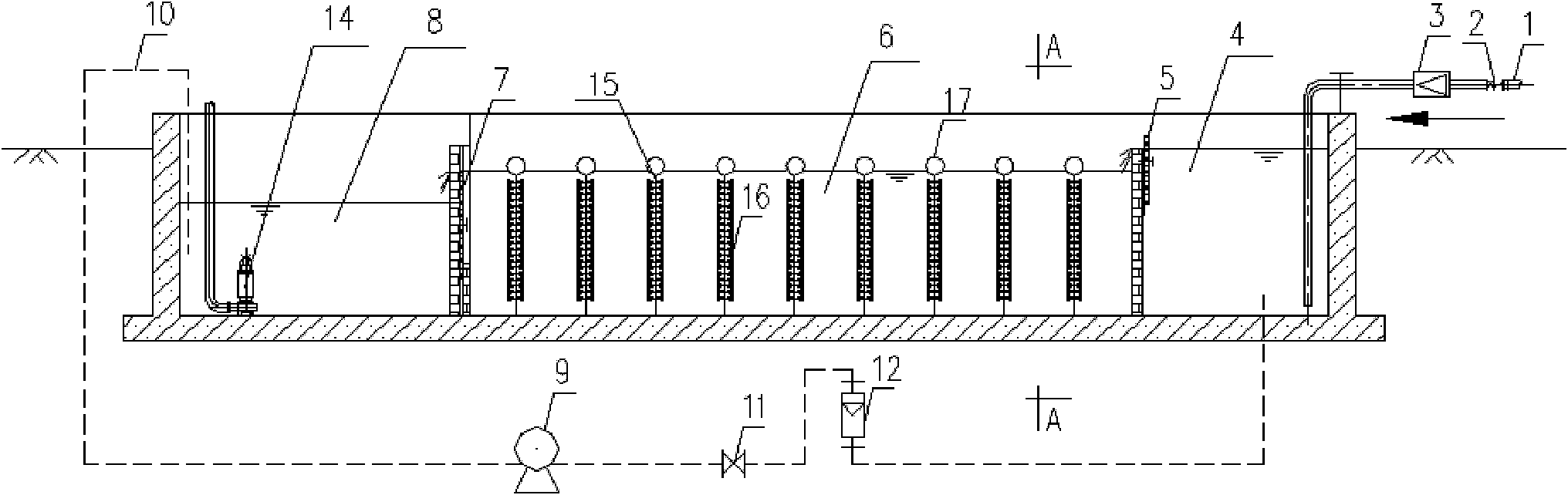
[0033] A treatment test was carried out on the source water (Table 1) of a water plant in Suzhou, with a hydraulic load of 3m 3 / h, the planting density of biofilm carrier is 16 trees / square meter, and the specific surface area of the carrier is 1400m 2 / m 3 , the water depth is 0.6m, and there is no backflow and continuous water discharge.
[0034] The average removal rate of permanganate index, ammonia nitrogen and total phosphorus in water source water is 18%, 19% and 33% when the device is running stably (30 days).
[0035] Table 1 Source water quality indicators and concentration
[0036] index
the structure of the environmentally friendly knitted fabric provided by the present invention; figure 2 Flow chart of the yarn wrapping machine for environmentally friendly knitted fabrics and storage devices; image 3 Is the parameter map of the yarn covering machine
Login to View More PUM
 Login to View More
 Abstract
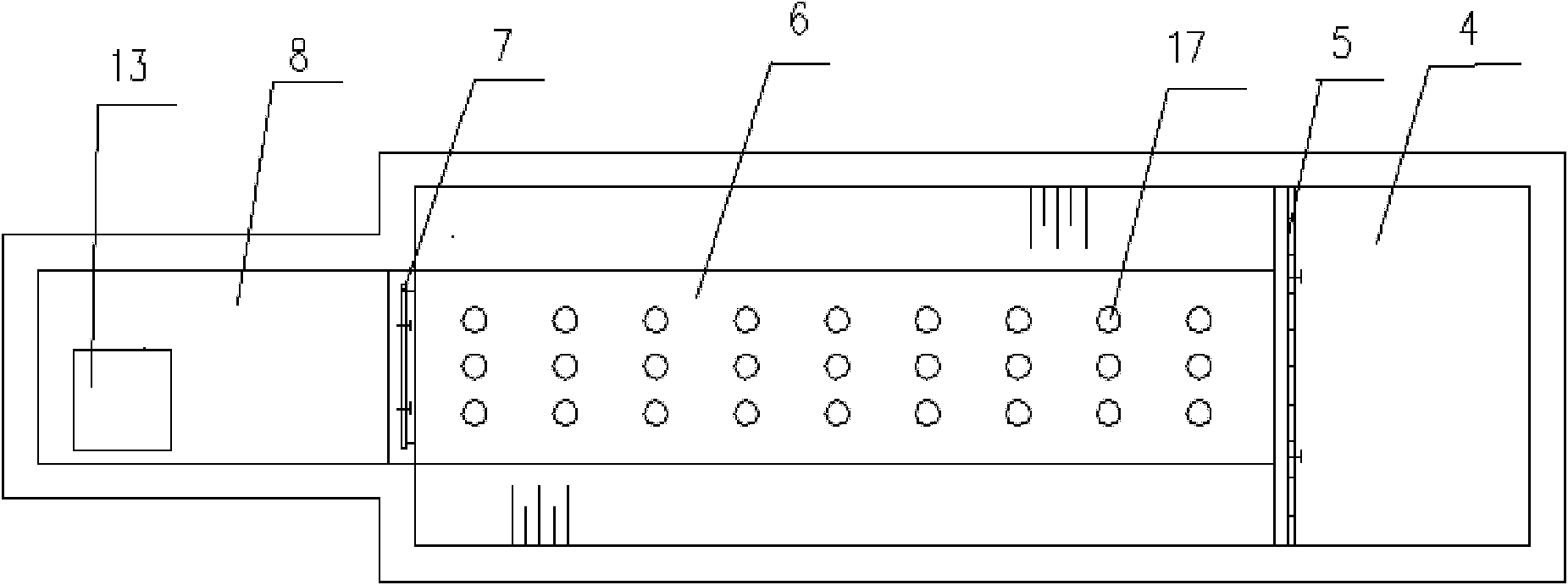
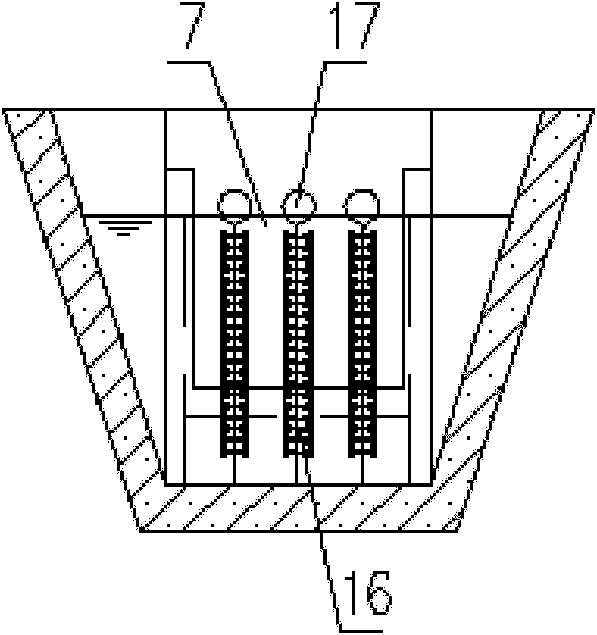
The invention discloses a water treatment method and device based on a photoautotroph film. The whole body of the device is arranged from eastern to western along the flow direction and successively comprises a pre-precipitation area, a treatment area and a water discharging area, wherein the three areas are adjacently connected, and weirs are arranged among the three areas; an water inlet pipe is arranged on the side wall of the pre-precipitation area, and a return pipe is provided with a reflux valve; bionic biological film carriers are evenly planted in a treatment pool, and the bionic biological film carriers consist of main carriers and carrier floating balls, wherein the main carriers are mutually connected and fixed at the bottom of treatment pool, and the carrier floating balls are light and transparent; water enters the pre-precipitation area through the water inlet pipe to preliminarily remove inorganic particles, and then overflows to the treatment area for treatment by weirs and flows into the water discharging area through the weirs; part of the treated water in the water discharging area flows back to the pre-precipitation area through the return pipe under the action of a reflux pump, and the reflux ratio is controlled by the reflux valve; and the rest water is discharged by a water discharging pump in the water discharging area. In the invention, the illumination utilization ratio is high, a precipitation pool does not need to be arranged additionally, and the occupied area is reduced; and besides the energy consumption required by reflux, light energy is asingle energy source of the device, and the device has the characteristics of low carbon content and low energy consumption.
Description
technical field [0001] The invention belongs to the field of water treatment, and relates to a water treatment method using photoautotrophic biofilm and a device thereof. Background technique [0002] Photoautotrophic biofilm is a kind of light energy as energy source, CO 2 As the main inorganic carbon source, it is a complex microbial community in the state of attached growth composed of algae (green algae, cyanobacteria, diatoms) and bacteria. Algae, the primary producers in photoautotrophic biofilms, perform photosynthesis under light conditions and utilize dissolved CO in water 2 (source: atmosphere, product of bacterial aerobic respiration) as an inorganic carbon source, via the pentose phosphate reduction pathway or C 4 - Dicarboxylic acid reduction via fixation of CO 2 , while generating O 2, It can increase the dissolved oxygen concentration in water, effectively promote the metabolism of aerobic bacteria and facultative bacteria in the biofilm system, improve th...
Claims
the structure of the environmentally friendly knitted fabric provided by the present invention; figure 2 Flow chart of the yarn wrapping machine for environmentally friendly knitted fabrics and storage devices; image 3 Is the parameter map of the yarn covering machine
Login to View More Application Information
Patent Timeline
 Login to View More
 IPC IPC(8): C02F9/14
Inventor操家顺陆文涛薛朝霞冯骞方芳王超
OwnerHOHAI UNIV