Method for driving a group of vehicle members on the basis of driving situations, and corresponding device

A control method, technology for driving conditions, applied in the direction of control devices, vehicle components, transportation and packaging, etc., can solve the problem of not describing set points, etc.

CN102317100AInactive Publication Date: 2012-01-11RENAULT SA
9 Cites 1 Cited by

Patent Information

Authority / Receiving Office
CN · China
Patent Type
Applications(China)
Current Assignee / Owner
Publication Date
2012-01-11
Estimated Expiration
Not applicable · inactive patent

Smart Images

  • Figure 1
    Figure 1
  • Figure 2
    Figure 2
  • Figure 3
    Figure 3
Patent Text Reader

Abstract

The invention relates to a driving method on the basis of driving situations using at least one effective control signal (Signal_effect) of a member or group of members of an automobile, said method comprising making an arbitration between different control strategies each corresponding to a driving context, each control strategy being marked with an identifier (id1, id2, id3). The method further comprises: continuously calculating an optimal control signal corresponding to each of the strategies; continuously transmitting a value representative of the identifier (Ident(t)) of the selected strategy; detecting if a strategy identifier change has occurred; when a change is detected, generating a time function x(t) increasing from 0 to 1 over a finite time interval starting when said strategy change has been detected; when a strategy identifier change has been detected, transmitting, during at least one time interval following the identifier change, an effective control signal (Signal_effect) which is the sum (Signal_mix) of the optimal signal of the control strategy following the last identifier change (Signal(Ident(t))) weighed by the value x(t) and of the optimal signal of the control strategy preceding the last identifier change (Signal(Ident_avt_chg)) weighed by the value (1-x(t)).
Need to check novelty before this filing date? Find Prior Art

Description

technical field

[0001] The invention finds application in the field of control of transmissions for vehicles with four drive wheels. Background technique

[0002] A vehicle with four drive wheels is configured with a transmission system including a front axle system and a rear axle system. Both the front and rear axle systems include rotating shafts at each end of which the drive wheels of the vehicle are mounted. One of the main problems to be solved for this type of vehicle is how to properly distribute the drive torque to the vehicle's front and rear axle systems while driving. In a known transmission system with four drive wheels, a viscous coupling makes it possible to ensure the transmission of torque from the faster rotating shaft to the slower rotating shaft, the transfer of torque being between the rotational speeds of the front and rear axles of the vehicle poor function. Another known system consists in using an electronic clutch, the operation of which is base...

Examples

Embodiment Construction

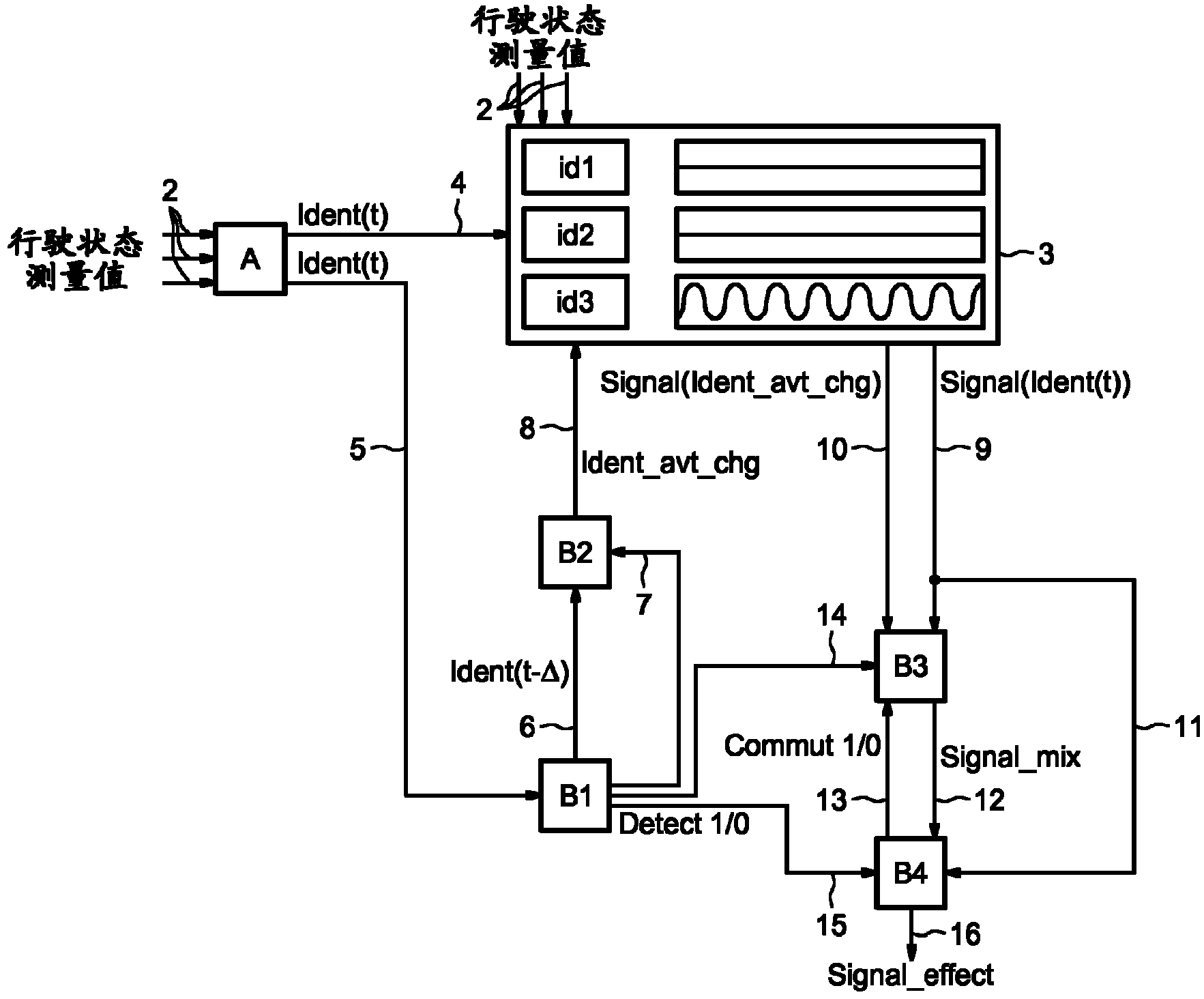
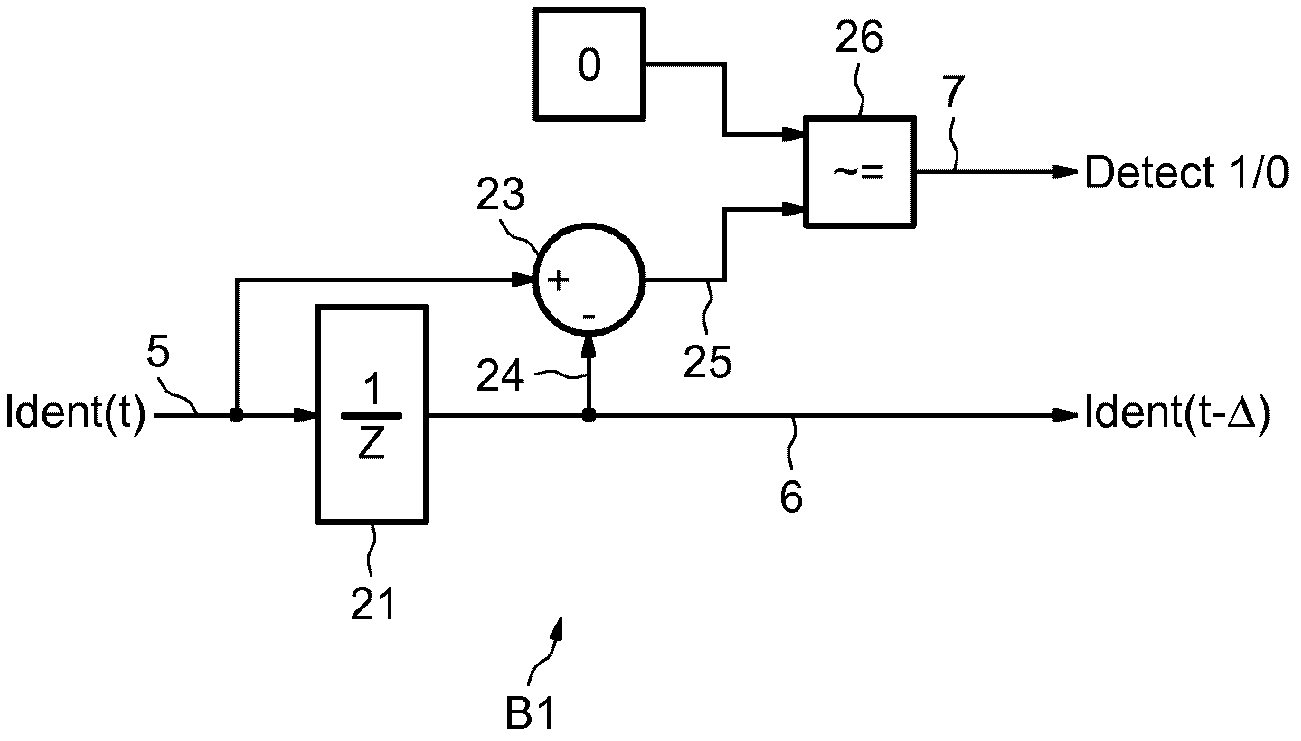
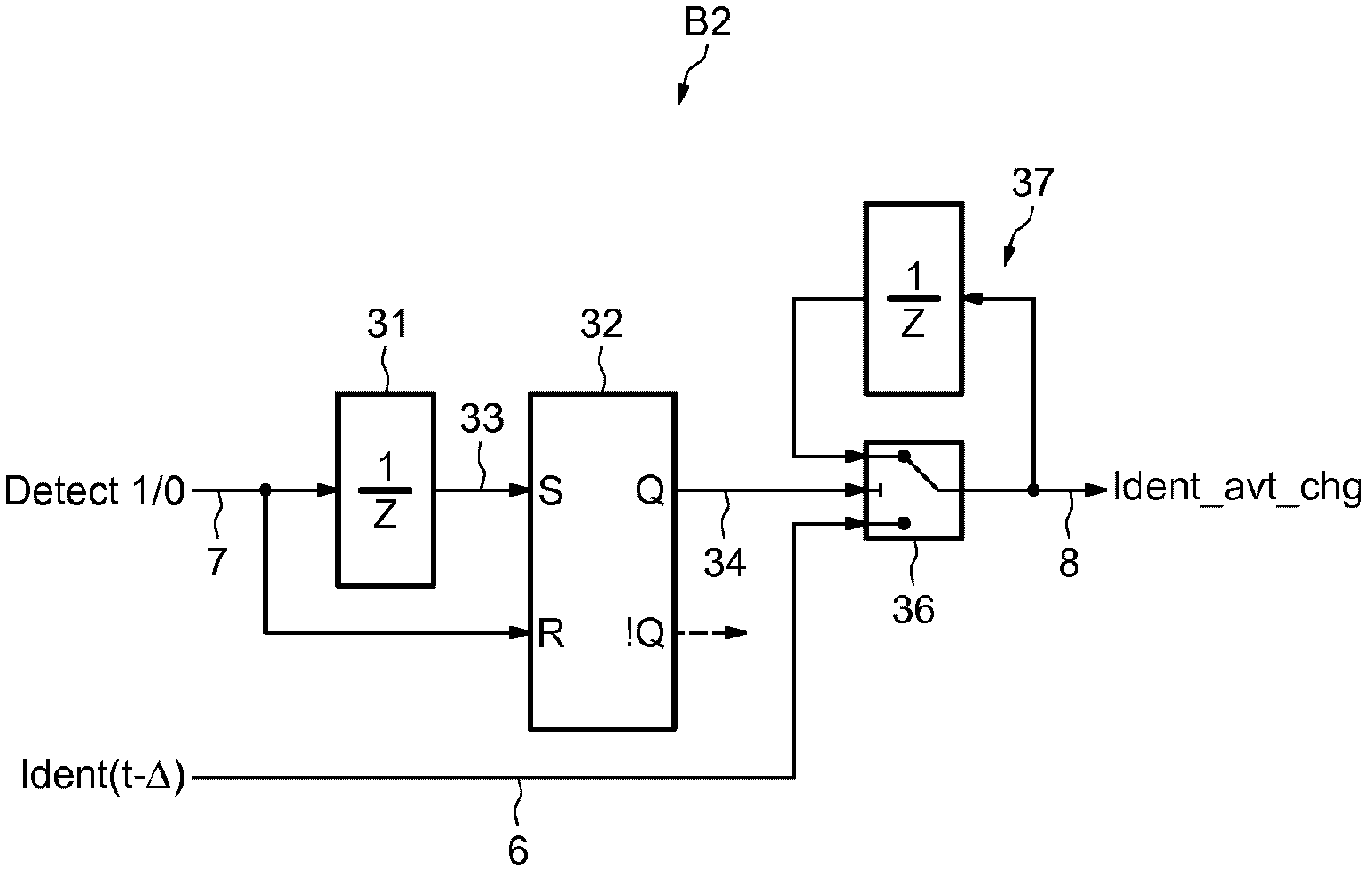
[0033] Such as figure 1 As shown, a device 1 for controlling a set of components of a motor vehicle receives various measurements via a line 2 so that the device 1 can reconstruct the driving conditions of the vehicle, such as the rotational speed of the wheels, the aperture angle of the intake butterfly valve , the operating point of the engine (eg represented by the torque of the engine and the rotational speed of the engine). These operating parameters are sent to the monitor unit A and the generator unit 3 . Monitor A continuously transmits to generator 3 via line 4 a policy identifier "Ident(t)" as a function of time t, and sends this same policy identifier via line 5 to detection unit B1. The detection unit B1 transmits the Boolean detection variable "Detect" to the memory unit B2 via the line 7 . The detection unit B1 transmits to the storage unit B2 via line 6 the value "Ident(t-Δ)", which is the value of the previous policy identifier corrected by the time delay Δ. ...