

Optically active tryptamine derivative and synthetic method and application thereof
An optically active and synthetic method technology, applied in the field of optically active tryptamine derivatives and their synthesis, can solve the problems of high cost, low yield, complicated operation and the like, and achieve high selectivity, high yield, simple and safe operation. Effect
- Summary
- Abstract
- Description
- Claims
- Application Information
AI Technical Summary
Problems solved by technology
Method used
Image

Examples
Embodiment 1
[0049]
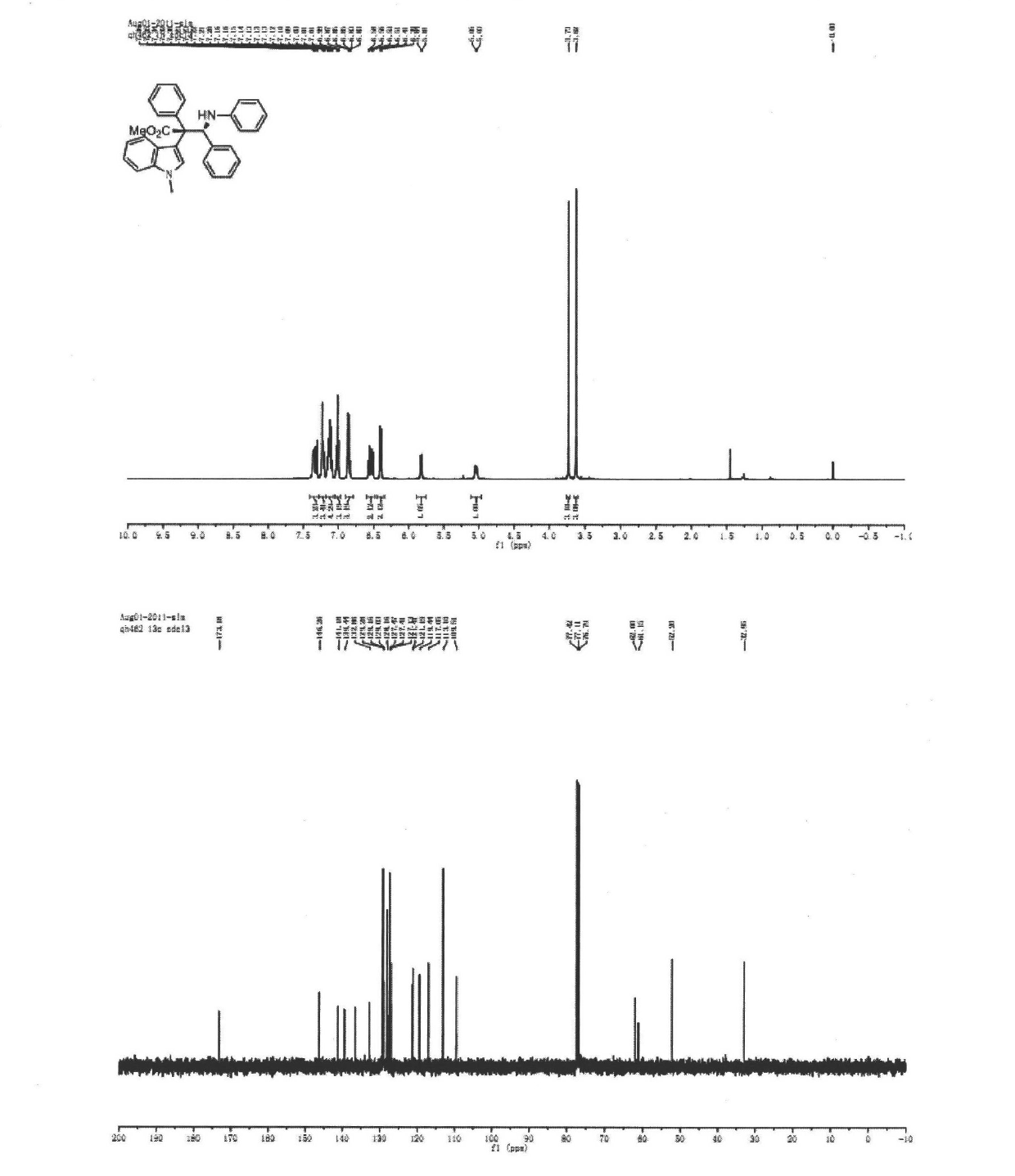
[0050] N-methylindole (0.3mmol), N-benzylidene aniline (0.3mmol), Rh 2 (OAc) 4 (0.0025mmol), chiral small molecule catalyst PPA (0.005mmol) and Molecular sieves (0.1g) were dissolved in toluene (2ml), then, methyl phenyldiazoacetate (0.25mmol,) dissolved in toluene (2.0ml) was added dropwise in the reaction system in 2 hours, and the reaction system was At -10°C, after the dropwise addition, the mixture was stirred for 12 hours, and the solvent was removed by rotary evaporation under reduced pressure to obtain a crude product, the structure of which was shown in formula (2-1). The crude product was subjected to column chromatography (ethyl acetate:petroleum ether=1:100~1:40) to obtain a pure product. Yield 94%, dr > 20:1, ee% = 97%. nuclear magnetic resonance 1 H NMR, 13 C NMR spectrum as figure 1 As shown, the product 4a 1 H NMR (400MHz, CDCl 3 )δ (ppm) 3.65 (s, 3H), 3.78 (s, 3H), 5.06 (br, 1H), 5.79 (d, J = 8.2Hz, 1H), 6.39 (d, J = 8.0Hz, 2H), 6.53(d, J=...
Embodiment 2
[0052]
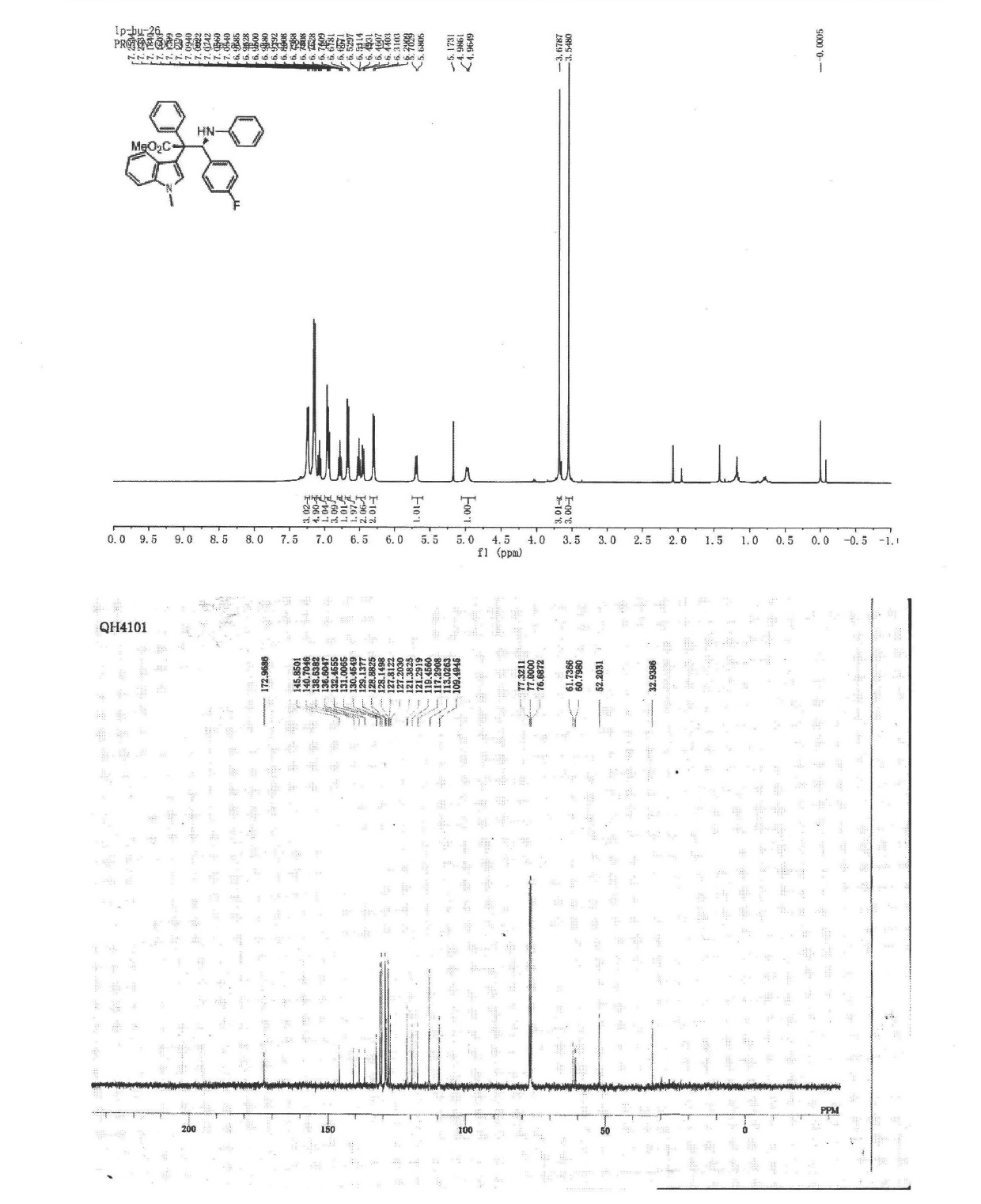
[0053] N-methylindole (0.3mmol), N-(4-bromobenzylidene) aniline (0.3mmol), Rh 2 (OAc) 4 (0.0025mmol), chiral small molecule catalyst PPA (0.005mmol) and Molecular sieves (0.1g) were dissolved in toluene (2ml), then, methyl phenyldiazoacetate (0.25mmol,) dissolved in toluene (2.0ml) was added dropwise in the reaction system in 2 hours, and the reaction system was At -10°C, after the dropwise addition was completed, the mixture was stirred for 12 hours, and the solvent was removed by rotary evaporation under reduced pressure to obtain a crude product, the structure of which was shown in formula (2-2). The crude product was subjected to column chromatography (ethyl acetate:petroleum ether=1:100~1:40) to obtain a pure product. Yield 93%, dr > 20:1, ee% = 99%. nuclear magnetic resonance 1 H NMR, 13 C NMR spectrum as figure 2 As shown, the product 4b 1 H NMR (400MHz, CDCl 3 )δ(ppm) 3.55(s, 3H), 3.68(s, 3H), 4.98(d, J=8.5Hz, 1H), 5.69(d, J=8.9Hz, 1H), 6.30(d, J=...
Embodiment 3
[0055]
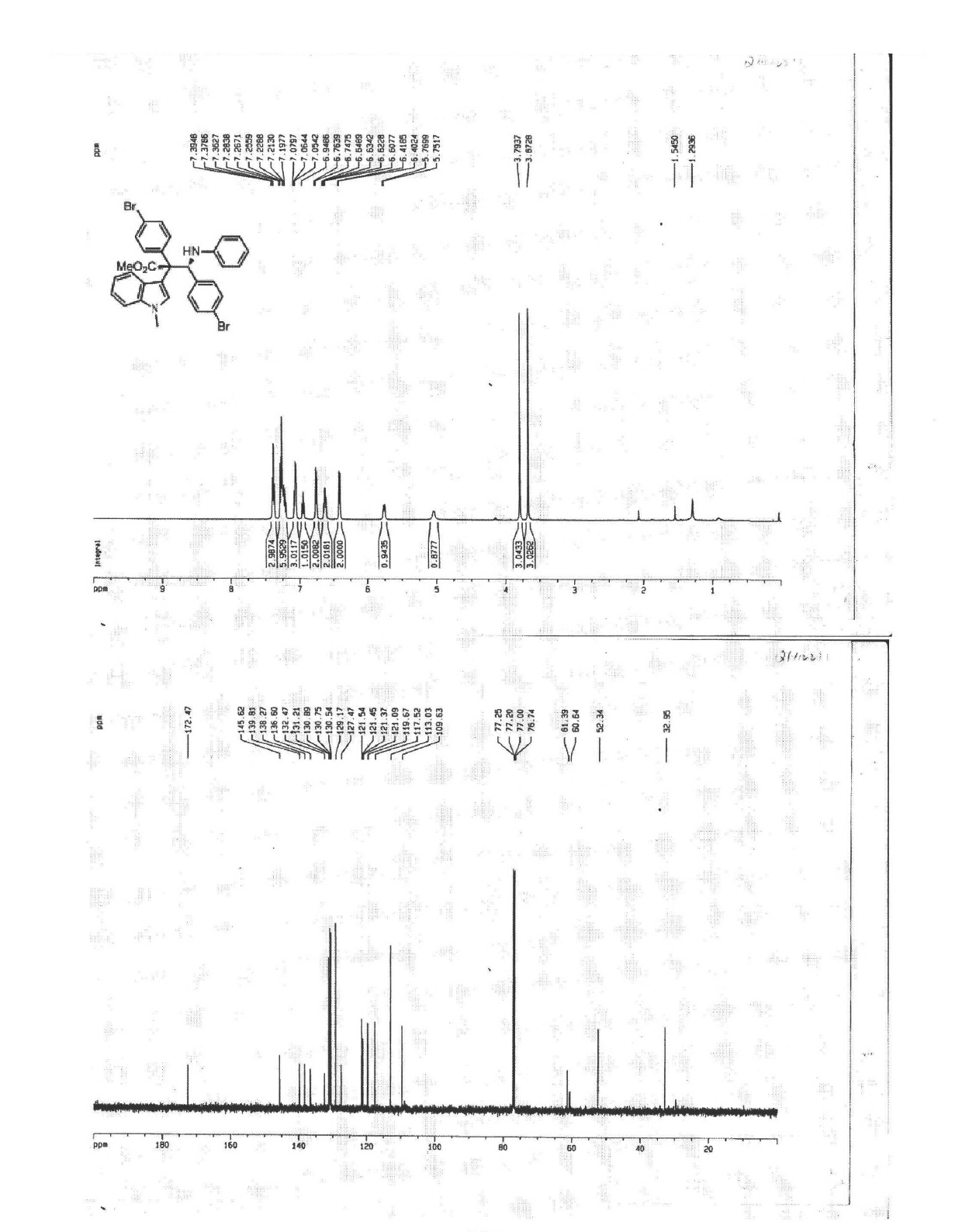
[0056] N-methylindole (0.3mmol), N-(4-bromobenzylidene) aniline (0.3mmol), Rh 2 (OAc) 4 (0.0025mmol), chiral small molecule catalyst PPA (0.005mmol) and Molecular sieves (0.1g) were dissolved in toluene (2ml), then, 4-bromophenyldiazoacetic acid methyl ester (0.25mmol,) dissolved in toluene (2.0ml) was added dropwise in the reaction system within 2 hours, The reaction system was kept at -10°C. After the dropwise addition was completed, it was stirred for 12 hours, and the solvent was removed by rotary evaporation under reduced pressure to obtain a crude product, the structure of which was shown in formula (2-3). The crude product was subjected to column chromatography (ethyl acetate:petroleum ether=1:100~1:40) to obtain a pure product. Yield 85%, dr > 20:1, ee% = 91%. nuclear magnetic resonance 1 H NMR, 13 C NMR spectrum as image 3 As shown, the product 4c 1 H NMR (500MHz, CDCl 3 )δ(ppm) 3.67(s, 3H), 3.79(s, 3H), 5.05(br, 1H), 5.76(d, J=7.3Hz, 1H), 6.41(d...
PUM
 Login to View More
 Abstract
Description
Claims
Application Information
 Login to View More