
Nest polymerase chain reaction (PCR) detecting method of transgenic crop cauliflower mosaic virus
A detection method and cauliflower technology, applied in the field of molecular biology, can solve problems such as insufficient evaluation of benefits and risks of genetically modified crops, immature evaluation system in biosafety, etc., to achieve the effect of protecting people's health
- Summary
- Abstract
- Description
- Claims
- Application Information
AI Technical Summary
Problems solved by technology
Method used
Image

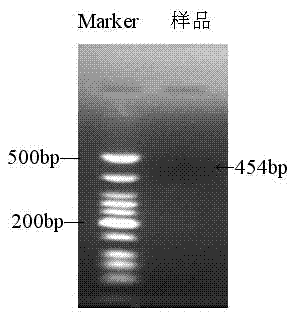
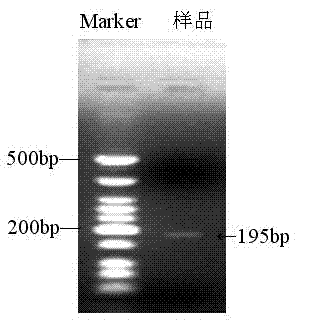
Examples
Embodiment 1
[0038] In this example, the nested PCR detection method was used to detect whether the soybean sample A contained the CaMV35S promoter of the transgenic component cauliflower mottle virus. The operation process is as follows:
[0039] (1) DNA extraction Weigh 0.1 g of soybean sample A, and use the CTAB method for DNA extraction.
[0040] (2) PCR amplification The first round of PCR amplification, the 20μl reaction system includes: 10mmol / L Tris-HCl, 50mmol / L KCl, 1.5mmol / L MgCl2, 0.15μmol / L dNTP, 0.5μmol / L 35S EF and 35S ER Primer, 1 unit of Taq DNA polymerase, 50ng DNA template; the reaction program is as follows: pre-denaturation at 94°C for 10 min, denaturation at 94°C for 40 s, annealing at 58°C for 40 s, extension at 72°C for 45 s, 35 cycles; extension at 72°C for 5 min, 4°C save.
[0041] In the second-round PCR reaction system, 2 μL of the first-round PCR amplification product was added as a template, and the reaction program was: pre-denaturation at 94°C for 10 minut...
Embodiment 2
[0045] In this example, the nested PCR detection method was used to detect whether the corn sample B contained the cauliflower mottle virus CaMV35S promoter of the transgenic component. The operation process is as follows:
[0046] (1) DNA extraction Weigh 0.1 g of corn sample B, and use the CTAB method for DNA extraction.
[0047] (2) PCR amplification The first round of PCR amplification, the 20μl reaction system includes: 10mmol / L Tris-HCl, 50mmol / L KCl, 1.5mmol / L MgCl2, 0.15μmol / L dNTP, 0.5μmol / L 35S EF and 35S ER Primer, 1 unit of Taq DNA polymerase, 50ng DNA template; the reaction program is as follows: pre-denaturation at 94°C for 10 min, denaturation at 94°C for 40 s, annealing at 58°C for 40 s, extension at 72°C for 45 s, 35 cycles; extension at 72°C for 5 min, 4°C save.
[0048] In the second-round PCR reaction system, 2 μL of the first-round PCR amplification product was added as a template, and the reaction program was: pre-denaturation at 94°C for 10 minutes, de...
PUM
| Property | Measurement | Unit |
|---|---|---|
| concentration | aaaaa | aaaaa |
Abstract
Description
Claims
Application Information
 Login to View More