Head-shoulder sequence image segmentation method based on double-pattern matching and edge thinning

An edge thinning and sequential image technology, applied in image analysis, image data processing, instruments, etc., can solve the problem of pixel classification that is not suitable for the head and shoulders model, and achieve the effect of effective segmentation

CN102567998AInactive Publication Date: 2012-07-11XIAN UNIV OF TECH
4 Cites 18 Cited by

Patent Information

Authority / Receiving Office
CN · China
Patent Type
Applications(China)
Current Assignee / Owner
Publication Date
2012-07-11
Estimated Expiration
Not applicable · inactive patent

Smart Images

  • Figure 1
    Figure 1
  • Figure 2
    Figure 2
  • Figure 3
    Figure 3
Patent Text Reader

Abstract

The invention discloses a head-shoulder sequence image segmentation method based on double-pattern matching and edge thinning, and the method is carried out as per the following steps: step 1, determining a face position, namely, adopting the Bayesian risk decision to determine the face area by considering the distribution of the face on a color plane; step 2, determining the head-shoulder area, namely, considering the head-shoulder area as a combination of two rectangular areas, one as head rectangle and the other as shoulder rectangle, setting the width of the shoulder rectangle as three times of the width of the head rectangle, and finally determining the head rectangle through adopting two rectangular moving templates and taking the proportion falling in the two template areas as the matching standard; and step 3, edge thinning, namely, adopting the Canny edge detection operator to acquire the accurate contour of a moving object. The head-shoulder sequence image segmentation method has the benefits that the Bayesian risk decision mechanism is adopted to determine the face position, the double-pattern matching algorithm is adopted to further determine the head-shoulder area, and finally the edge thinning is conducted, as a result, the algorithm can efficiently segment the head-shoulder sequence.
Need to check novelty before this filing date? Find Prior Art

Description

technical field

[0001] The invention belongs to the technical field of image compression, and relates to a head-shoulder sequence image segmentation method based on double-template matching and edge refinement. Background technique

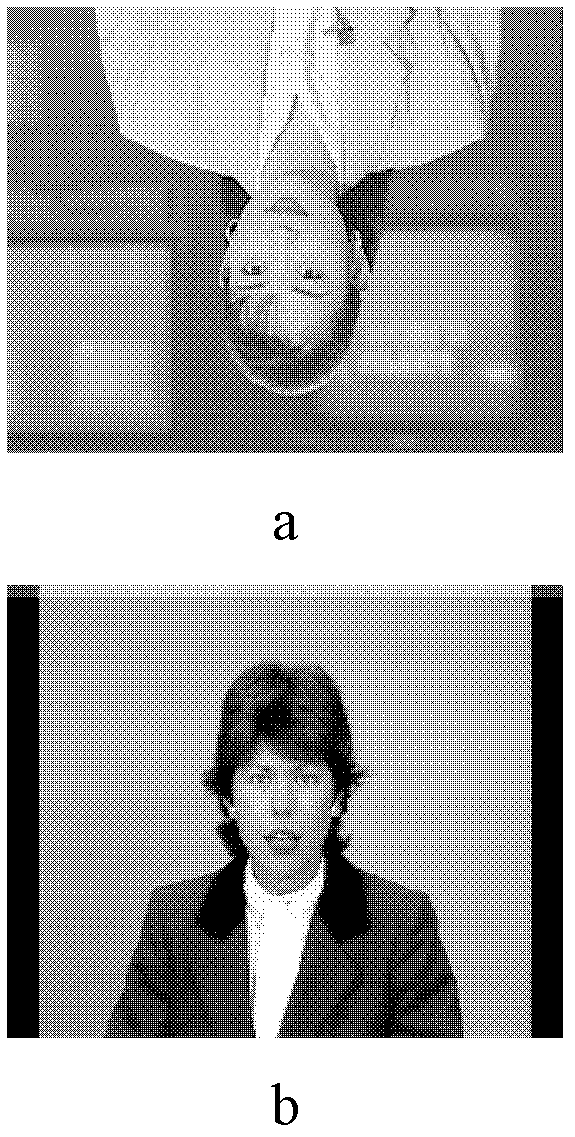
[0002] Head-and-shoulders video is a typical head-and-shoulders image model commonly found in videophone and videoconferencing applications. Its main features are: 1) The position of the camera and the background is relatively fixed, and the background is still in the image sequence; 2) The background is relatively simple, does not contain complex texture features, and there is a more obvious grayscale between the foreground object 3) The image only contains a single moving object, or multiple main moving objects that do not overlap with each other. The main moving object can contain small sub moving objects, such as eyes and mouth, see figure 1 , Figure 4 , and moving objects tend to move slowly or only have small local movements.

[0003] ...

Examples

Embodiment Construction

[0047] The present invention will be described in detail below in conjunction with the accompanying drawings and specific embodiments.

[0048] There are two important characteristics of the head and shoulders sequence of the image: one is that the skin color of the face has certain rules on the chromaticity plane, and there must be a human face in the head and shoulders sequence, and the illumination changes are relatively stable; the other is that the head and shoulders area can be approximated. Think of it as a combination of two rectangular boxes. Aiming at the above two characteristics of the head-and-shoulders sequence, the present invention proposes a head-and-shoulders sequence segmentation flow framework based on face discovery, the framework is divided into three steps, the first step is to use the face discovery algorithm to determine the location of the face; In the second step, a double template matching algorithm is used to determine the general area of ​​the hea...