

Data unloading method, user equipment, peer node and data unloading system
A peer-to-peer node and user equipment technology, applied in the communication field, can solve problems such as high maintenance costs and inability to choose DRA, and achieve the effect of reducing maintenance costs
- Summary
- Abstract
- Description
- Claims
- Application Information
AI Technical Summary
Problems solved by technology
Method used
Image

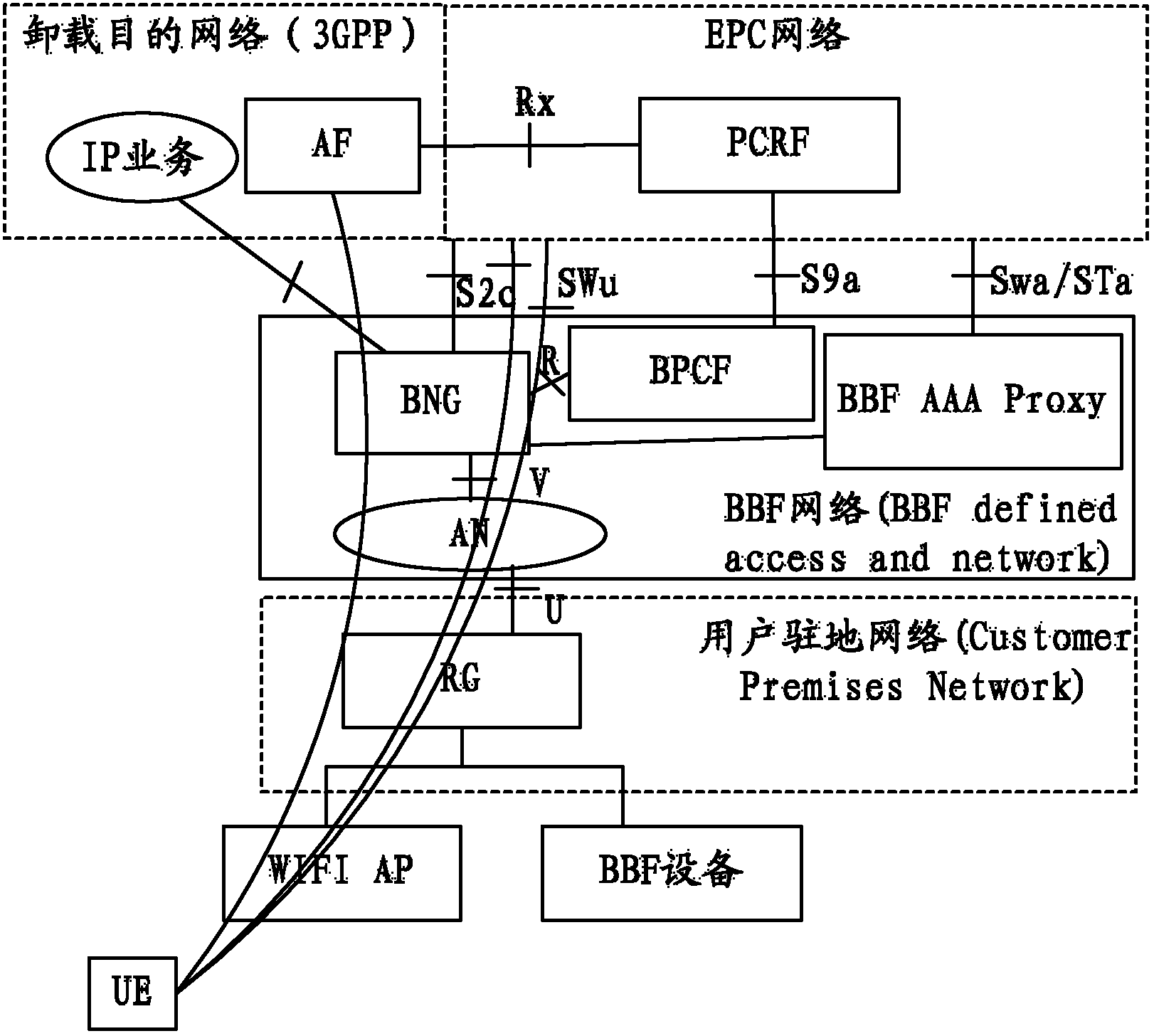


Examples
Embodiment 1
[0046] see Figure 4 , this embodiment provides a method for unloading data, and the method flow is as follows:
[0047] 401: Receive the address of the PCRF sent by the PDN GW (Packet Data Network Gateway, packet data network gateway).
[0048] 402: Send an offload notification message including at least the address of the PCRF to a peer node located in the offload destination network.
[0049] 403: After receiving the offload notification confirmation message sent by the peer node, send the data flow that needs to be offloaded to the peer node, so that the peer node addresses the PCRF according to the address of the PCRF included in the offload notification message, and The PCRF is triggered to perform policy and QoS control on data flows that need to be offloaded.
[0050] Wherein, receiving the address of the PCRF sent by the PDN GW includes:
[0051] The binding confirmation message sent by the PDN GW is received, and the binding confirmation message includes the addre...
Embodiment 2
[0069] see Figure 6 , this embodiment provides a method for unloading data. The UE obtains the address of the PCRF by receiving the binding confirmation message sent by the PDN GW that includes the address of the PCRF. The process of the method is as follows:
[0070] 601: The UE sends a binding update message to the PDN GW.
[0071] In this embodiment, the PDN GW is a gateway that provides network compatibility functions such as protocol conversion, route selection, and data exchange when the packet data network communicates with networks of different architectures or protocols. After accessing the EPC network, the UE will initiate a binding update process. Specifically, the UE initiates the binding update process by sending a binding update message to the PDN GW. Wherein, the binding update message includes but not limited to: ID (Identity) of UE, IP address of UE and other information, as well as information related to binding and so on. The IP address of the UE is alloc...
Embodiment 3
[0108] see Figure 8 , this embodiment provides a method for unloading data. The difference between this method and the method provided in Embodiment 2 is that the UE obtains the address of the PCRF by receiving the IKEv2 message sent by the ePDG. The method flow is as follows:
[0109] 801: The ePDG sends a proxy binding update message to the PDN GW.
[0110] 802: The PDN GW sends a proxy binding confirmation message including the address of the PCRF to the ePDG.
[0111] The process for the PDN GW to obtain the address of the PCRF is as follows: the PDN GW initiates the process of establishing an IP-CAN session with the PCRF, and in this process the PDN GW obtains the address of the PCRF.
[0112] In this embodiment, after the PDN GW obtains the address of the PCRF, it can send a separate message to send the address of the PCRF to ePDG, or it can carry the address of the PCRF in other messages and send it to ePDG. Preferably, the address of the PCRF Carried in the proxy bi...
PUM
 Login to View More
 Abstract
Description
Claims
Application Information
 Login to View More