A Method of Calculating the Output of a Power Amplifier Using a Modified Model of Volterra

A technology for power amplifiers and model corrections, applied to power amplifiers, etc., can solve problems such as difficulty in use, narrow frequency band, and inability to meet broadband communication systems, and achieve the effect of reducing the number of coefficients and improving accuracy

CN103036514BInactive Publication Date: 2015-09-09NANJING UNIV OF AERONAUTICS & ASTRONAUTICS
4 Cites 0 Cited by

Patent Information

Authority / Receiving Office
CN · China
Patent Type
Patents(China)
Current Assignee / Owner
Publication Date
2015-09-09
Estimated Expiration
Not applicable · inactive patent

Smart Images

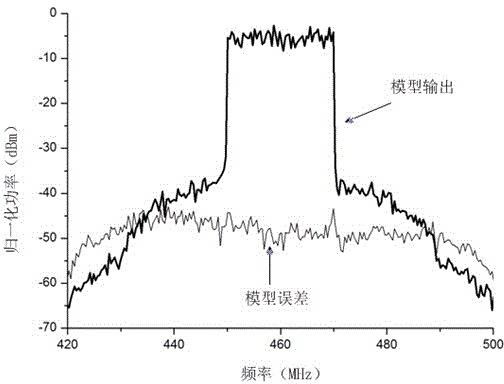
  • Figure 1
    Figure 1
  • Figure 2
    Figure 2
  • Figure 3
    Figure 3
Patent Text Reader

Abstract

The invention discloses a method for calculating output quantity of a power amplifier by using a Volterra correction model, belonging to the technical field of digital signal processing. The method comprises the following steps of: setting a correction constraint condition; measuring a performance parameter of the power amplifier to determine a correction constraint condition expression; correcting input data of the power amplifier by using the correction constraint expression to obtain a corrected Volterra model; and calculating the output quantity of the power amplifier according to discrete data output by the power amplifier and the corrected Volterra model. The output quantity of the power amplifier is calculated by using the method, so that not only the number of coefficients of the Volterra model is simplified, but also the accuracy for calculating the output quantity of the power amplifier by using the Volterra model is improved.
Need to check novelty before this filing date? Find Prior Art

Description

technical field

[0001] The invention discloses a method for calculating the output of a power amplifier by using a Volterra correction model, and belongs to the technical field of digital signal processing. Background technique

[0002] Calculating the output of a power amplifier to evaluate its performance is a common method. The output is calculated one by one according to the input of the power amplifier, the workload is heavy, and the output data obtained is incomplete. Scholars have gradually studied the discrete input and discrete output of the power amplifier by modeling methods, so as to calculate all the output of the power amplifier. Evaluate the performance of the power amplifier by analyzing the output, and analyze its pre-distortion application in the broadband communication system.

[0003] There are several methods for modeling and calculating power amplifiers: Please briefly describe the existing modeling methods and their respective problems. Establishing...

Examples

Embodiment Construction

[0025] Below in conjunction with accompanying drawing, the technical scheme of invention is described in detail:

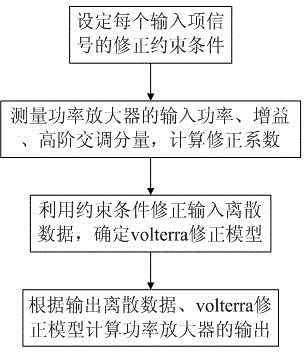
[0026] The method of calculating the output of the Doherty power amplifier using the Volterra modified model, such as figure 2 As shown in the flowchart, it includes the following steps:

[0027] Step 1, set the correction constraints of each input signal: α∑m+β*p≤-lnε,

[0028] Among them: α, β and ε are correction coefficients, p is the nonlinear coefficient of each input signal, and ∑m is the sum of memory depth of all input signals.

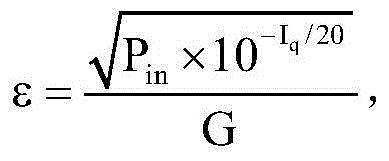
[0029] Step 2, measure the input power P of the power amplifier in =10W, gain G=20dB, 5th (q=5) order intermodulation component I 5 =-40dBc, calculate the correction coefficients α, β and ε, and determine the correction constraint expression described in step 1:

[0030] ϵ = P in × 10 ...