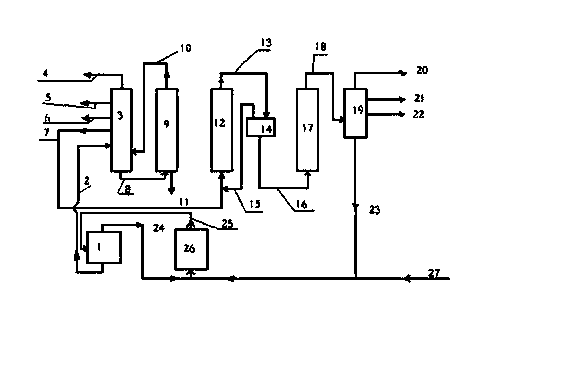
Combined process for treating residual oil

A combined process and residual oil technology, which is applied in the fields of hydrotreating process, hydrocarbon oil treatment, petroleum industry, etc., can solve the problems of no specific combination, etc., and achieve the effect of saving investment costs and saving investment
CN103059998BActive Publication Date: 2014-08-20CHINA PETROLEUM & CHEM CORP +1

Patent Information

Authority / Receiving Office
CN · China
Patent Type
Patents(China)
Current Assignee / Owner
CHINA PETROLEUM & CHEM CORP
Publication Date
2014-08-20

Smart Images

  • Figure 1
    Figure 1
Patent Text Reader

Abstract

The invention discloses a combined process for treating residual oil. Boiling bed residual oil hydrotreatment, delayed coking, wax oil hydrotreatment and catalytic cracking are organically combined in the method. The method concretely comprises the following steps of: enabling a liquid-phase product obtained after residual oil raw materials are subjected to boiling bed hydrotreatment to directly enter a coking fractional distillation column to be in countercurrent contact with oil gas generated through coking, and then, carrying out fractional distillation to obtain a wax oil fraction, and enabling the wax oil fraction to enter a wax oil hydrotreatment device, wherein the liquid-phase product is not subjected to fractional distillation; enabling the obtained liquid-phase product as a raw material to enter a catalytic cracking unit for treating; enabling circulating oil obtained through the fractional distillation of the coking fractional distillation column to return to a delayed coking unit; generating gasoline and diesel products by the coking fractional distillation column; and carrying out catalytic cracking and fractional distillation to obtain liquefied gas, gasoline and diesel products. Compared with the prior art, the combined process has the advantages that a hydrogenization fractional distillation column can be omitted, the investment cost can be reduced, the coking and catalytic cracking raw material sources are expanded, and the coked and catalyzed light oil yield is increased; and meanwhile, the reaction heat energy is sufficiently utilized, and the production energy consumption is reduced.
Need to check novelty before this filing date? Find Prior Art

Description

technical field

[0001] The invention relates to a method for lightening residue oil, specifically a process for producing light distillate oil by organically combining residue oil hydrotreating, delayed coking, mild hydrotreating, and catalytic cracking, using residue oil as raw material . Background technique

[0002] As crude oil becomes heavier and worse, more and more residues need to be processed. The processing of heavy and residual oil not only needs to crack it into products with low boiling point, such as naphtha, middle distillate oil and vacuum gas oil, etc., but also to increase their hydrogen-carbon ratio, which requires decarbonization or Hydrogenation method to achieve. The decarbonization process includes coking, solvent deasphalting, heavy oil catalytic cracking, etc.; hydrogenation includes hydrocracking, hydrofining, etc. The hydrogenation method can not only hydrogenate and convert residual oil, improve the yield of liquid products, but also remove het...

Claims

the structure of the environmentally friendly knitted fabric provided by the present invention; figure 2 Flow chart of the yarn wrapping machine for environmentally friendly knitted fabrics and storage devices; image 3 Is the parameter map of the yarn covering machine
Login to View More