A ternary liquid metal thermal interface material with dual melting point characteristics

A thermal interface material, liquid metal technology, applied in the direction of heat exchange materials, electrical components, semiconductor/solid-state device components, etc., can solve problems such as high fluidity and short circuit, and achieve the effect of broad application prospects.

CN103725261BActive Publication Date: 2015-09-30曹帅
4 Cites 0 Cited by

Patent Information

Authority / Receiving Office
CN · China
Patent Type
Patents(China)
Current Assignee / Owner
Publication Date
2015-09-30

Smart Images

  • Figure 1
    Figure 1
  • Figure 2
    Figure 2
  • Figure 3
    Figure 3
Patent Text Reader

Abstract

The invention discloses a ternary liquid metal heat interface material with dual melting points. The liquid metal heat interface material adopts a three-layered foil-shaped structure, wherein the upper layer and the lower layer are made of 56% indium, 20% of bismuth and 24% of tin by mole; the middle layer is made of 40% of indium, 48% of bismuth and 12% of tin by mole. A hole between a heating element and a radiator can be completely filled with the liquid metal heat interface material at a relatively low temperature after initial mounting, and then the liquid metal heat interface material is solidified due to diffusion. The liquid metal heat interface material is solid at normal working temperatures. When the temperature of an electronic device is raised to a design value, the liquid metal heat interface material can be melted twice to cool the electronic device sharply. Therefore, the ternary liquid metal heat interface material has a wide application prospect.
Need to check novelty before this filing date? Find Prior Art

Description

technical field

[0001] The invention relates to a preparation method of a ternary liquid metal thermal interface material, in particular to a ternary liquid metal thermal interface material with double melting point characteristics. Background technique

[0002] With the development of highly integrated electronic chips, the heating power of the entire electronic device is increasing, and the operating temperature of different components has risen sharply. The operating temperature of an electronic device directly determines its service life and stability. Devices operating at high temperatures will greatly reduce the service life of electronic devices. To make electronic devices work within a reasonable temperature range, in addition to ensuring that the working environment temperature is within a reasonable range, it is also necessary to effectively dissipate heat from the electronic devices. The problem of heat dissipation has become a key technical bottleneck in the d...

Examples

Embodiment 1

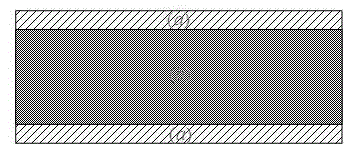
[0013] For the ternary liquid metal thermal interface material composed of In-Bi-Sn, the composition of the upper and lower layers is selected as In0.56-0.20Bi-0.24Sn (mole fraction). The material of the middle layer is In0.40-0.48Bi-0.12Sn (mole fraction). The alloy prepared according to this formula is melted in a vacuum induction furnace and prepared into a three-layer foil structure. The thickness of the upper and lower layers is 0.01mm, and the thickness of the middle layer is The thickness is 0.03mm. Then the three-layer foil-like alloy material is combined into a liquid metal thermal interface material with a sandwich structure, and the highest melting point is around 90°C. Such as figure 1 Shown are the upper and lower layers (a) with a lower melting point and the middle layer (b) with a higher melting point, respectively.

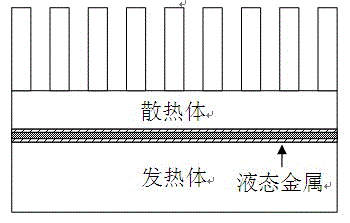
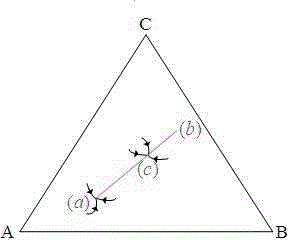
[0014] The present invention selects elements with sufficient chemical compatibility with the materials of the heating element and the radiator ...