
Traffic flow predicating method based on sliding window average
A technology of traffic flow and forecasting method, which is applied in the field of intelligent transportation science, can solve the problems of increased volatility of data flow and low forecasting accuracy, and achieve the effect of reducing forecasting data errors, improving accuracy and reliability, and eliminating random fluctuations
- Summary
- Abstract
- Description
- Claims
- Application Information
AI Technical Summary
Problems solved by technology
Method used
Image

Examples
Embodiment 1
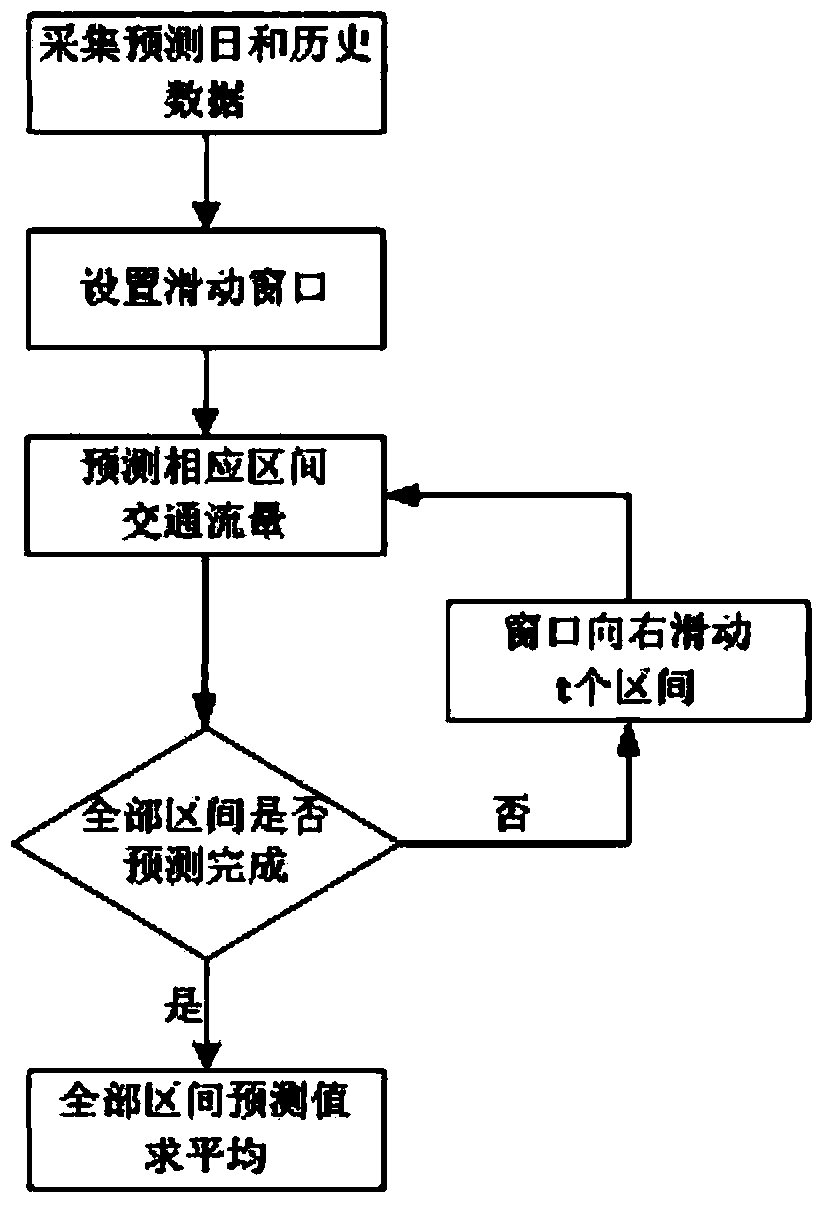
[0028] Embodiment 1: as figure 1 As shown, a traffic flow prediction method based on sliding window average includes the following steps:
[0029] 1) Collect historical traffic flow data and forecast day traffic flow data;
[0030] 2) Set the window threshold and train the parameters of the traffic flow prediction model; the traffic flow prediction model is:
[0031] X ^ = C · Φ T - - - ( 1 )
[0032] in, Represents the predicted traffic flow data matrix in a continuous interval; C represents the parameter matrix; Φ is the eigenvector matrix describing the changing trend of traffic flow in the corresponding interval;
[0033] The specific calculation process of the parameters of the training traffic flow forecasting model is as follows:
[0034] 2.1) Define the data in M rows and ω colu...
PUM
 Login to View More
 Abstract
Description
Claims
Application Information
 Login to View More